


Class 10 Science Short Notes 2026-27
Class 10 Science Short Notes 2026-27
9,900+ students bought this in the last 12 months
Pay online: ₹764 after 10% off + free deliveryCash on delivery adds ₹80
Choose your set
Couldn't load pickup availability
- Upi payment method
- Master payment method
- Visa payment method
- Google pay payment method
-
Ordered
-
Order Ready
- - -
Delivered

Class 10 Science Short Notes 2026-27
Class 10 Science Short Notes 2026-27 is a printed, full-colour revision book for CBSE Class 10 students preparing for the 2026-27 board exams. It turns the NCERT Class 10 Science textbook into 116 pages of handwritten-style short notes: the key points of every chapter in short, highlighted notes with labelled diagrams, tables and flowcharts.
- Complete syllabus: all 13 chapters, unit-wise for the 80-mark theory paper, including Chemical Reactions and Equations, Life Processes, Light – Reflection and Refraction and Our Environment.
- Built for quick revision: one topic per page, key terms highlighted, diagrams drawn next to the line they explain.
- Exam focus: written for the CBSE Class 10 board exam, strictly as per the latest syllabus.
- Printed book, 116 full-colour pages. Not a PDF. Delivered all over India.
- Save with a set: choose Math+Science+Social Science for ₹849 (save ₹650).
- Trusted by 9,900+ students in the last 12 months.
- Created by a district topper and NIT graduate.
More about this book
Most students read the textbook once and run out of time for a second revision. This short notes book is made for that gap: it keeps only what the exam asks, in the same order as the NCERT chapters, so you can revise the full syllabus three or four times before the exam.
Ordering: pay online to get 10% off and free delivery. Cash on delivery is available for ₹80 extra.


Same topic. Textbook vs this book. Drag to compare.
Left: the same topic as it reads in a regular textbook. Right: the real page from this book.
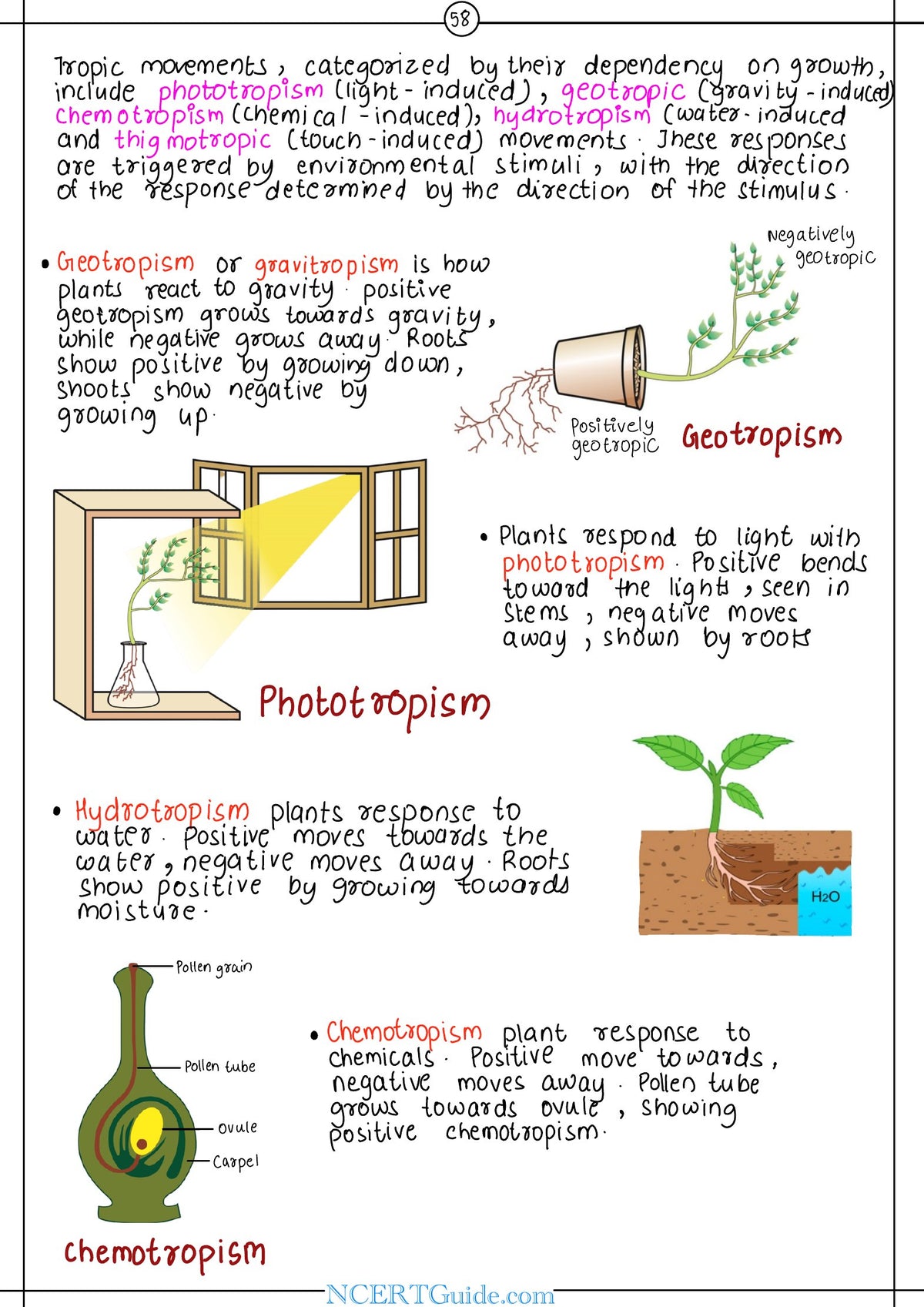
6.2 COORDINATION IN PLANTS
In animals the work of control and coordination is shared between the nervous system and the endocrine system. Plants possess neither nerves nor muscles, and yet they clearly respond to changes in their surroundings. The leaves of the touch-me-not plant fold within seconds when they are touched, while a germinating seed always sends its root downwards and its shoot upwards whichever way the seed happens to be lying. The first kind of movement is rapid and does not depend on growth; the second is gradual and results from growth taking place more on one side than the other.
Movements that depend on the direction of a stimulus and are brought about by growth are known as tropic movements. They may be directed towards the stimulus or away from it. Stems usually bend towards the source of light and roots bend away from it; this is called phototropism. Roots grow downwards in response to gravity, a response known as geotropism, while the response to water and to chemicals is called hydrotropism and chemotropism respectively.
Growth in plants is regulated by chemical substances called plant hormones. Among these, auxin promotes elongation of cells, gibberellins help the stem to grow, cytokinins promote cell division and abscisic acid has an inhibitory effect on growth.
See what's inside
Swipe through real pages from this book. Tap any page to read it.
All 13 chapters. All 80 marks.
Unit-wise marks as per the CBSE 2026-27 theory paper.
- 01Chemical Reactions and Equations
- 02Acids, Bases and Salts
- 03Metals and Non-metals
- 04Carbon and its Compounds
- 05Life Processes
- 06Control and Coordination
- 07How do Organisms Reproduce?
- 08Heredity
- 09Light – Reflection and Refraction
- 10The Human Eye and the Colourful World
- 11Electricity
- 12Magnetic Effects of Electric Current
- 13Our Environment
Units 1 and 2 alone carry 50 of 80 marks — revise them first.
One chapter a day. Full syllabus in 13 days.
Repeat the cycle 3–4 times before boards. Most students finish the textbook once.
What's inside
- Format
- Printed book
- Pages
- 116
- Printing
- Full colour throughout
- Syllabus
- CBSE Class 10, 2026-27, based on the NCERT textbook
Made for the last month before the exam
Questions
Is this a PDF or a printed book?
A printed book, packed and delivered to your address.
Is it the latest syllabus?
Yes, the 2026-27 edition, written from the current NCERT textbook.
How long does delivery take?
Usually 5 to 7 business days; remote areas up to 10. You get a tracking link on WhatsApp.
What if it arrives damaged?
Send photos within 48 hours of delivery and we replace it free.
Can I pay cash on delivery?
Yes. Paying online gives free delivery and an extra discount; cash on delivery adds ₹80, shown before you place the order.