Quick answer: NEET Biology is 90 of the 180 questions in the paper, and nearly all of them are based on NCERT lines and diagrams. Revise the 32 NCERT chapters in 10 units over 8 weeks – Human Physiology, Genetics and Ecology first – and repeat the cycle at least twice before the exam.
Biology is the highest-scoring section in NEET because it is the most predictable: the questions are built from NCERT sentences, tables and diagrams. The challenge is not understanding – it is remembering 32 chapters of detail on exam day. That needs a plan that brings every chapter back again and again.
The 32 chapters, grouped into 10 units
| Unit | Chapters |
|---|---|
| Diversity in the Living World | The Living World; Biological Classification; Plant Kingdom; Animal Kingdom |
| Structural Organisation | Morphology of Flowering Plants; Anatomy of Flowering Plants; Structural Organisation in Animals |
| Cell | Cell: The Unit of Life; Biomolecules; Cell Cycle and Division |
| Plant Physiology | Photosynthesis in Higher Plants; Respiration in Plants; Plant Growth and Development |
| Human Physiology | Breathing and Exchange of Gases; Body Fluids and Circulation; Excretory Products; Locomotion and Movement; Neural Control; Chemical Coordination |
| Reproduction | Sexual Reproduction in Flowering Plants; Human Reproduction; Reproductive Health |
| Genetics and Evolution | Principles of Inheritance and Variation; Molecular Basis of Inheritance; Evolution |
| Biology and Human Welfare | Human Health and Disease; Microbes in Human Welfare |
| Biotechnology | Principles and Processes; Applications |
| Ecology | Organisms and Populations; Ecosystem; Biodiversity and Conservation |

An 8-week plan
| Week | Revise |
|---|---|
| 1 | Human Physiology (6 chapters) – the largest unit |
| 2 | Genetics and Evolution, Molecular Basis of Inheritance in detail |
| 3 | Cell, Biomolecules, Cell Cycle |
| 4 | Plant Physiology and Structural Organisation |
| 5 | Diversity in the Living World (classification tables) |
| 6 | Reproduction, Human Health and Disease, Microbes |
| 7 | Biotechnology and Ecology |
| 8 | Full mock tests; re-read only the lines you got wrong |
Each day: revise one chapter from short notes, then solve 40–50 NCERT-based MCQs from it. Mark every wrong answer back on the page of the notes where it belongs – by the second cycle, those marks show you exactly what to read.
Why short notes work for NEET Biology
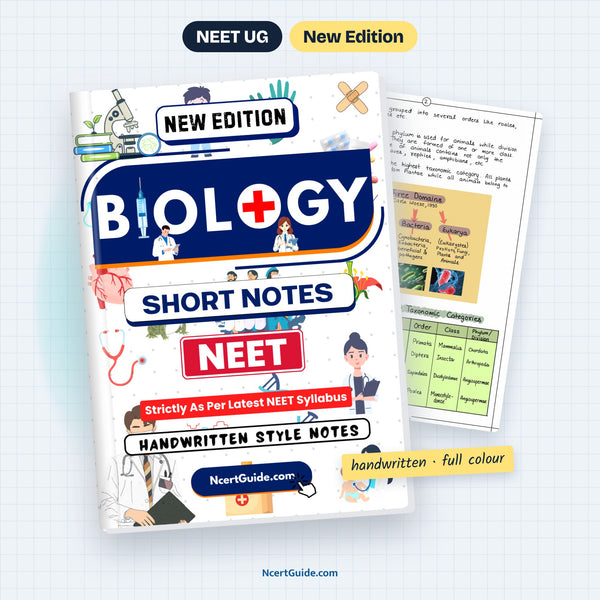
Re-reading the full NCERT textbook three times before NEET is almost impossible alongside Physics and Chemistry. Short notes keep the NCERT lines, tables and diagrams that questions are built on, so a chapter can be revised in under an hour. The NEET Biology Short Notes 2027 cover all 32 chapters in 188 colourful pages; a Hindi medium edition (Jeev Vigyan) is also available. Students revising all three subjects can take the PCB set.
NEET UG has usually been held in the first week of May. NTA has not announced the NEET 2027 date at the time of writing – check neet.nta.nic.in for the official notice.
Frequently asked questions
How many Biology questions are there in NEET?
Biology has 90 of the 180 questions, split between Botany and Zoology.
Is NCERT enough for NEET Biology?
NCERT is the base of almost every Biology question. Most students add MCQ practice and short notes for revision rather than extra textbooks.