Quick answer: In CBSE Class 10 Maths (80 marks), Algebra carries 20, Geometry 15 and Trigonometry 12 – 47 marks together. Revise their formulas first, then Statistics and Probability (11), Mensuration (10), Number Systems (6) and Coordinate Geometry (6).
Maths is the one board subject where a short, well-organised formula list makes an immediate difference. Most lost marks are not from difficult questions but from a forgotten formula, a wrong sign or a missing condition. Here is where the 80 marks sit and what to revise first.
Unit-wise marks for CBSE Class 10 Maths 2026-27
| Unit | Chapters | Marks |
|---|---|---|
| 1. Number Systems | Real Numbers | 6 |
| 2. Algebra | Polynomials; Pair of Linear Equations in Two Variables; Quadratic Equations; Arithmetic Progressions | 20 |
| 3. Coordinate Geometry | Coordinate Geometry | 6 |
| 4. Geometry | Triangles; Circles | 15 |
| 5. Trigonometry | Introduction to Trigonometry; Some Applications of Trigonometry | 12 |
| 6. Mensuration | Areas Related to Circles; Surface Areas and Volumes | 10 |
| 7. Statistics and Probability | Statistics; Probability | 11 |
| Total (theory) | 14 chapters | 80 |
Confirm the latest split on cbseacademic.nic.in before the exam; Standard and Basic Maths share the same syllabus but differ in the difficulty of questions.
Formulas to revise first
Algebra (20 marks)
- Relationship between zeroes and coefficients of a quadratic polynomial: α + β = −b/a, αβ = c/a.
- Conditions for a pair of linear equations to have a unique solution, no solution or infinitely many solutions (comparing a₁/a₂, b₁/b₂ and c₁/c₂).
- Quadratic formula and the discriminant D = b² − 4ac, with what D > 0, D = 0 and D < 0 mean.
- AP: aₙ = a + (n − 1)d and Sₙ = n/2 [2a + (n − 1)d].
Geometry and Trigonometry (27 marks)
- Similarity criteria (AA, SSS, SAS) and the basic proportionality theorem.
- Tangent results: the tangent is perpendicular to the radius; tangents from an external point are equal.
- The six trigonometric ratios, values for 0°, 30°, 45°, 60° and 90°, and the identities sin²A + cos²A = 1, 1 + tan²A = sec²A, 1 + cot²A = cosec²A.
Mensuration, Statistics and Coordinate Geometry
- Area of a sector (θ/360 × πr²) and length of an arc (θ/360 × 2πr).
- Surface area and volume of the cylinder, cone, sphere and hemisphere, and how to combine them for joined solids.
- Mean (direct, assumed-mean and step-deviation methods), median and mode formulas for grouped data.
- Distance formula and section formula.
How to use a formula sheet properly
Reading formulas is not enough. A good routine is: revise one unit’s formulas for ten minutes, close the sheet, write them from memory, then solve five mixed questions. Do this three times a week and the formulas stop being something you remember and become something you simply use.
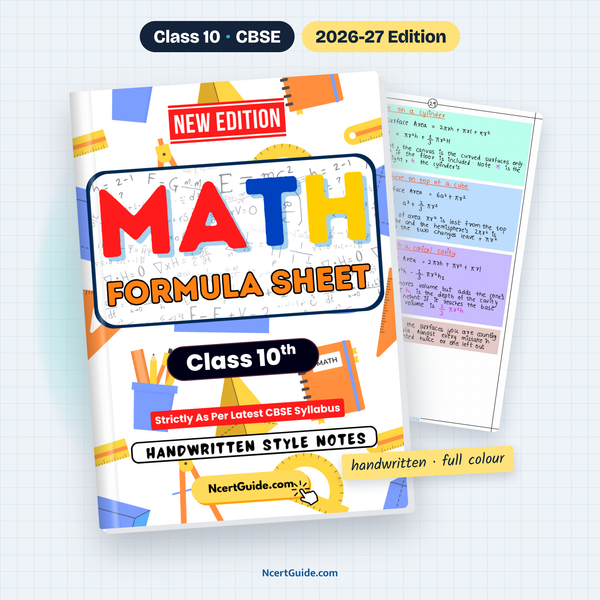
The Class 10 Maths Formula Sheet 2026-27 sets out every chapter’s formulas on colour-coded pages, with the conditions you lose marks for. It is also available in Hindi medium (Ganit).
Frequently asked questions
Which chapter carries the most marks in Class 10 Maths?
Algebra is the biggest unit with 20 marks, spread over four chapters: Polynomials, Linear Equations, Quadratic Equations and Arithmetic Progressions.
Is the syllabus the same for Standard and Basic Maths?
Yes. Both follow the same NCERT chapters and unit marks; the Basic paper has easier questions.
How often should I revise formulas?
A short revision of one unit’s formulas every day, plus a full sheet once a week, works for most students.