Quick answer: In the CBSE Class 10 Science theory paper (80 marks), Chemical Substances (25) and World of Living (25) together carry 50 marks. Revise those eight chapters first, then Electricity and Magnetism (13), Light (12) and Our Environment (5).
Class 10 Science has 13 chapters, and most students run out of time not because the chapters are hard, but because they read the textbook once and never get round to a second or third revision. This guide shows where the marks are, which chapters deserve the most time, and a 30-day plan you can actually follow alongside school.
Unit-wise marks for CBSE Class 10 Science 2026-27
| Unit | Chapters | Marks |
|---|---|---|
| 1. Chemical Substances – Nature and Behaviour | Chemical Reactions and Equations; Acids, Bases and Salts; Metals and Non-metals; Carbon and its Compounds | 25 |
| 2. World of Living | Life Processes; Control and Coordination; How do Organisms Reproduce?; Heredity | 25 |
| 3. Natural Phenomena | Light – Reflection and Refraction; The Human Eye and the Colourful World | 12 |
| 4. Effects of Current | Electricity; Magnetic Effects of Electric Current | 13 |
| 5. Natural Resources | Our Environment | 5 |
| Total (theory) | 13 chapters | 80 |
The remaining 20 marks come from internal assessment in school. Always check the latest curriculum PDF on cbseacademic.nic.in, since CBSE occasionally adjusts the split.
Which chapters to revise first
- Chemistry (Unit 1): balancing equations, types of reactions, pH and indicators, reactivity series and the naming of carbon compounds come up every year. These are quick marks if your notes keep each reaction on one line.
- Biology (Unit 2): diagrams carry marks here – the human heart, nephron, neuron, the reflex arc, the human digestive system and the flower. Practise drawing each one at least three times.
- Physics (Units 3–4): numericals from mirrors and lenses, and from Ohm’s law and resistors in series and parallel. Keep a single page of formulas and sign conventions and revise it every few days.
- Our Environment (Unit 5): short and predictable; one careful reading plus the food chain and ozone questions is usually enough.
A 30-day revision plan (three full cycles)
The idea is simple: the first pass is slow, the second is faster, and the third is only the highlighted points and diagrams.
| Days | What to do |
|---|---|
| 1–13 | Cycle 1: one chapter a day from short notes, then 15–20 questions from that chapter. Draw every diagram once. |
| 14–15 | Buffer days: finish anything left, and list your weak chapters. |
| 16–23 | Cycle 2: two chapters a day, weak chapters first. Re-solve the questions you got wrong. |
| 24–27 | Two full sample papers under exam conditions (3 hours, no breaks). Mark them strictly. |
| 28–30 | Cycle 3: only formulas, reactions, definitions and diagrams – no new questions. |
How short notes make this possible
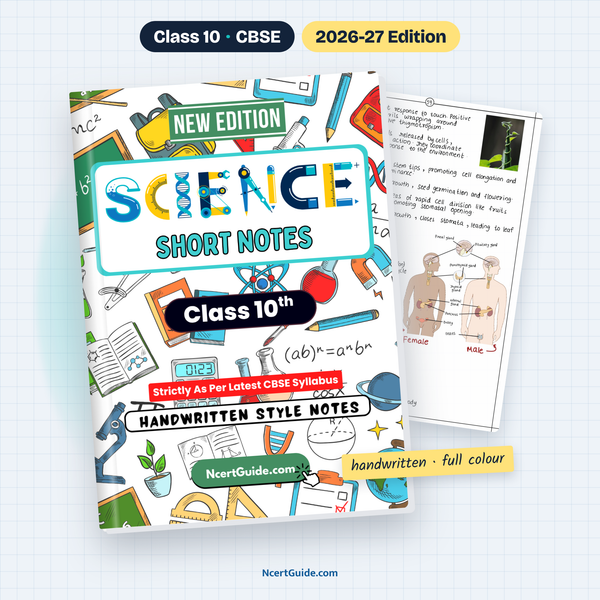
A 30-day plan only works if one chapter can be revised in under an hour. That is the point of the Class 10 Science Short Notes 2026-27: every chapter in a few colourful pages, with the reaction, definition or diagram you need set beside the line that explains it. Hindi medium students can use the Hindi medium edition. If you are also revising Maths and Social Science, the Class 10 three-book set saves more than buying them one by one.
Frequently asked questions
How many marks is the Class 10 Science theory paper?
The theory paper is for 80 marks and internal assessment is for 20, making 100 in all.
Which unit carries the most marks in Class 10 Science?
Chemical Substances and World of Living carry 25 marks each, 50 of the 80 theory marks together.
Is one revision of the textbook enough?
Most toppers revise each chapter at least three times. Reading the full textbook three times is rarely possible, which is why short notes are used for the second and third revisions.