New NCERT Ganita Prakash Part 2 · Class 8 Maths · Part II · Chapter 7: Area
This chapter gives the area formulas for rectangles, triangles, parallelograms, rhombuses, trapeziums and other polygons. It also explains key area results and how to convert between units of area.
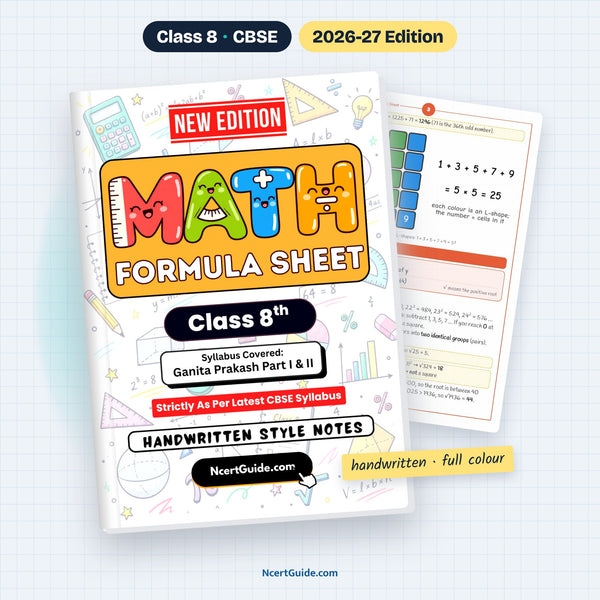
From the Class 8 Maths Formula Sheet, made as per the new NCERT book Ganita Prakash · Pages 57–60 of the book.
Key points
- Area of a triangle = ½ × base × height, where the height is perpendicular to the base; it works for obtuse triangles too.
- Any side of a parallelogram can be its base, with its own height.
- A diagonal divides a rectangle into 2 congruent triangles, each half the rectangle.
- A median divides a triangle into 2 triangles of equal area.
- Triangles on the same base between the same parallels have equal area.
- Cutting a triangle from one end of a parallelogram and moving it to the other end makes a rectangle.
- Two copies of a trapezium make a parallelogram of base (a + b) and height h.
- Any polygon can be split into triangles and their areas added.
- Shapes with the same perimeter can have different areas.
- Local Indian land units such as bigha, gaj, katha, dhur, cent and ankanam vary by region.
Formulas
| Rectangle | Area = length × width |
| Square | Area = side × side |
| Triangle | Area = ½ × base × height |
| Parallelogram | Area = base × height |
| Rhombus | Area = ½ × d₁ × d₂ d₁, d₂ = diagonals |
| Trapezium | Area = ½ × h × (a + b) a, b = parallel sides, h = distance between them |
| Two base–height pairs of a triangle | Area = ½ × BC × AX = ½ × AC × BY |
| Inch to cm | 1 inch = 2.54 cm ; 1 in² = 6.4516 cm² |
| Square feet | 1 ft² = 144 in² ; 1 acre = 43,560 ft² |
| Metric area units | 1 m² = 10,000 cm² ; 1 km² = 10,00,000 m² |
Diagrams to learn
- Table of all area formulas
- Base and height for the main shapes
- Two copies of a trapezium make a parallelogram
- Perimeter is not a measure of area — shapes with the same perimeter can have different areas (7 × 4 = 28, 8 × 3 = 24).
- The height of a triangle must be perpendicular to the base you choose.
- Area of a path = outer rectangle − inner rectangle.
- A rectangle 5 × 4 has more area than a parallelogram with sides 5 and 4, because the parallelogram's height is less than 4.
A real page from the book

Get the full chapter in the book
This page is a summary. The Class 8 Maths Formula Sheet has the complete chapter in colour, with every diagram and worked example.
Frequently asked questions
What is the formula for the area of a trapezium?
Area = ½ × h × (a + b), where a and b are the parallel sides and h is the distance between them. Parallel sides 6 and 10 with height 8 give 64 sq units.
How do you find the area of a rhombus using diagonals?
Area = ½ × d₁ × d₂. A rhombus with diagonals 20 cm and 15 cm has area 150 cm².
Do shapes with the same perimeter have the same area?
No. A 7 × 4 rectangle and an 8 × 3 rectangle both have perimeter 22, but their areas are 28 and 24.