New NCERT Exploring Society: India and Beyond Part 2 · Class 8 Social Science · Part 2 · Chapter 4: The Role of the Judiciary in Our Society
This chapter explains what justice means, how India's courts are organised and other ways to settle disputes. It covers the Supreme Court, High Courts, subordinate courts, tribunals, new criminal laws and digital technology in courts.
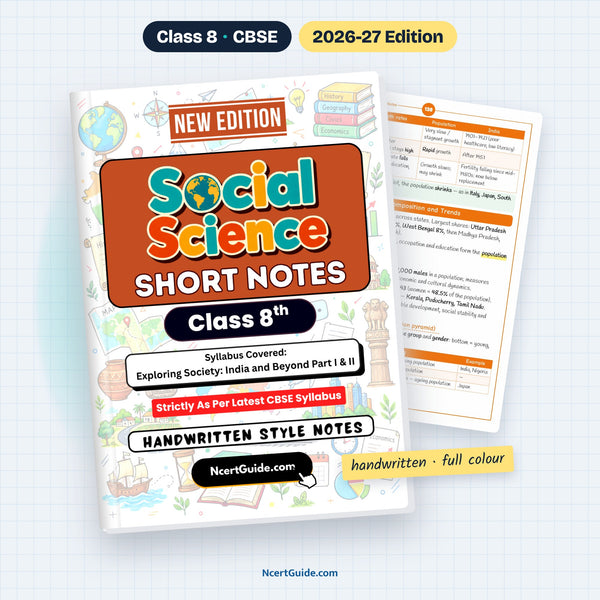
From the Class 8 Social Science Short Notes, made as per the new NCERT book Exploring Society: India and Beyond · Pages 113–121 of the book.
Key points
- The Preamble promises all citizens social, economic and political justice; the judiciary is independent of the legislature and the executive.
- The judiciary keeps two checks: laws must stay within the Constitution, and the executive must not overstep its role.
- India has repealed over 1500 unjust colonial-era laws, such as the Criminal Tribes Act, 1871 and the Vernacular Press Act, 1878.
- Justice has two aspects: substantive justice (a fair outcome) and procedural justice (a fair hearing).
- India has a unified judicial system: the Supreme Court at the top, High Courts at the State level and subordinate courts at the district level.
- The Supreme Court came into existence on 26.01.1950; it has the CJI and 33 other judges, who retire at 65.
- Citizens can file writ petitions in the Supreme Court (Article 32) or a High Court (Article 226) to protect Fundamental Rights.
- Public Interest Litigation (PIL) is an innovation of the Supreme Court to take up issues of public concern.
- India has 28 States but 25 High Courts; High Court judges retire at 62.
- Tribunals like the NCLT, NGT and Consumer Fora decide specific types of disputes.
- The IPC, CrPC and Indian Evidence Act have been replaced by the Bharatiya Nyaya Sanhita, Bharatiya Nagarik Suraksha Sanhita and Bharatiya Sakshya Adhiniyam, 2023.
- Alternate modes of dispute resolution include arbitration, mediation, Lok Adalats and Gram Nyayalayas.
Key terms
- Judiciary: The institution which ensures fair adjudication of disputes according to the law.
- Laws: General rules made by the government to regulate people's activities, with consequences for not following them.
- Substantive justice: Justice that focuses on whether the final outcome is fair, just and reasonable.
- Procedural justice: Justice that focuses on the process, giving every person a full hearing before the court decides.
- Public Interest Litigation (PIL): A Supreme Court innovation to take up issues of public concern under Articles 32 and 226.
- Tribunal: A committee or body set up to settle certain types of disputes.
- Litigant: A person involved in a legal case, both the one who sues and the one who is sued.
Diagrams to learn
- Table: repealed unjust laws
- Table: substantive vs procedural justice
- Flowchart: hierarchy of courts in India
- Table: other jurisdictions of the Supreme Court
- Table: shared High Courts
- Table: tribunals and what they decide
- Table: old criminal laws and new laws
- Table: alternate modes of dispute resolution
- As a rule, every person is presumed innocent till proved guilty.
- An arbitrator decides and the decision is binding; a mediator only helps the parties agree and cannot decide.
- Writ petitions go to the Supreme Court under Article 32 and to a High Court under Article 226.
A real page from the book

Get the full chapter in the book
This page is a summary. The Class 8 Social Science Short Notes has the complete chapter in colour, with every diagram and worked example.
Frequently asked questions
What is the hierarchy of courts in India?
India has a unified judicial system. The Supreme Court is at the top (national level), High Courts are at the State level, and subordinate courts are at the district level.
What is a PIL?
Public Interest Litigation is an innovation of the Supreme Court to take up issues of public concern under Articles 32 and 226. The first reported PIL, filed by Mrs. Kapila Hingorani, led to the release of under-trial prisoners.
What is the difference between arbitration and mediation?
In arbitration, an independent arbitrator gives a final, legally binding decision. In mediation, a neutral mediator only helps the parties reach a settlement and has no power to decide.
← Part 2 · Chapter 3: A Journey Through Indian ArchitecturePart 2 · Chapter 5: Citizenship: Rights and Duties →