New NCERT Ganita Manjari · Class 9 Maths · Part I · Chapter 1: Orienting Yourself: The Use of Coordinates
This chapter shows how a system of coordinates lets us fix the exact position of any point using numbers. We learn the Cartesian plane, its four quadrants, and how to find the distance between two points. Coordinates also let us see algebraic equations as geometric shapes.
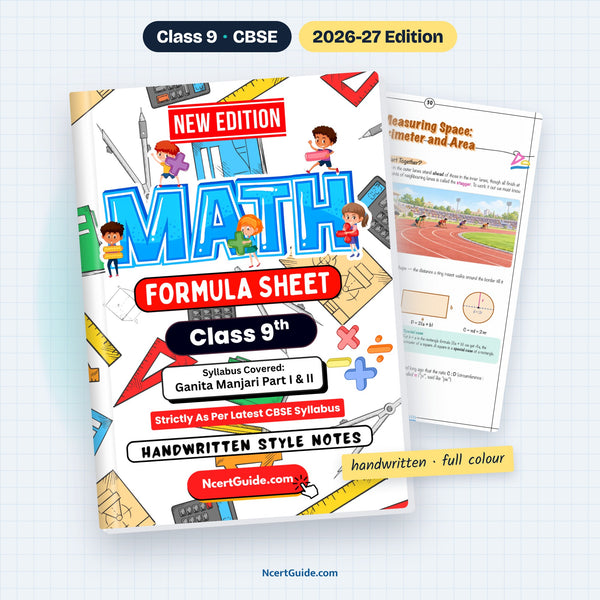
From the Class 9 Maths Formula Sheet, made as per the new NCERT book Ganita Manjari · Pages 2–6 of the book.
Key points
- A system of coordinates is a framework, like grid lines on a map, that uses numbers to give the exact position of points.
- A plane uses two number lines at right angles: the horizontal x-axis and the vertical y-axis.
- The axes meet at the origin O = (0, 0).
- Right of O or up from O is positive; left of O or down from O is negative.
- The x-coordinate of P is its perpendicular distance from the y-axis; the y-coordinate is its distance from the x-axis.
- Every point on the x-axis looks like (x, 0) and every point on the y-axis looks like (0, y).
- The axes divide the Cartesian plane into four quadrants, numbered anticlockwise from the top right: I (+, +), II (−, +), III (−, −), IV (+, −).
- Points on an axis, including the origin, lie in no quadrant.
- For a segment not parallel to an axis, make a right triangle with sides parallel to the axes and use the Baudhāyana–Pythagoras theorem.
- Reflection in an axis keeps side lengths and angles the same, so the image triangle is congruent.
- If PQ + QR = PR, then P, Q and R lie on one line (collinear).
- Descartes (1637) showed that any point of a plane can be given by two numbers, joining geometry and algebra.
Formulas
| Distance formula | PQ = √[(x₂ − x₁)² + (y₂ − y₁)²] P(x₁, y₁) and Q(x₂, y₂) |
| Distance from the origin | OP = √(x² + y²) P(x, y) |
| Distance on a line parallel to the x-axis | |x₂ − x₁| points (x₁, y) and (x₂, y) |
| Distance on a line parallel to the y-axis | |y₂ − y₁| points (x, y₁) and (x, y₂) |
| Midpoint of PQ | M = ((x₁ + x₂)/2, (y₁ + y₂)/2) e.g. P(−2, 5), Q(6, −1) gives M = (2, 2) |
| Reflection in the y-axis | (x, y) → (−x, y) |
| Reflection in the x-axis | (x, y) → (x, −y) |
| Collinear points | PQ + QR = PR ⇒ P, Q, R lie on one line |
| Circle with centre O, radius r | P(x, y) is on it if √(x² + y²) = r inside if less than r, outside if more than r |
Diagrams to learn
- Cartesian plane with points marked on the axes
- Reiaan's room drawn on a coordinate grid (bed, wardrobe, door)
- Four quadrants diagram with sign table
- Right triangle used to find the distance between two points
- Reflection of a triangle in the y-axis
- Midpoint of a line segment on a graph
- Timeline: A Pinch of History — Grid Thinking from Bhārat to the World
- Order matters: (x, y) is an ordered pair. (3, −5) is in Quadrant IV but (−5, 3) is in Quadrant II; (x, y) = (y, x) only when x = y.
- √(4² + 3²) is not 4 + 3 = 7. It is √(16 + 9) = 5.
- The order of subtraction does not matter, (x₂ − x₁)² = (x₁ − x₂)², but never mix an x with a y.
- Points on an axis (including O) lie in no quadrant.
A real page from the book

Get the full chapter in the book
This page is a summary. The Class 9 Maths Formula Sheet has the complete chapter in colour, with every diagram and worked example.
Frequently asked questions
What is the distance formula in Class 9 Maths Chapter 1?
The distance between P(x₁, y₁) and Q(x₂, y₂) is PQ = √[(x₂ − x₁)² + (y₂ − y₁)²]. The distance of P(x, y) from the origin is √(x² + y²).
How do you find the quadrant of a point?
Look at the signs of its coordinates: Quadrant I is (+, +), II is (−, +), III is (−, −) and IV is (+, −). A point on an axis lies in no quadrant.
What happens to a point when it is reflected in the y-axis?
The sign of the x-coordinate changes: (x, y) → (−x, y). Lengths and angles stay the same, so the image is congruent.