New NCERT Ganita Manjari · Class 9 Maths · Part I · Chapter 6: Measuring Space: Perimeter and Area
This chapter is about measuring the length around a shape and the space inside it. It explains π as the ratio C : D, arc length and the stagger on a running track, and then area formulas for rectangles, parallelograms, triangles (including Heron's formula), cyclic quadrilaterals, circles, sectors and segments.
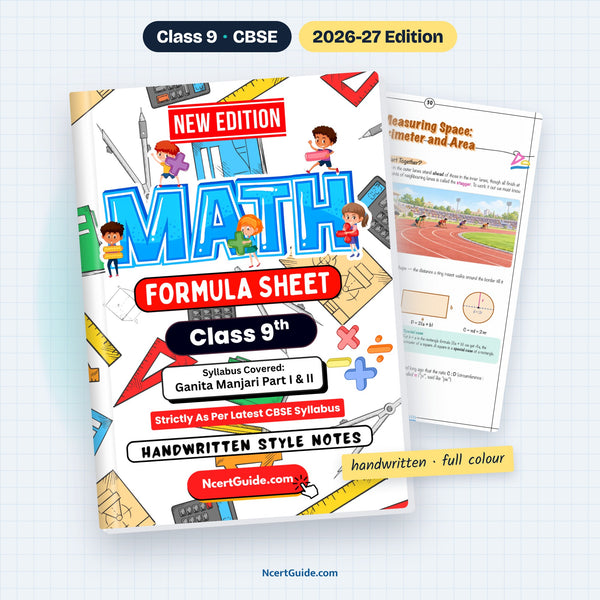
From the Class 9 Maths Formula Sheet, made as per the new NCERT book Ganita Manjari · Pages 30–36 of the book.
Key points
- The perimeter is the total length around the border of a shape.
- For every circle, big or small, circumference : diameter is the same constant, called π.
- π ≈ 22/7 ≈ 3.14 for most practical uses, but π is irrational (proved by Lambert, 1761).
- Mādhava of Saṅgamagrāma found an exact infinite-series formula for π.
- On a running track, outer lanes start ahead (the stagger) because the bends are longer; the extra length depends only on the lane width.
- Area is the amount of space a flat region occupies, measured in square units.
- A parallelogram can be cut and rearranged into a rectangle with the same base and height.
- A triangle is half of a rectangle or half of a parallelogram, and a median divides a triangle into two triangles of equal area.
- Heron's formula gives the area of a triangle from its three sides.
- Brahmagupta's formula gives the area of a cyclic quadrilateral; with d = 0 it becomes Heron's formula.
- Area of a circle = ½ × circumference × radius = πr².
- A sector is bounded by an arc and two radii; a segment is bounded by an arc and its chord.
Formulas
| Perimeter of square, equilateral triangle, rectangle | P = 4a; P = 3a; P = 2(a + b) |
| Circumference of a circle | C = πd = 2πr C/D = π |
| Length of an arc | l = 2πr × θ/360 arc subtending θ° at the centre |
| Perimeter of a sector | 2r + l |
| Area of rectangle, square, parallelogram | ab; a²; base × height = bh |
| Area of a triangle | Area = ½ × base × height = ½bh |
| Heron's formula | s = (a + b + c)/2, Area = √[s(s − a)(s − b)(s − c)] |
| Area using circumradius and inradius | Area = abc/4R and Area = r(a + b + c)/2 = rs |
| Brahmagupta's formula (cyclic quadrilateral) | s = (a + b + c + d)/2, Area = √[(s − a)(s − b)(s − c)(s − d)] |
| Area of a circle | A = πr² |
| Area of a sector | πr² × θ/360 |
| Area of a segment | area of sector − area of △OAB |
Diagrams to learn
- Perimeter of square, triangle, rectangle and circle
- Table: history of values of π
- Arc length, semicircle and quarter circle
- 400 m athletics track
- Parallelogram rearranged into a rectangle
- Median divides a triangle into two equal areas
- Circumcircle and incircle of a 3-4-5 triangle
- Baudhāyana's method of squaring a rectangle
- Circle cut into slices and rearranged into a parallelogram
- Sector and segment of a circle
- π ≈ 22/7 but π ≠ 22/7. 22/7 = 3.142857… while π = 3.141592…
- In Heron's formula use the semi-perimeter s, not the perimeter.
- Doubling the radius makes the circumference 2 times but the area 4 times.
- Unlike a rectangle, a parallelogram's area is not fixed by its sides alone.
A real page from the book

Get the full chapter in the book
This page is a summary. The Class 9 Maths Formula Sheet has the complete chapter in colour, with every diagram and worked example.
Frequently asked questions
What is Heron's formula?
For a triangle with sides a, b, c, first find s = (a + b + c)/2. Then Area = √[s(s − a)(s − b)(s − c)]. For sides 13, 14, 15 cm, s = 21 and the area is 84 cm².
What is the formula for the length of an arc?
An arc that subtends θ° at the centre of a circle of radius r has length l = 2πr × θ/360.
How do you find the area of a segment of a circle?
Area of segment = area of sector − area of triangle OAB, where the area of the sector is πr² × θ/360.
← Part I · Chapter 5: I'm Up and Down, and Round and RoundPart I · Chapter 7: The Mathematics of Maybe: Introduction to Probability →