New NCERT Exploration · Class 9 Science · Chapter 11: Reproduction: How Life Continues
This chapter explains how living organisms produce new individuals of their own kind. It covers asexual reproduction (vegetative propagation, budding and spore formation) and sexual reproduction in flowering plants, including pollination, fertilisation and seed formation. It ends with reproduction in animals and human beings, embryo development and healthy reproductive practices.
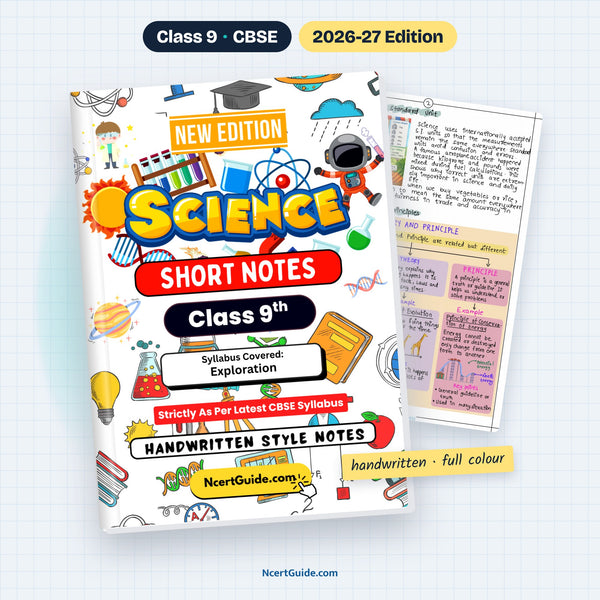
From the Class 9 Science Short Notes, made as per the new NCERT book Exploration · Pages 89–107 of the book.
Key points
- Reproduction ensures the continuity of life from one generation to the next.
- In asexual reproduction a single parent produces offspring that are genetically identical clones, without fertilisation.
- In vegetative propagation new plants grow from roots, stems or leaves, e.g. potato, ginger, sugarcane and Bryophyllum.
- Artificial methods of vegetative propagation are cutting, grafting, layering and tissue culture.
- Yeast and Hydra reproduce by budding; Rhizopus (bread mould) and Aspergillus reproduce by spores.
- Mitosis is the main process behind asexual reproduction; meiosis forms gametes with half the chromosome number.
- Sexual reproduction involves two parents and produces variation, which helps species survive changing environments.
- A flower has sepals, petals, stamen (anther and filament) and pistil (stigma, style, ovary and ovule).
- Pollination is transfer of pollen from anther to stigma; it can be self-pollination or cross-pollination by wind, water, insects or birds.
- After fertilisation the ovule becomes the seed and the ovary becomes the fruit.
- Fertilisation in animals may be external (frogs, most fishes) or internal (reptiles, birds, mammals).
- In humans, body cells have 46 chromosomes and sperm and egg have 23 each; fertilisation occurs in the fallopian tube.
Key terms
- Clone: An organism with the same genetic material as its parent, produced without fertilisation.
- Vegetative propagation: Growth of new plants from vegetative parts such as roots, stems or leaves.
- Budding: Asexual reproduction in which a small outgrowth (bud) develops on the parent and later separates.
- Gametes: Specialised reproductive cells with half the number of chromosomes, like sperm and egg.
- Pollination: Transfer of pollen grains from the anther to the stigma of a flower.
- Zygote: The fertilised egg formed when male and female gametes fuse.
- Metamorphosis: The change of a larva into an adult, e.g. egg → larva → pupa → butterfly.
- Ovulation: Release of one mature egg every month from one of the ovaries.
- Puberty: The stage when reproductive organs become fully developed and begin producing gametes.
Diagrams to learn
- Vegetative propagation in potato, ginger, sugarcane and Bryophyllum
- Steps of cutting, grafting, layering and tissue culture
- Budding in yeast and Hydra
- Rhizopus and Aspergillus spore structures
- Meiosis forming four haploid cells
- Labelled structure of a flower
- Self-pollination and cross-pollination
- Pollen tube growth and fertilisation in the ovule
- Agents of seed dispersal
- Life cycle of a butterfly
- Male and female reproductive systems
- Fertilisation in the fallopian tube and foetus development month by month
- Asexual reproduction is fast but gives no genetic variation, so diseases can spread easily among identical individuals.
- After fertilisation the ovule develops into the seed, while the ovary develops into the fruit.
- External fertilisation produces a very large number of eggs because survival chances are low; internal fertilisation produces fewer eggs with higher survival.
A real page from the book

Get the full chapter in the book
This page is a summary. The Class 9 Science Short Notes has the complete chapter in colour, with every diagram and worked example.
Frequently asked questions
What is the difference between self-pollination and cross-pollination?
In self-pollination, pollen moves to the stigma of the same flower or another flower on the same plant. In cross-pollination, pollen moves to a flower on another plant of the same species, which gives greater genetic variation.
What are the artificial methods of vegetative propagation?
The four methods are cutting, grafting, layering and tissue culture. Tissue culture grows many healthy, disease-free plants like banana from a small piece of meristem in a nutrient medium.
What is the difference between external and internal fertilisation?
External fertilisation happens outside the female's body, usually in water, as in frogs and most fishes. Internal fertilisation happens inside the female's body, as in reptiles, birds and mammals, and gives the embryo better protection.
← Chapter 10: Sound Waves: Characteristics and ApplicationsChapter 12: Patterns in Life: Diversity and Classification →