


Class 11 Economics Short Notes 2026-27
Class 11 Economics Short Notes 2026-27
100+ students bought this in the last 12 months
Pay online: ₹269 after 10% off + free deliveryCash on delivery adds ₹80
Choose your set
Couldn't load pickup availability
- Upi payment method
- Master payment method
- Visa payment method
- Google pay payment method
-
Ordered
-
Order Ready
- - -
Delivered

Class 11 Economics Short Notes 2026-27
Class 11 Economics Short Notes 2026-27 is a printed, full-colour revision book for CBSE Class 11 commerce students. It turns the NCERT Class 11 Economics textbook into 128 pages of handwritten-style short notes: definitions, formats, formulas and comparison tables from every chapter in short highlighted notes.
- Complete syllabus: all 12 chapters, unit-wise for the 80-mark theory paper, covering Statistics for Economics and Introductory Microeconomics, including Measures of Central Tendency, Correlation, Theory of Consumer Behaviour and Market Equilibrium.
- Built for quick revision: one topic per page, key terms highlighted, diagrams drawn next to the line they explain.
- Exam focus: written for Class 11 exams, strictly as per the latest syllabus.
- Printed book, 128 full-colour pages. Not a PDF. Delivered all over India.
- Save with a set: choose Acc+BST+Eco+Maths for ₹999 (save ₹1,000).
- Trusted by 100+ students in the last 12 months.
- Created by a district topper and NIT graduate.
More about this book
Most students read the textbook once and run out of time for a second revision. This short notes book is made for that gap: it keeps only what the exam asks, in the same order as the NCERT chapters, so you can revise the full syllabus three or four times before the exam.
Ordering: pay online to get 10% off and free delivery. Cash on delivery is available for ₹80 extra.


See the book in action
Short videos that walk you through the real book, page by page.
Same topic. Textbook vs this book. Drag to compare.
Left: the same topic as it reads in a regular textbook. Right: the real page from this book.
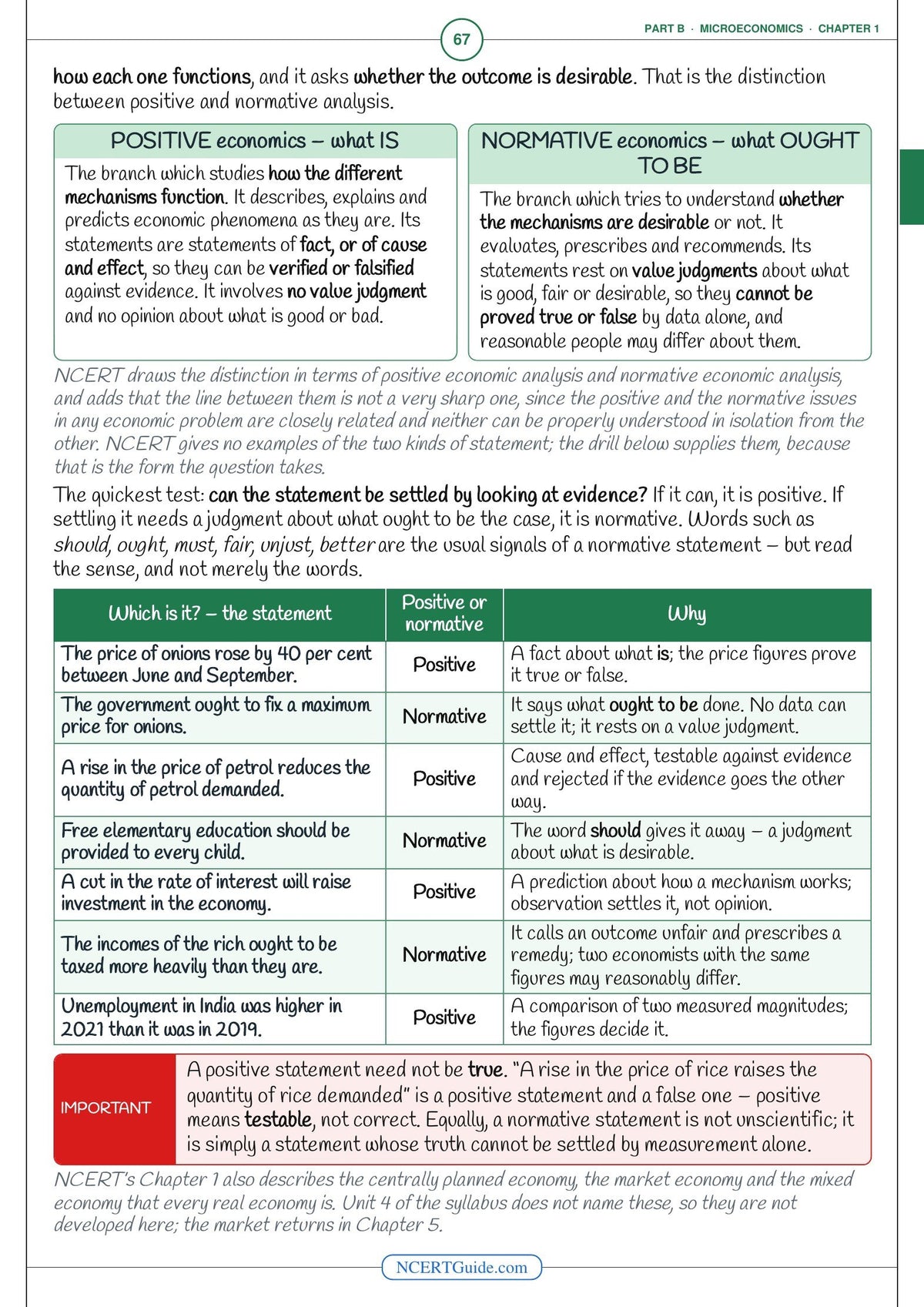
1.5 POSITIVE AND NORMATIVE ECONOMICS
Every economy must find answers to the basic questions of what to produce, how to produce and for whom to produce, and there is more than one way in which a society can settle these questions. Different methods are likely to lead to different results. Economists therefore try, first, to work out how a particular method actually functions and what results it can be expected to produce, and second, to judge whether those results are good or bad for society.
The first kind of study, which describes what is and examines cause and effect, is called positive economic analysis. Its statements can, at least in principle, be checked against facts and accepted or rejected on the basis of evidence. The second kind, which asks what ought to be and evaluates outcomes, is called normative economic analysis. Its statements depend on value judgements, so two reasonable persons may disagree about them even when they agree on all the facts.
The line separating the two is not always sharp. Questions of policy usually involve both a positive part and a normative part, and a full understanding of an economic problem requires attention to both.
See what's inside
Swipe through real pages from this book. Tap any page to read it.
All 12 chapters. All 80 marks.
Unit-wise marks as per the CBSE 2026-27 theory paper.
- 01Introduction
- 02Collection of Data
- 03Organisation of Data
- 04Presentation of Data
- 05Measures of Central Tendency
- 06Correlation
- 07Index Numbers
- 08Introduction
- 09Theory of Consumer Behaviour
- 10Production and Costs
- 11The Theory of the Firm under Perfect Competition
- 12Market Equilibrium
Part A and Part B carry 40 + 40 marks — neither can be skipped, so both get equal space in the notes.
One chapter a day. Full syllabus in 12 days.
Repeat the cycle 3–4 times before boards. Most students finish the textbook once.
What's inside
- Format
- Printed book
- Pages
- 128
- Printing
- Full colour throughout
- Syllabus
- 2026-27 edition, NCERT-based
Made for the last month before the exam
Questions
Is this a PDF or a printed book?
A printed book, packed and delivered to your address.
Is it the latest syllabus?
Yes, the 2026-27 edition, written from the current NCERT textbook.
How long does delivery take?
Usually 5 to 7 business days; remote areas up to 10. You get a tracking link on WhatsApp.
What if it arrives damaged?
Send photos within 48 hours of delivery and we replace it free.
Can I pay cash on delivery?
Yes. Paying online gives free delivery and an extra discount; cash on delivery adds ₹80, shown before you place the order.
