


Class 11 Maths Formula Sheet 2026-27 (Commerce Stream)
Class 11 Maths Formula Sheet 2026-27 (Commerce Stream)
Pay online: ₹224 after 10% off + free deliveryCash on delivery adds ₹80
Choose your set
Couldn't load pickup availability
- Upi payment method
- Master payment method
- Visa payment method
- Google pay payment method
-
Ordered
-
Order Ready
- - -
Delivered

Class 11 Maths Formula Sheet 2026-27 (Commerce Stream)
Class 11 Maths Formula Sheet 2026-27 (Commerce Stream) is a printed, full-colour revision book for CBSE Class 11 commerce students. It turns the NCERT Class 11 Maths textbook into 32 pages of handwritten-style formula sheet: every important formula, definition, unit and result, chapter by chapter, set out so you can revise a full chapter in minutes.
- Complete syllabus: all 14 chapters, unit-wise for the 80-mark theory paper, including Sets, Linear Inequalities, Conic Sections and Probability.
- Built for quick revision: formulas grouped by topic, with the conditions and units you lose marks for.
- Exam focus: written for Class 11 exams, strictly as per the latest syllabus.
- Printed book, 32 full-colour pages. Not a PDF. Delivered all over India.
- Save with a set: choose Acc+BST+Eco+Maths for ₹999 (save ₹1,000).
- Created by a district topper and NIT graduate.
More about this book
Most students read the textbook once and run out of time for a second revision. This formula sheet book is made for that gap: it keeps only what the exam asks, in the same order as the NCERT chapters, so you can revise the full syllabus three or four times before the exam.
Ordering: pay online to get 10% off and free delivery. Cash on delivery is available for ₹80 extra.


See the book in action
Short videos that walk you through the real book, page by page.
Same topic. Textbook vs this book. Drag to compare.
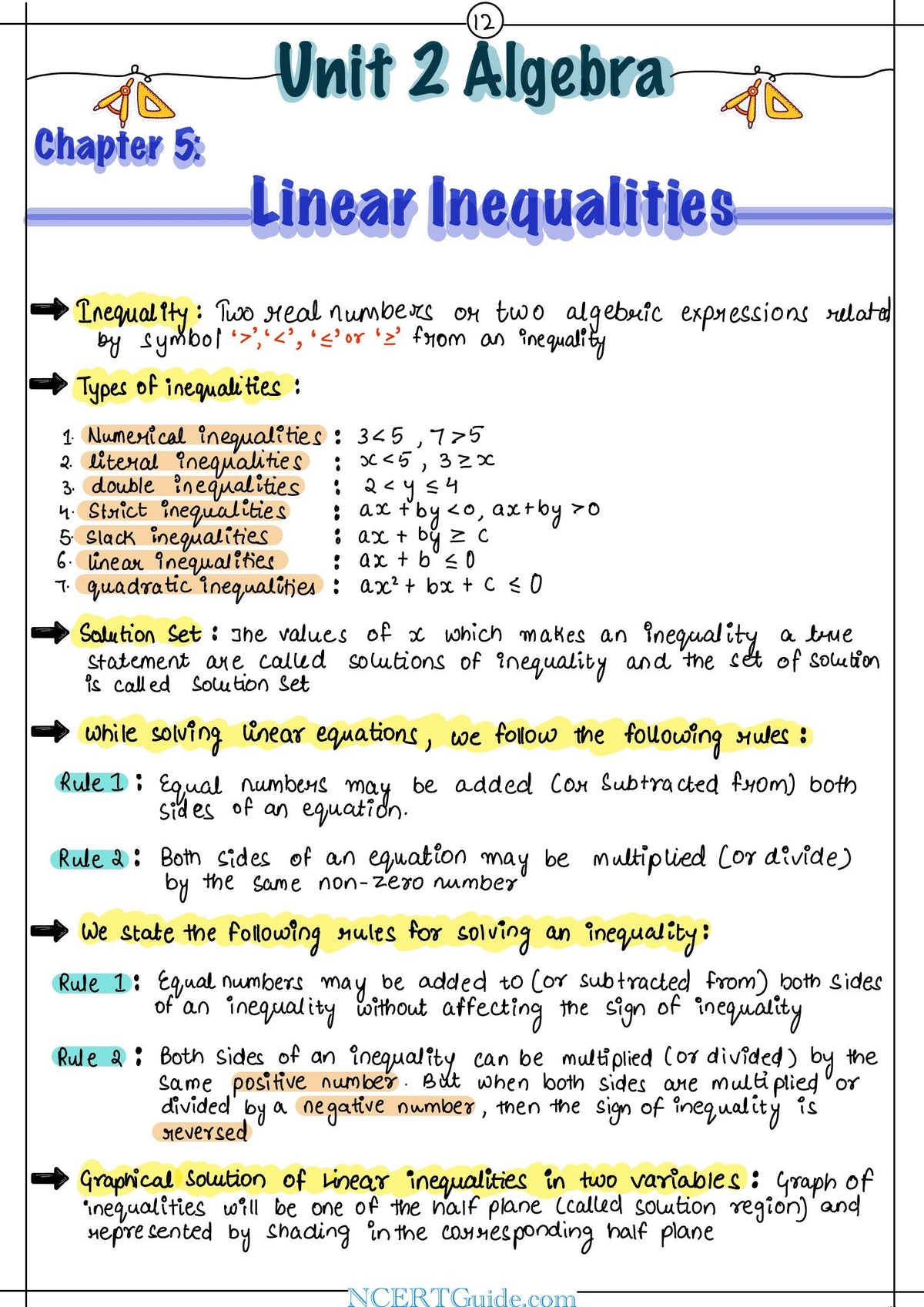
Left: the same topic as it reads in a regular textbook. Right: the real page from this book.
5.2 INEQUALITIES
A statement in which two real numbers, or two algebraic expressions, are connected by one of the signs <, >, ≤ or ≥ is called an inequality. Thus 3 < 5 and 7 > 5 are numerical inequalities, whereas x < 5 and y ≥ 3 are inequalities involving letters. When a quantity is placed between two others, as in 2 < y < 4, we speak of a double inequality.
An inequality in which the variable appears only in the first degree, for instance ax + b > 0, is a linear inequality in one variable; ax + by < c is linear in two variables; and an inequality containing x², such as ax² + bx + c ≤ 0, is quadratic.
Any value of the variable that turns an inequality into a true statement is a solution, and the collection of all such values is the solution set. The procedure for finding it closely resembles the procedure for equations: the same number may be added to or taken away from each side, and each side may be multiplied or divided by the same positive number without changing the inequality. Care is needed with negative numbers, because multiplying or dividing both sides by a negative quantity turns the inequality the other way round.
The solution of a linear inequality in two variables is represented graphically by a half plane.
See what's inside
Swipe through real pages from this book. Tap any page to read it.
All 14 chapters. All 80 marks.
Unit-wise marks as per the CBSE 2026-27 theory paper.
- 01Sets
- 02Relations and Functions
- 03Trigonometric Functions
- 04Complex Numbers and Quadratic Equations
- 05Linear Inequalities
- 06Permutations and Combinations
- 07Binomial Theorem
- 08Sequence and Series
- 09Straight Lines
- 10Conic Sections
- 11Introduction to Three Dimensional Geometry
- 12Limits and Derivatives
- 13Statistics
- 14Probability
Unit 1 and Unit 2 carry 48 of 80 marks — revise them first.
One chapter a day. Full syllabus in 14 days.
Repeat the cycle 3–4 times before boards. Most students finish the textbook once.
What's inside
- Format
- Printed book
- Pages
- 32
- Printing
- Full colour throughout
- Syllabus
- 2026-27 edition, NCERT-based
Made for the last month before the exam
Questions
Is this a PDF or a printed book?
A printed book, packed and delivered to your address.
Is it the latest syllabus?
Yes, the 2026-27 edition, written from the current NCERT textbook.
How long does delivery take?
Usually 5 to 7 business days; remote areas up to 10. You get a tracking link on WhatsApp.
What if it arrives damaged?
Send photos within 48 hours of delivery and we replace it free.
Can I pay cash on delivery?
Yes. Paying online gives free delivery and an extra discount; cash on delivery adds ₹80, shown before you place the order.
