Class 11 Biology Short Notes 2026-27

Class 11 Biology Short Notes 2026-27

Regular price Rs. 349.00
Regular price Rs. 349.00 Sale price Rs. 499.00
Save 30% Sold out

2,300+ students bought this in the last 12 months

Pay online: ₹314 after 10% off + free deliveryCash on delivery adds ₹80


Choose your set

  • Upi payment method UPI
  • Master payment method Mastercard
  • Visa payment method Visa
  • Google pay payment method Google Pay
 
add_shopping_cart

-

Ordered

local_shipping

-

Order Ready

redeem

- - -

Delivered

Class 11 Biology Short Notes 2026-27 – book cover with inside page

Class 11 Biology Short Notes 2026-27

Regular price Rs. 349.00
Regular price Rs. 349.00 Sale price Rs. 499.00
Save 30% Sold out

Class 11 Biology Short Notes 2026-27 is a printed, full-colour revision book for CBSE Class 11 science students. It turns the NCERT Class 11 Biology textbook into 104 pages of handwritten-style short notes: the key points of every chapter in short, highlighted notes with labelled diagrams, tables and flowcharts.

  • Complete syllabus: all 19 chapters, unit-wise for the 70-mark theory paper, including The Living World, Structural Organisation in Animals, Plant Growth and Development and Chemical Coordination and Integration.
  • Built for quick revision: one topic per page, key terms highlighted, diagrams drawn next to the line they explain.
  • Exam focus: written for Class 11 exams, and as a base for JEE and NEET, strictly as per the latest syllabus.
  • Printed book, 104 full-colour pages. Not a PDF. Delivered all over India.
  • Save with a set: choose PCMB for ₹999 (save ₹1,000).
  • Trusted by 2,300+ students in the last 12 months.
  • Created by a district topper and NIT graduate.
More about this book

Most students read the textbook once and run out of time for a second revision. This short notes book is made for that gap: it keeps only what the exam asks, in the same order as the NCERT chapters, so you can revise the full syllabus three or four times before the exam.

Ordering: pay online to get 10% off and free delivery. Cash on delivery is available for ₹80 extra.

View full details
watch before you buy

See the book in action

Short videos that walk you through the real book, page by page.

    before → after

    Same topic. Textbook vs this book. Drag to compare.

    Left: the same topic as it reads in a regular textbook. Right: the real page from this book.
    Class 11 Biology Short Notes 2026-27
    BIOLOGY · CHAPTER 14140

    14.1 RESPIRATORY ORGANS

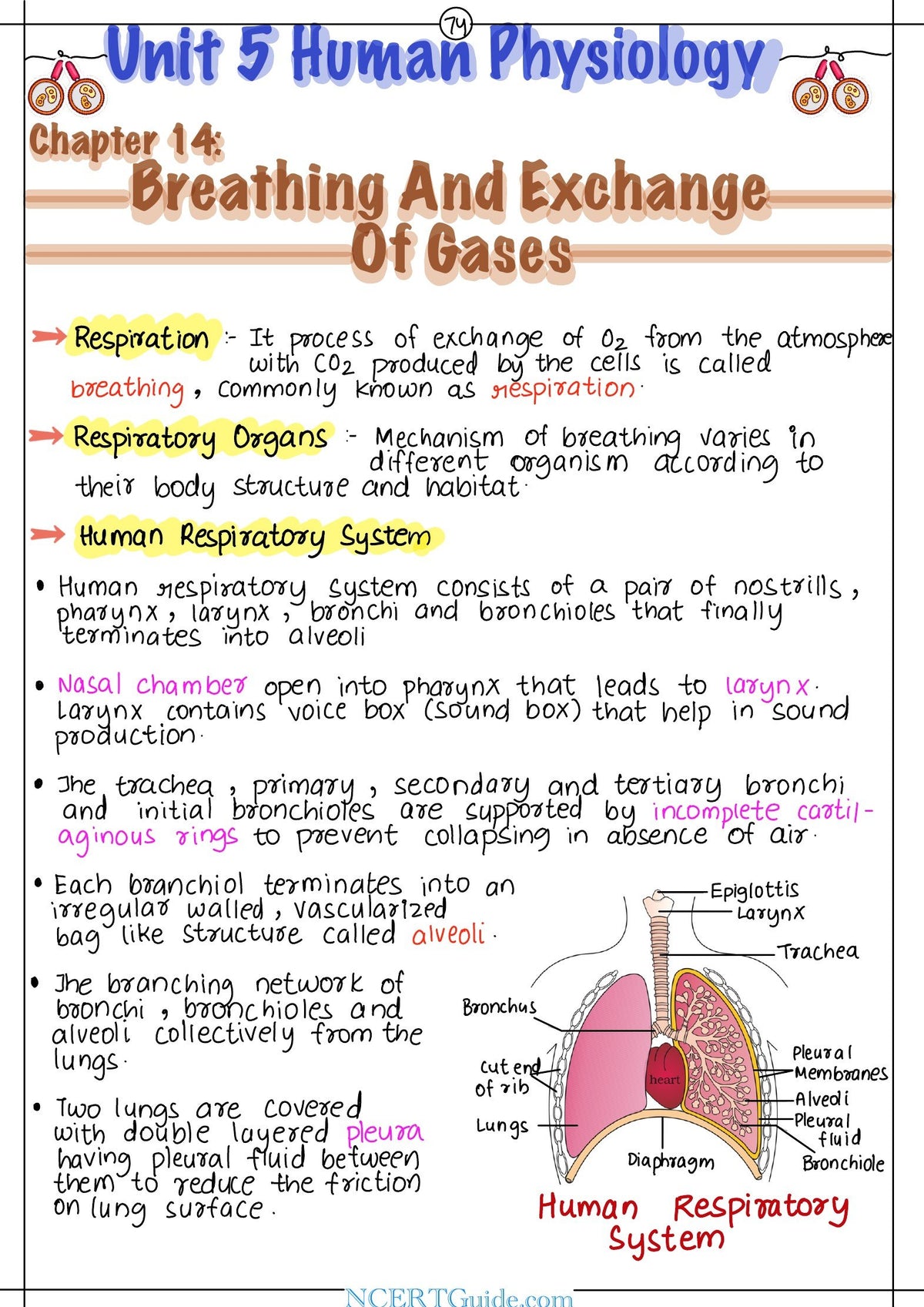
    Living cells continuously break down food molecules such as glucose and fatty acids in order to release the energy needed for their activities. Oxygen is consumed in these reactions and carbon dioxide, which becomes harmful if allowed to accumulate, is produced as a waste. An organism must therefore have some arrangement by which oxygen from the surroundings is supplied to its cells and carbon dioxide is removed from them. The taking in of oxygen-rich air and the giving out of air rich in carbon dioxide is termed breathing.

    The structures used for breathing are not the same in all animals. Lower invertebrates exchange gases over the general body surface, insects possess a network of tubes called tracheae, most aquatic animals use gills, and land vertebrates breathe with the help of lungs. In human beings, air enters through a pair of nostrils into the nasal chamber and passes into the pharynx, which serves as a common passage for food and air. From the pharynx air moves through the larynx, the voice box, into the windpipe or trachea.

    The trachea divides into right and left primary bronchi, which branch repeatedly into finer tubes ending in small air sacs called alveoli. The two lungs are covered by a double-layered membrane with fluid between the layers.

    Fig. 14.1 The human respiratory system
    Textbook Short notes
    14 → 2pages for one chapter: textbook vs this book (approx.)
    1 pageper topic, with the diagram next to the text
    3–4×full revision cycles possible before the board exam
    flip through

    See what's inside

    Swipe through real pages from this book. Tap any page to read it.

    1 /
    complete coverage

    All 19 chapters. All 70 marks.

    Unit-wise marks as per the CBSE 2026-27 theory paper.

    Diversity in the Living World 15Structural Organisation in Plants and Animals 10Cell: Structure and Functions 15Plant Physiology 12Human Physiology 18
    Unit 1 · Diversity in the Living World15 marks
    1. 01The Living World
    2. 02Biological Classification
    3. 03Plant Kingdom
    4. 04Animal Kingdom
    Unit 2 · Structural Organisation in Plants and Animals10 marks
    1. 05Morphology of Flowering Plants
    2. 06Anatomy of Flowering Plants
    3. 07Structural Organisation in Animals
    Unit 3 · Cell: Structure and Functions15 marks
    1. 08Cell: The Unit of Life
    2. 09Biomolecules
    3. 10Cell Cycle and Division
    Unit 4 · Plant Physiology12 marks
    1. 11Photosynthesis in Higher Plants
    2. 12Respiration in Plants
    3. 13Plant Growth and Development
    Unit 5 · Human Physiology18 marks
    1. 14Breathing and Exchange of Gases
    2. 15Body Fluids and Circulation
    3. 16Excretory Products and their Elimination
    4. 17Locomotion and Movement
    5. 18Neural Control and Coordination
    6. 19Chemical Coordination and Integration
    exam tip

    Unit 1 and Unit 5 carry 33 of 70 marks — revise them first.

    the 19-day plan

    One chapter a day. Full syllabus in 19 days.

    Repeat the cycle 3–4 times before boards. Most students finish the textbook once.

    1The Living World
    2Biological Classification
    3Plant Kingdom
    4Animal Kingdom
    5Morphology of Flowering…
    6Anatomy of Flowering…
    7Structural Organisation in…
    8Cell: The Unit of Life
    9Biomolecules
    10Cell Cycle & Division
    11Photosynthesis in Higher…
    12Respiration in Plants
    13Plant Growth & Development
    14Breathing & Exchange of…
    15Body Fluids & Circulation
    16Excretory Products & their…
    17Locomotion & Movement
    18Neural Control…
    19Chemical Coordination…

    What's inside

    Format
    Printed book
    Pages
    104
    Printing
    Full colour throughout
    Syllabus
    CBSE Class 11, 2026-27, based on the NCERT textbook
    Free delivery when you pay online
    Damaged book? Free replacement
    Cash on delivery available
    why students keep them

    Made for the last month before the exam

    The whole chapter in a few pages
    Only what the exam asks, in the order the NCERT book teaches it.
    Diagrams you actually remember
    Colour-coded maps, flowcharts and formula boxes, drawn to be recalled in the exam hall.
    Easy language
    Short sentences, Hindi-medium editions for Class 10 and NEET, no jargon.
    Printed in full colour
    Sturdy binding that survives a full year of revision, every page in colour.

    real students, real feedback

    What students say

    What students and parents say about this book and its combinations

    Rhea Nambiar

    The labelled diagrams and NCERT terminology are very helpful. Chapters revise karna faster and more systematic ho gaya.

    Biology Short Notes

    Kunal Bhardwaj

    School exams aur NEET foundation dono ke liye useful set hai. Weekly revision plan follow karna easy ho gaya.

    PCB Combo

    Rishabh Nair

    All four subjects are covered in one coordinated set. Class 11 ka heavy syllabus manage karna comparatively easier lagta hai.

    PCMB Complete Combo

    Questions

    Is this a PDF or a printed book?

    A printed book, packed and delivered to your address.

    Is it the latest syllabus?

    Yes, the 2026-27 edition, written from the current NCERT textbook.

    How long does delivery take?

    Usually 5 to 7 business days; remote areas up to 10. You get a tracking link on WhatsApp.

    What if it arrives damaged?

    Send photos within 48 hours of delivery and we replace it free.

    Can I pay cash on delivery?

    Yes. Paying online gives free delivery and an extra discount; cash on delivery adds ₹80, shown before you place the order.