New NCERT Ganita Prakash Part 1 · Class 8 Maths · Part I · Chapter 1: A Square and a Cube
This chapter is about square numbers and cube numbers and how to find their roots. It shows patterns in squares and cubes using odd numbers, and gives quick ways to check whether a number is a perfect square or a perfect cube.
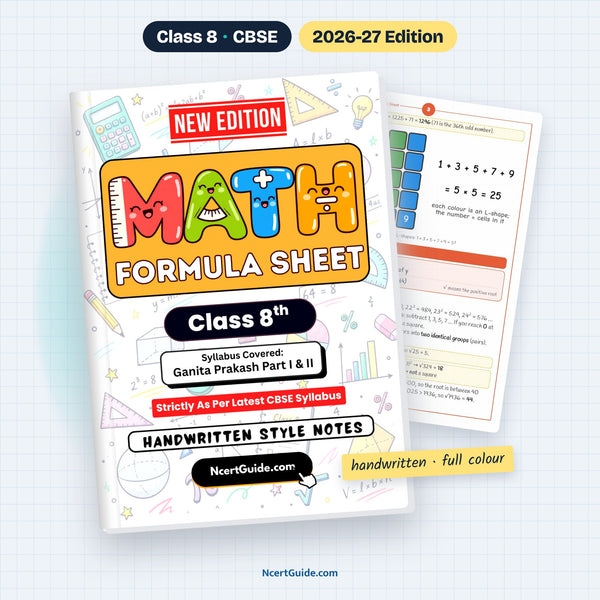
From the Class 8 Maths Formula Sheet, made as per the new NCERT book Ganita Prakash · Pages 2–6 of the book.
Key points
- A perfect square is the square of a natural number, like 1, 4, 9, 16, 25.
- Only square numbers have an odd number of factors.
- A square always ends in 0, 1, 4, 5, 6 or 9. It never ends in 2, 3, 7 or 8.
- The sum of the first n odd numbers is n².
- There are 2n non-square numbers between n² and (n + 1)².
- A square root can be found by listing squares, by subtracting odd numbers 1, 3, 5, … until you reach 0, by prime factorisation, or by estimation.
- A number is a perfect square if its prime factors can be split into two identical groups (pairs).
- A number is a perfect cube if its prime factors form three identical groups (triplets).
- Every digit 0 to 9 can be the last digit of a cube.
- n³ is the sum of the next n consecutive odd numbers: 1 = 1³, 3 + 5 = 2³, 7 + 9 + 11 = 3³.
- 1729 = 1³ + 12³ = 9³ + 10³ is the smallest number that is a sum of two cubes in two ways (Hardy–Ramanujan number).
- Numbers that are both squares and cubes are 6th powers: 1, 64, 729, 4096 …
Formulas
| Square of a number | n × n = n² |
| Sum of first n odd numbers | 1 + 3 + 5 + … + (2n − 1) = n² |
| nth odd number | 2n − 1 |
| Next square | (n + 1)² = n² + (2n + 1) |
| Non-squares between n² and (n + 1)² | 2n |
| Two triangular numbers | Tₙ + Tₙ₊₁ = (n + 1)² |
| Square root | If y = x², then x is a square root of y √ means the positive root, e.g. √64 = 8 |
| Cube of a number | n × n × n = n³ |
| Cube root | If y = x³, then x = ∛y e.g. ∛3375 = 15 |
| Taxicab number | 1729 = 1³ + 12³ = 9³ + 10³ |
| Useful square pattern | n² + (n + 1)² + (n(n + 1))² = (n(n + 1) + 1)² |
Diagrams to learn
- Inverted L-shapes showing 1 + 3 + 5 + 7 + 9 = 5²
- 4³ = 64 shown as four layers of 4 × 4 unit cubes
- Table of last digits of n and n³
- Table of levels of difference for squares and cubes
- Ending in 0, 1, 4, 5, 6 or 9 does not prove a number is a square: 26 ends in 6 but is not a square.
- A square ending in 6 has a root ending in 4 or 6.
- A cube ends in 0, 3, 6, 9 … zeros (a multiple of 3), never exactly 2 zeros.
- When you subtract odd numbers and go below 0, the number is not a perfect square.
A real page from the book

Get the full chapter in the book
This page is a summary. The Class 8 Maths Formula Sheet has the complete chapter in colour, with every diagram and worked example.
Frequently asked questions
How do you check if a number is a perfect square in Class 8?
Use prime factorisation: if the prime factors can be split into two identical groups, the number is a perfect square. You can also subtract 1, 3, 5, 7 … one by one; if you reach exactly 0, it is a square.
Why is 1729 called the Hardy–Ramanujan number?
1729 is the smallest number that can be written as the sum of two cubes in two ways: 1³ + 12³ and 9³ + 10³. It is linked to Hardy's taxi number and Ramanujan.
How do you find the cube root using prime factorisation?
Write the prime factors and group them in threes. Take one factor from each group and multiply. For example, 3375 = (3 × 5)³, so ∛3375 = 15.