New NCERT Ganita Prakash Part 1 · Class 8 Maths · Part I · Chapter 2: Power Play
This chapter is about exponents (powers) and how they help us write very large and very small numbers. It covers the laws of exponents, powers of 10, scientific notation and the names of large numbers.
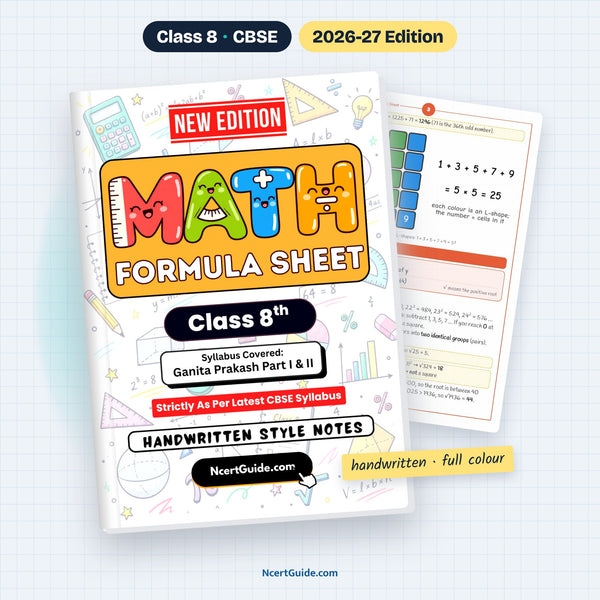
From the Class 8 Maths Formula Sheet, made as per the new NCERT book Ganita Prakash · Pages 7–10 of the book.
Key points
- nᵃ means n multiplied by itself a times; n is the base and a is the exponent (power).
- (−1) raised to an odd power is −1 and to an even power is +1.
- Repeated addition is not repeated multiplication: 4 + 4 + 4 = 12, but 4 × 4 × 4 = 4³ = 64.
- The laws of exponents work for all integer exponents, including negative ones.
- Any non-zero number raised to the power 0 is 1; 0⁰ is not defined.
- Exponential growth multiplies by a fixed amount each step; linear growth adds a fixed amount.
- When choices are combined, they multiply: a 5-digit lock with digits 0–9 has 10⁵ codes.
- In scientific notation a number is written as x × 10ʸ, where 1 ≤ x < 10 and y is an integer.
- To compare numbers in standard form, compare the exponents first, then the coefficients.
- Indian number names go up by 10², international names go up by 10³.
- A googol is 10¹⁰⁰.
Formulas
| Product law (same base) | nᵃ × nᵇ = nᵃ⁺ᵇ |
| Quotient law (same base) | nᵃ ÷ nᵇ = nᵃ⁻ᵇ n ≠ 0 |
| Power of a power | (nᵃ)ᵇ = (nᵇ)ᵃ = nᵃᵇ |
| Same exponent, product | mᵃ × nᵃ = (mn)ᵃ |
| Same exponent, quotient | mᵃ ÷ nᵃ = (m/n)ᵃ n ≠ 0 |
| Zero exponent | n⁰ = 1 n ≠ 0; 0⁰ is not defined |
| Negative exponent | n⁻ᵃ = 1/nᵃ n ≠ 0 |
| Scientific notation | x × 10ʸ, where 1 ≤ x < 10 y is an integer, e.g. 0.000345 = 3.45 × 10⁻⁴ |
| Thickness of paper after n folds | 0.001 × 2ⁿ cm doubles each fold |
| Signs of powers of −1 | (−1)ᵒᵈᵈ = −1 ; (−1)ᵉᵛᵉⁿ = +1 |
Diagrams to learn
- Power line of 4 (each step right is × 4, each step left is ÷ 4)
- Table of laws of exponents with examples
- Table of numbers in standard form
- Table of Indian and international names of large numbers
- Table of common mistakes with exponents (wrong vs right)
- 2³ is 2 × 2 × 2 = 8, not 2 × 3 = 6.
- (2³)² = 2⁶, not 2⁹; and 2³ × 2⁴ = 2⁷, not 2¹².
- −2⁴ = −16, but (−2)⁴ = 16; 5⁰ = 1, not 0; 2⁻³ = 1/8, not −8.
- 10⁹ + 10⁹ = 2 × 10⁹, not 10¹⁸.
A real page from the book

Get the full chapter in the book
This page is a summary. The Class 8 Maths Formula Sheet has the complete chapter in colour, with every diagram and worked example.
Frequently asked questions
What are the laws of exponents in Class 8 Maths?
nᵃ × nᵇ = nᵃ⁺ᵇ, nᵃ ÷ nᵇ = nᵃ⁻ᵇ, (nᵃ)ᵇ = nᵃᵇ, mᵃ × nᵃ = (mn)ᵃ, mᵃ ÷ nᵃ = (m/n)ᵃ, n⁰ = 1 and n⁻ᵃ = 1/nᵃ (n ≠ 0). They hold for all integer exponents.
How do you write a number in scientific notation?
Write it as x × 10ʸ where x is at least 1 but less than 10 and y is an integer. For example, 5900 = 5.9 × 10³ and 0.000345 = 3.45 × 10⁻⁴.
What is the value of any number to the power zero?
Any non-zero number to the power 0 is 1, for example 7⁰ = 1. 0⁰ is not defined.
← Part I · Chapter 1: A Square and a CubePart I · Chapter 3: A Story of Numbers →