New NCERT Ganita Prakash Part 1 · Class 8 Maths · Part I · Chapter 3: A Story of Numbers
This chapter tells how people learnt to count and write numbers, from tally marks to the Hindu (Indian) number system. It explains landmark numbers, bases and place value, and shows how to change a number from one base to another.
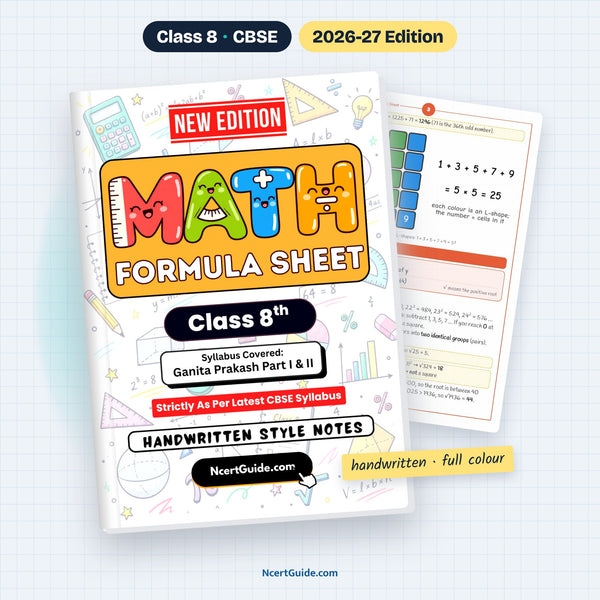
From the Class 8 Maths Formula Sheet, made as per the new NCERT book Ganita Prakash · Pages 11–14 of the book.
Key points
- Early counting used one-to-one mapping, body parts, tally marks on bones and counting in twos.
- Roman numerals use the landmarks I, V, X, L, C, D, M and have no zero and no place value.
- The Egyptian system used a picture symbol for each power of 10; the Mesopotamian system used base 60.
- The Mayan system used dot = 1, bar = 5 and a seashell for zero, with landmarks 1, 20, 360.
- In a base-n system the landmarks are 1, n, n², n³ …; base 10 is the decimal system.
- In a place value system, the position of a digit decides its landmark.
- The Hindu (Indian) system uses ten digits 0–9, base 10 and place value; 0 is both a digit and a number.
- Ten-digit numerals developed in India about 2000 years ago; the right name is Hindu / Indian / Hindu-Arabic numerals.
- To change base 10 to base n, divide by the base again and again and read the remainders from last to first.
- In base n only the digits 0, 1, …, n − 1 are used; base 2 uses only 0 and 1.
Formulas
| Roman numeral values | I = 1, V = 5, X = 10, L = 50, C = 100, D = 500, M = 1000 |
| Roman subtractive forms | IV = 4, IX = 9, XL = 40, XC = 90, CD = 400, CM = 900 |
| Landmarks in base n | 1, n, n², n³ … each landmark = previous × n |
| Hindu place value | 375 = 3 × 10² + 7 × 10 + 5 |
| Base 5 to base 10 | 1033 (base 5) = 1 × 125 + 0 × 25 + 3 × 5 + 3 × 1 = 143 |
| Base 2 to base 10 | 11001 (base 2) = 16 + 8 + 1 = 25 |
| Mesopotamian base 60 | 7530 = 2 × 3600 + 5 × 60 + 30 |
| Rules for zero (Aryabhata) | 0 + a = a ; a × 0 = 0 |
Key terms
- One-to-one mapping: Matching each object with exactly one item.
- Number system: A fixed, ordered set of symbols used to count.
- Numerals: The written symbols of a number system.
- Landmark numbers: Numbers that get a new basic symbol.
- Base: The number whose powers are used as landmarks, e.g. base 10 uses 1, 10, 100, 1000 …
- Place value system: A system in which the position of a digit decides its landmark.
Diagrams to learn
- Table of early number systems
- Abacus with counters on lines for 1, 10, 100, 1000
- Table of Roman numeral sums and products
- Roman numerals have no zero and no place value, so large multiplication and division are hard.
- In base n only the digits 0 to n − 1 are used.
- A base helps because the product of two landmark numbers is another landmark number (100 × 1000 = 1,00,000).
- In the Mesopotamian system, a blank for an empty place was ambiguous.
A real page from the book

Get the full chapter in the book
This page is a summary. The Class 8 Maths Formula Sheet has the complete chapter in colour, with every diagram and worked example.
Frequently asked questions
How do you convert a number from base 10 to base 5?
Divide the number by 5 again and again and write the remainders. Read the remainders from the last to the first. For example, 143 becomes 1033 in base 5.
Why is the Hindu number system better than Roman numerals?
The Hindu system uses base 10, ten digits 0–9 and place value, with 0 as a digit and a number. Roman numerals have no zero and no place value, so big calculations are hard.
Who used zero as a number first?
The book says the Bakhshali manuscript uses a dot for 0, Aryabhata (499 CE) computed with the ten-symbol system, and Brahmagupta (628 CE) gave rules for 0 as a number.
← Part I · Chapter 2: Power PlayPart I · Chapter 4: Quadrilaterals →