New NCERT Ganita Prakash Part 1 · Class 8 Maths · Part I · Chapter 4: Quadrilaterals
This chapter studies four-sided figures: rectangle, square, parallelogram, rhombus, kite and trapezium. It lists their properties of sides, angles and diagonals and shows how congruent triangles are used to prove them.
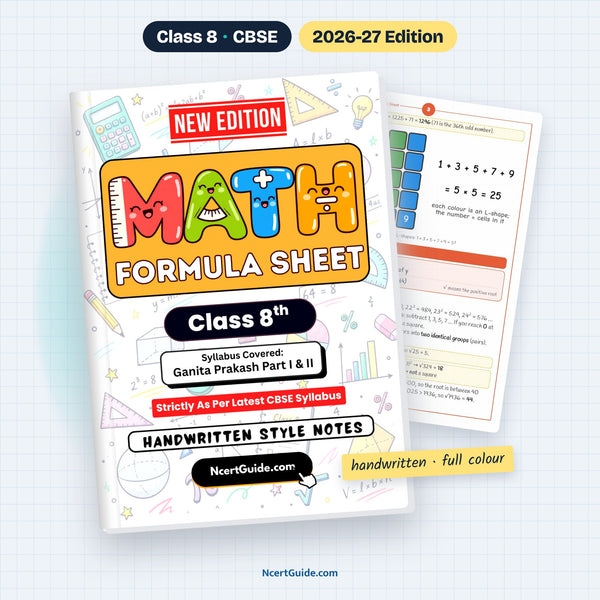
From the Class 8 Maths Formula Sheet, made as per the new NCERT book Ganita Prakash · Pages 15–18 of the book.
Key points
- The angles of any quadrilateral add up to 360°, because a diagonal splits it into two triangles.
- A quadrilateral cannot have exactly three right angles.
- A rectangle has all angles 90°; equivalently, its diagonals are equal and bisect each other.
- A square has all angles 90° and all sides equal; its diagonals are equal and bisect each other at 90°.
- A parallelogram has both pairs of opposite sides parallel; its opposite angles are equal and adjacent angles add to 180°.
- A rhombus has all sides equal, so it is a parallelogram; its diagonals are perpendicular and bisect the angles.
- A kite has two adjacent pairs of equal sides; one diagonal bisects the other at right angles.
- A trapezium has at least one pair of parallel sides; in an isosceles trapezium the non-parallel sides and base angles are equal.
- Every square is a rectangle and a rhombus; every rectangle and rhombus is a parallelogram; every parallelogram is a trapezium; every rhombus is a kite.
- Properties are proved using congruence tests SSS, SAS, ASA, AAS and RHS.
Formulas
| Angle sum of a quadrilateral | ∠A + ∠B + ∠C + ∠D = 360° |
| Adjacent angles of a parallelogram | x and 180° − x |
| Trapezium with PQ ∥ SR | ∠P + ∠S = 180°, ∠Q + ∠R = 180° |
| Angles in a given ratio | Each part = 360° ÷ (sum of ratio terms) 1 : 2 : 3 : 4 gives 36°, 72°, 108°, 144° |
Key terms
- Parallelogram: A quadrilateral with both pairs of opposite sides parallel.
- Rhombus: A quadrilateral with all sides equal.
- Kite: A quadrilateral with two adjacent pairs of equal sides.
- Trapezium: A quadrilateral with at least one pair of parallel sides.
- Isosceles trapezium: A trapezium whose non-parallel sides are equal.
- Conjecture: A guess seen in a few drawings; it is not a proof until it is deduced for every case.
Diagrams to learn
- Properties at a glance table for parallelogram, rectangle, rhombus, square, kite and trapezium
- Family tree of quadrilaterals
- Quick true/false table
- Table of proof ideas using congruent triangles
- Steps to construct a parallelogram
- Perpendicular diagonals do not make a quadrilateral a rhombus, because a kite also has them.
- Equal diagonals that bisect each other give a rectangle, not necessarily a square.
- The angle sum is 360° for concave (non-convex) quadrilaterals too.
- A conjecture seen in a few drawings is not a proof; a deduction proves it for every case.
A real page from the book

Get the full chapter in the book
This page is a summary. The Class 8 Maths Formula Sheet has the complete chapter in colour, with every diagram and worked example.
Frequently asked questions
What is the angle sum property of a quadrilateral?
The four angles of any quadrilateral add up to 360°. A diagonal splits it into two triangles, and 180° + 180° = 360°.
Is every square a rhombus?
Yes. Every square is both a rectangle and a rhombus, because it has all angles 90° and all sides equal.
What are the properties of the diagonals of a rhombus?
The diagonals of a rhombus bisect each other, are perpendicular and bisect the angles. They are not equal in general.
← Part I · Chapter 3: A Story of NumbersPart I · Chapter 5: Number Play →