New NCERT Ganita Prakash Part 1 · Class 8 Maths · Part I · Chapter 5: Number Play
This chapter plays with numbers using parity (odd and even), divisibility rules and digital roots. It explains why the tests for 9 and 11 work and shows how to solve cryptarithms, where letters stand for digits.
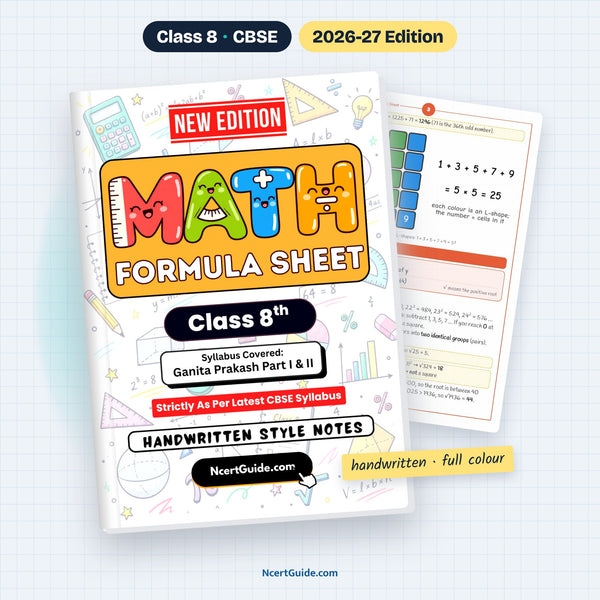
From the Class 8 Maths Formula Sheet, made as per the new NCERT book Ganita Prakash · Pages 19–23 of the book.
Key points
- odd ± odd = even, even ± even = even, odd ± even = odd.
- a + b and a − b always have the same parity.
- Every odd number is the sum of two consecutive numbers: 2k + 1 = k + (k + 1).
- If a divides M and N, then a divides M + N and M − N.
- If k and m both divide A, then LCM(k, m) divides A.
- Divisibility by 3 or 9: the sum of the digits is divisible by 3 or 9.
- Divisibility by 4: the last 2 digits; by 8: the last 3 digits.
- Divisibility by 11: (sum of digits in odd places) − (sum in even places) is 0 or a multiple of 11.
- The digital root is found by adding digits again and again until one digit is left; it equals the remainder on dividing by 9.
- In a cryptarithm, each letter stands for one digit, different letters are different digits and a number never starts with 0.
- The product of 3 consecutive integers is a multiple of 6; of 4, a multiple of 24.
Formulas
| Even numbers in terms of 4 | 4p or 4p + 2 |
| Remainder 3 on dividing by 5 | 5k + 3 3, 8, 13, 18 … |
| Odd number as consecutive sum | 2k + 1 = k + (k + 1) |
| General form of a number | …dcba = … + 1000d + 100c + 10b + a |
| Why the 9-test works | 10 = 9 + 1, 100 = 99 + 1, 1000 = 999 + 1 |
| Why the 11-test works | 10 = 11 − 1, 100 = 99 + 1, 1000 = 1001 − 1 |
| Sum of 4 consecutive numbers | n + (n + 1) + (n + 2) + (n + 3) = 4n + 6 |
| Remainder 2 on dividing by 3 and by 4 | 12n + 2 2, 14, 26 … |
Diagrams to learn
- Table of divisibility tests for 2 to 11 with examples
- Digital roots of 1, 2, 3 … going round from 1 to 9
- Tables of cryptarithm puzzles and answers
- Always / sometimes / never table
- Divisible by 4 and 6 does not mean divisible by 24 (12 is a counter-example). For 24, test 3 and 8.
- Multiples of 9 have digital root 9; multiples of 3 have digital roots that cycle 3, 6, 9.
- All values of a ± b ± c ± d have the same parity; for 4 consecutive numbers the result is always even.
- For tests like 12, 18, 36 and 44, use co-prime pairs: 3 & 4, 2 & 9, 4 & 9, 4 & 11.
A real page from the book

Get the full chapter in the book
This page is a summary. The Class 8 Maths Formula Sheet has the complete chapter in colour, with every diagram and worked example.
Frequently asked questions
What is the divisibility rule for 11?
Find the sum of digits in odd places and the sum in even places. If their difference is 0 or a multiple of 11, the number is divisible by 11. For example, 90,904 gives 22 − 0 = 22.
What is a digital root?
Add the digits of a number again and again until only one digit is left, e.g. 489710 → 29 → 11 → 2. The digital root equals the remainder on dividing by 9 (root 9 means remainder 0).
Why does the divisibility test for 9 work?
Each place value (10, 100, 1000 …) is 1 more than a multiple of 9. So the remainder on dividing a number by 9 is the same as the remainder of its digit sum.
← Part I · Chapter 4: QuadrilateralsPart I · Chapter 6: We Distribute, Yet Things Multiply →