New NCERT Ganita Prakash Part 1 · Class 8 Maths · Part I · Chapter 6: We Distribute, Yet Things Multiply
This chapter is about the distributive property and the algebraic identities that come from it. It shows how identities like (a + b)² and a² − b² make mental multiplication fast and explain number patterns.
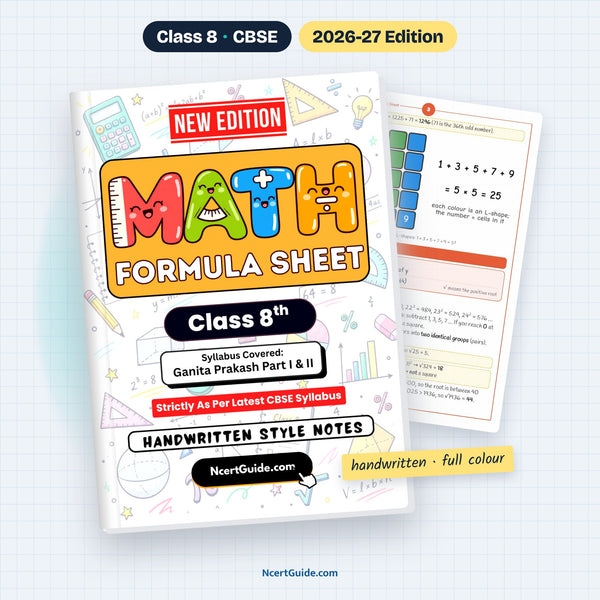
From the Class 8 Maths Formula Sheet, made as per the new NCERT book Ganita Prakash · Pages 24–27 of the book.
Key points
- The distributive property: a(b + c) = ab + ac.
- To multiply two brackets, multiply each term of one by each term of the other, then combine like terms.
- An identity is a pair of expressions that are equal for all values of the letters.
- Identities help in mental maths, e.g. 99² = 10000 − 200 + 1 = 9801.
- Products like 98 × 102 can be done as 100² − 2² = 9996.
- To multiply by 11, keep the end digits and add neighbouring digits in between.
- × 101 = × 100 + × 1, and × 99 = × 100 − × 1.
- Identities work for negative numbers and fractions too.
- Different ways of counting the same pattern give equal expressions.
- Brahmagupta (628 CE) first stated the distributive law clearly as khanda-gunana, "multiplication by parts".
Formulas
| Distributive property | a(b + c) = ab + ac ; a(b − c) = ab − ac |
| Identity 1 | (a + m)(b + n) = ab + an + mb + mn |
| Identity 1A | (a + b)² = a² + 2ab + b² |
| Identity 1B | (a − b)² = a² − 2ab + b² |
| Identity 1C | (a + b)(a − b) = a² − b² |
| Cube of a sum | (a + b)³ = a³ + 3a²b + 3ab² + b³ |
| Sum of squares pattern | 2(a² + b²) = (a + b)² + (a − b)² |
| Difference of cubes | (a − b)(a² + ab + b²) = a³ − b³ |
| Sridharacharya's squaring rule | a² = (a + b)(a − b) + b² 197² = 200 × 194 + 9 = 38809 |
| Both numbers up by 1 | (a + 1)(b + 1) = ab + a + b + 1 |
| Middle-square rule | n² − (n − 1)(n + 1) = 1 |
| Calendar diagonals | (a + 1)(a + 7) − a(a + 8) = 7 |
Diagrams to learn
- Area model of (a + b)² = a² + 2ab + b²
- Area model of (a − b)² and a² − b²
- Table using identities for mental maths
- Mind the mistake table (wrong vs correct)
- (5m + 6n)² is 25m² + 60mn + 36n², not 25m² + 36n² — do not forget the middle term.
- (a + 2)(b + 4) = ab + 4a + 2b + 8, not ab + 8.
- 5w² + 6w cannot be combined into 11w, because they are not like terms.
- (a − b)² = (b − a)².
A real page from the book

Get the full chapter in the book
This page is a summary. The Class 8 Maths Formula Sheet has the complete chapter in colour, with every diagram and worked example.
Frequently asked questions
What are the three main identities in Class 8 Maths?
(a + b)² = a² + 2ab + b², (a − b)² = a² − 2ab + b² and (a + b)(a − b) = a² − b².
How do you find 98 × 102 quickly?
Write it as (100 − 2)(100 + 2) = 100² − 2² = 10000 − 4 = 9996, using a² − b².
What is the trick to multiply a number by 11?
Keep the first and last digits and add neighbouring digits in between, carrying where needed. For example, 3874 × 11 = 42614.
← Part I · Chapter 5: Number PlayPart I · Chapter 7: Proportional Reasoning – 1 →