New NCERT Ganita Prakash Part 1 · Class 8 Maths · Part I · Chapter 7: Proportional Reasoning – 1
This chapter is about ratios and proportions. It explains cross multiplication, the Rule of Three (Trairashika), how to share an amount in a given ratio and how to convert units.
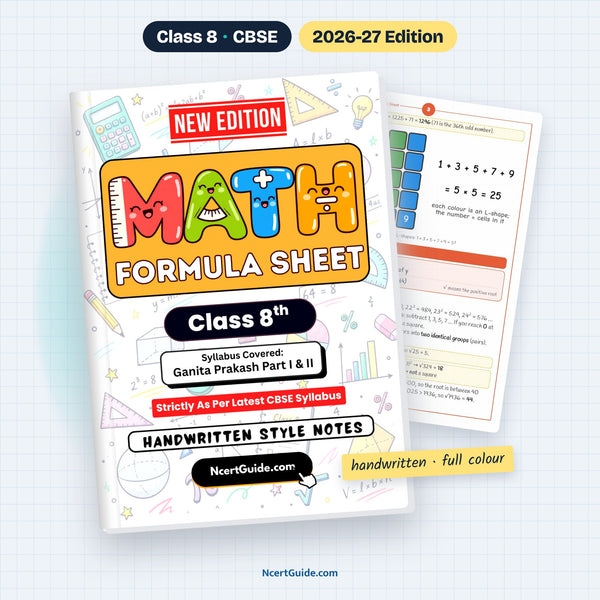
From the Class 8 Maths Formula Sheet, made as per the new NCERT book Ganita Prakash · Pages 28–31 of the book.
Key points
- a : b means for every a units of the first, there are b units of the second.
- Write a ratio in simplest form by dividing both terms by their HCF: 60 : 40 = 3 : 2.
- a : b :: c : d means the two ratios are in proportion.
- Multiplying or dividing by the same factor keeps shapes similar; adding or subtracting the same number changes the ratio.
- In a proportion, the cross products are equal.
- The Rule of Three (Trairashika) finds the fourth term: pramana : phala :: ichchha : ichchhaphala (Aryabhata).
- The Rule of Three works only for direct proportion.
- To divide an amount in the ratio m : n, find the value of one part and multiply.
- Units must be the same before comparing or using ratios.
- Compare unit rates (like ₹ per kg) to find the better buy.
Formulas
| Proportion (cross products) | a : b :: c : d ⇔ a × d = b × c |
| Fourth term | d = bc / a |
| Rule of Three | ichchhaphala = (phala × ichchha) ÷ pramana |
| Dividing x in m : n, first part | m × x ÷ (m + n) |
| Dividing x in m : n, second part | n × x ÷ (m + n) |
| Celsius to Fahrenheit | F = (9/5) × C + 32 |
| Fahrenheit to Celsius | C = (5/9) × (F − 32) |
| Length conversion | 1 metre = 3.281 feet |
| Area conversion | 1 hectare = 10,000 m² = 2.471 acres ; 1 acre = 43,560 ft² |
| Unit rate | Unit rate = total ÷ quantity |
Diagrams to learn
- Same factor gives similar shapes; same difference gives distorted shapes
- Table of image sizes and their ratios
- Filter coffee ratio table
- Proportional or not? table
- Rule of Three works only for direct proportion. For a fixed distance, more speed means less time.
- Always simplify both ratios to simplest form before comparing them, and make the units the same.
- Adding the same number to both terms changes the ratio (ages 3 : 30 become 12 : 39 after 9 years).
A real page from the book

Get the full chapter in the book
This page is a summary. The Class 8 Maths Formula Sheet has the complete chapter in colour, with every diagram and worked example.
Frequently asked questions
What is the Rule of Three in Class 8 Maths?
It is the method (Trairashika) of finding the fourth term of a proportion: ichchhaphala = (phala × ichchha) ÷ pramana. For example, if 120 students need 15 kg rice, 80 students need 15 × 80 ÷ 120 = 10 kg.
How do you divide an amount in a given ratio?
Add the ratio terms to get the total parts, find the value of one part, then multiply. ₹4500 in 2 : 3 gives 5 parts of ₹900, so ₹1800 and ₹2700.
How do you check if two ratios are in proportion?
Simplify both ratios or check whether the cross products are equal. For example, 72 : 96 simplifies to 3 : 4, so it is in proportion with 3 : 4.
← Part I · Chapter 6: We Distribute, Yet Things MultiplyPart II · Chapter 1: Fractions in Disguise →