New NCERT Ganita Prakash Part 2 · Class 8 Maths · Part II · Chapter 1: Fractions in Disguise
This chapter shows that percentages are fractions with denominator 100. It covers percentage increase and decrease, profit and loss, discount, GST and growth with and without compounding.
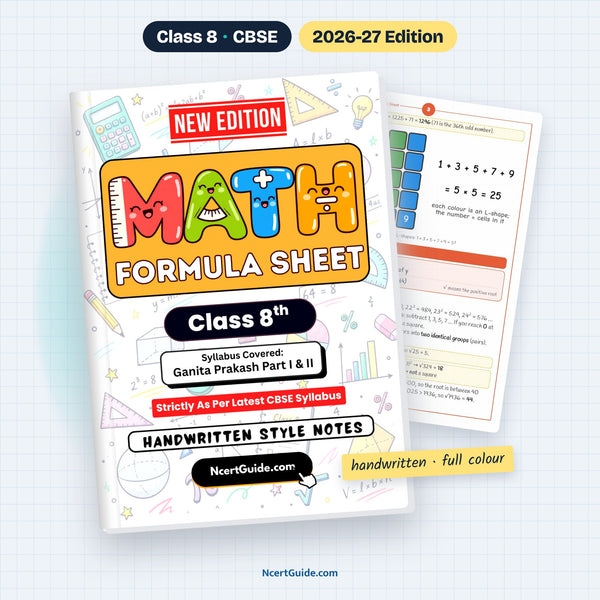
From the Class 8 Maths Formula Sheet, made as per the new NCERT book Ganita Prakash · Pages 32–35 of the book.
Key points
- x% means x out of 100; to change a fraction to a percentage, multiply by 100.
- x% of y is the same as y% of x.
- A percentage of a target can be more than 100%.
- Profit and loss percentages are found on the cost price (CP).
- Discount is found on the marked price (MP).
- Price with GST = price × (1 + GST rate).
- Without compounding, interest is paid out; with compounding, interest is added back.
- Depreciation reduces value by a fixed percentage each year.
- Successive percentage changes multiply, they do not add.
- Kautilya's Arthashastra (4th century BCE) already used "per cent".
Formulas
| Percentage | x% = x / 100 |
| y% of v | (y / 100) × v |
| Finding the whole | Whole = part × 100 ÷ percent |
| Percentage increase | (increase ÷ original) × 100 |
| Percentage decrease | (decrease ÷ original) × 100 |
| New value after r% change | old × (1 + r/100) or old × (1 − r/100) |
| Profit and loss | Profit = SP − CP ; Loss = CP − SP |
| Profit % and loss % | Profit % = (Profit ÷ CP) × 100 ; Loss % = (Loss ÷ CP) × 100 |
| Discount | Discount = MP − SP ; Discount % = (Discount ÷ MP) × 100 |
| Amount without compounding | A = P(1 + rt) r as a decimal |
| Amount with compounding | A = P(1 + r)ᵗ t = number of terms |
| Depreciation | value = P(1 − r)ᵗ |
Diagrams to learn
- The FDP trio: fraction, decimal and percent on one bar
- Linear growth (no compounding) vs exponential growth (compounding) graph
- Fraction–percentage–decimal conversion tables
- Always take the percentage of the correct base: profit/loss % on CP, discount % on MP, increase/decrease % on the original value.
- 30% off then 20% off is not 50% off: 0.7 × 0.8 = 0.56, so the total is 44% off.
- +50% then −50% gives 1.5 × 0.5 = 0.75, a 25% loss, not zero.
- Net profit = gross profit − other expenses.
A real page from the book

Get the full chapter in the book
This page is a summary. The Class 8 Maths Formula Sheet has the complete chapter in colour, with every diagram and worked example.
Frequently asked questions
What is the formula for compound interest in Class 8?
With compounding, A = P(1 + r)ᵗ, where P is the principal, r is the rate as a decimal and t is the number of terms. ₹6000 at 10% for 3 years gives 6000 × 1.331 = ₹7986.
Is profit percentage calculated on cost price or selling price?
Profit % and loss % are calculated on the cost price: Profit % = (Profit ÷ CP) × 100. Discount % is calculated on the marked price.
Do two successive discounts add up?
No. Successive changes multiply. 30% off then 20% off gives 0.7 × 0.8 = 0.56, which is 44% off in total, not 50%.
← Part I · Chapter 7: Proportional Reasoning – 1Part II · Chapter 2: The Baudhayana-Pythagoras Theorem →