New NCERT Ganita Prakash Part 2 · Class 8 Maths · Part II · Chapter 2: The Baudhayana-Pythagoras Theorem
This chapter starts with doubling and halving a square and finding √2. It then explains the Baudhayana-Pythagoras theorem for right triangles, Baudhayana (Pythagorean) triples and many applications.
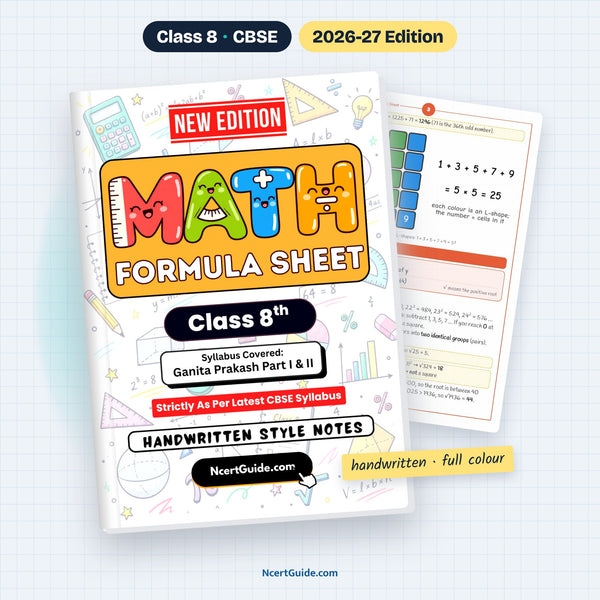
From the Class 8 Maths Formula Sheet, made as per the new NCERT book Ganita Prakash · Pages 36–40 of the book.
Key points
- The square on the diagonal of a square has double the area of the original square.
- Doubling the side of a square makes the area 4 times, not double.
- The hypotenuse is the side opposite the right angle and is always the longest side.
- In an isosceles right triangle with equal sides a, the hypotenuse is a√2.
- √2 lies between 1.414 and 1.415; it is not a terminating decimal and not a fraction.
- In a right triangle, a² + b² = c², where c is the hypotenuse.
- Baudhayana stated this theorem in general form in the Sulba-Sutra (c. 800 BCE), before Pythagoras.
- A Baudhayana triple is three whole numbers with a² + b² = c², like (3, 4, 5).
- If (a, b, c) is a triple, then (ka, kb, kc) is also a triple, so there are infinitely many triples.
- A primitive triple has no common factor greater than 1.
Formulas
| Baudhayana-Pythagoras theorem | a² + b² = c² c = hypotenuse |
| Finding the hypotenuse | c = √(a² + b²) |
| Finding a leg | a = √(c² − b²) |
| Isosceles right triangle | c² = 2a² ⇒ c = a√2 |
| Value of √2 | 1.414 < √2 < 1.415 ; √2 = 1.41421356… |
| Scaled triple | (a, b, c) is a triple ⇒ (ka, kb, kc) is a triple |
| Making triples from odd squares | (n − 1)² + (2n − 1) = n² if 2n − 1 is a square, it gives a triple |
| Diagonal of a square of side 5 cm | 5√2 ≈ 7.07 cm |
Diagrams to learn
- The square on the diagonal has double the area
- Squares on the three sides of a right triangle
- Bhaskara's lotus problem
- Table of triples listed in Sulba-Sutra 1.13
- Table of missing sides of right triangles
- a² + b² = c² works only for a right-angled triangle, with c opposite the right angle.
- The odd-square method always gives c = b + 1, so it misses triples like (8, 15, 17).
- Primitive triples with numbers up to 20 are (3, 4, 5), (5, 12, 13) and (8, 15, 17).
- Doubling the side gives 4 times the area, not double.
A real page from the book

Get the full chapter in the book
This page is a summary. The Class 8 Maths Formula Sheet has the complete chapter in colour, with every diagram and worked example.
Frequently asked questions
What is the Baudhayana-Pythagoras theorem?
In a right-angled triangle, the square on the hypotenuse equals the sum of the squares on the other two sides: a² + b² = c². Baudhayana stated it in the Sulba-Sutra around 800 BCE.
What are Baudhayana or Pythagorean triples?
They are whole numbers (a, b, c) with a² + b² = c², such as (3, 4, 5), (5, 12, 13), (8, 15, 17) and (7, 24, 25).
What is the hypotenuse of a right triangle with legs 3 cm and 4 cm?
c² = 9 + 16 = 25, so the hypotenuse is 5 cm.
← Part II · Chapter 1: Fractions in DisguisePart II · Chapter 3: Proportional Reasoning – 2 →