New NCERT Ganita Prakash Part 2 · Class 8 Maths · Part II · Chapter 3: Proportional Reasoning – 2
This chapter continues with ratios and proportion. It covers map scales, ratios with three or more terms, drawing pie charts and inverse proportion, where one quantity goes up as the other goes down.
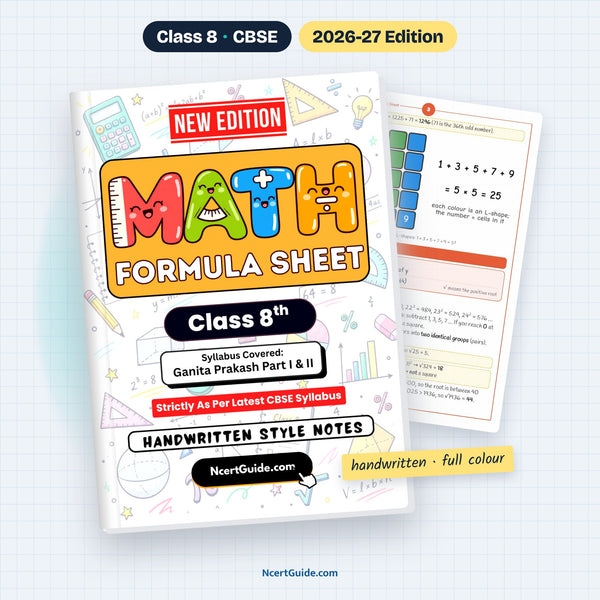
From the Class 8 Maths Formula Sheet, made as per the new NCERT book Ganita Prakash · Pages 41–44 of the book.
Key points
- A map scale (Representative Fraction) is map distance : actual distance.
- RF 1 : 60,00,000 means 1 cm on the map is 60 km on the ground.
- A map scale gives the straight-line distance, not the road distance.
- To divide an amount in a : b : c, divide by the sum of the terms and multiply by each term.
- In a pie chart, each slice angle is (value ÷ total) × 360°, and all angles add to 360°.
- Two quantities are inversely proportional if their product is constant.
- In inverse proportion, if one quantity is multiplied by n, the other is multiplied by 1/n.
- Workers and days, pumps and time, and speed and time for a fixed distance are inverse.
- Cost and number of items, and distance and time at fixed speed, are direct.
- For work done together, add the work done per hour.
Formulas
| Representative Fraction | RF = map distance : actual distance |
| Ratios with four terms | a : b : c : d :: p : q : r : s ⇔ a/p = b/q = c/r = d/s |
| Dividing x in a : b : c | x × a/(a + b + c), x × b/(a + b + c), x × c/(a + b + c) |
| Pie chart angle | Angle of a slice = (value ÷ total) × 360° |
| Inverse proportion | x × y = k (constant) |
| Inverse proportion (two cases) | x₁y₁ = x₂y₂ ⇔ x₁/x₂ = y₂/y₁ |
| Direct proportion | x₁/y₁ = x₂/y₂ = k |
| Rule of three (recap) | a : b :: c : d ⇒ d = bc / a |
Diagrams to learn
- Reading a map scale (RF 1 : 60,00,000)
- Pie chart of grades A–E
- Speed and time table for a 90 km journey
- Direct or inverse situations table
- A map scale gives the straight-line distance, not the road distance.
- Sides in the ratio 1 : 3 : 5 cannot make a triangle, since 1 + 3 < 5.
- For a fixed distance, speed × time stays the same (5 × 18 = 15 × 6 = 60 × 1.5 = 90).
A real page from the book

Get the full chapter in the book
This page is a summary. The Class 8 Maths Formula Sheet has the complete chapter in colour, with every diagram and worked example.
Frequently asked questions
How do you find the angle of a slice in a pie chart?
Angle = (value ÷ total) × 360°. For example, 12 students out of 40 get (12 ÷ 40) × 360° = 108°.
What is inverse proportion with an example?
Two quantities are inversely proportional if their product stays the same. If 20 workers take 4 days, 10 workers take 20 × 4 ÷ 10 = 8 days.
How do you use a map scale of 1 : 60,00,000?
1 cm on the map stands for 60 km. So 4.5 cm on the map is 4.5 × 60 = 270 km.
← Part II · Chapter 2: The Baudhayana-Pythagoras TheoremPart II · Chapter 4: Exploring Some Geometric Themes →