New NCERT Curiosity · Class 8 Science · Term I · Chapter 1: Exploring the Investigative World of Science
This chapter shows how science is about finding out new facts, not just remembering old ones. Using a simple kitchen question — why a puri puffs up — it explains how to ask a focused question, design a fair test and learn from careful observation.
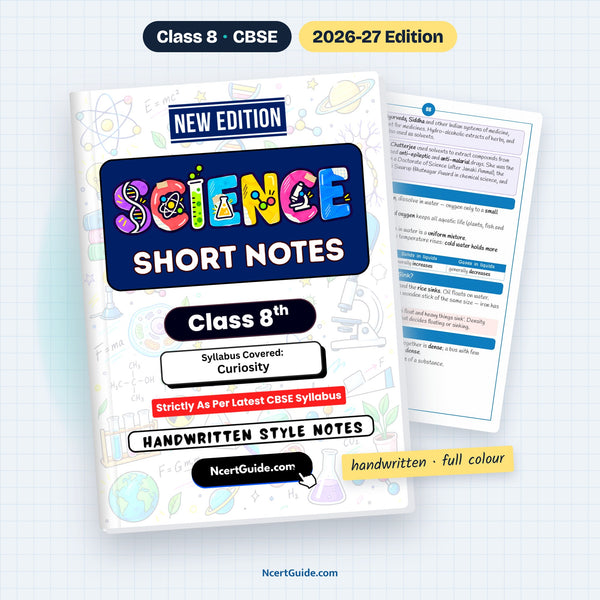
From the Class 8 Science Short Notes, made as per the new NCERT book Curiosity · Pages 2–3 of the book.
Key points
- Grade 6 showed that science begins with wonder; Grade 7 showed that science keeps changing; Grade 8 is about investigating.
- To investigate means to ask a focused question, design a simple experiment and use observations to understand better.
- You do not need a fancy laboratory — even a kitchen is a good place to observe and test.
- The root symbol stands for a strong foundation of knowledge; the kite symbol stands for curiosity taking flight.
- In the puri example, we can change dough thickness and size, type of flour, oil temperature and the way the dough is put in.
- We can observe whether the puri puffs, the time it takes to puff, and other things like splatter, smell and smoke.
- In a fair test, change only one thing at a time and keep everything else the same.
- Write down everything you notice, even things that seem unimportant.
- Good investigations lead to new questions, such as whether fresh dough puffs better than stored dough.
- This year's topics include microbes, health, electricity, forces and pressure, matter, light, and the sky and Earth.
Key terms
- Investigate: To ask a focused question, design a simple experiment and use observations to understand better.
- Fair test: A test in which only one thing is changed at a time and everything else is kept the same.
- Independent variable: The one thing we change on purpose.
- Dependent variable: What we observe or measure.
- Controlled variables: Everything we keep the same during the test.
Diagrams to learn
- The investigation cycle (Fig 1.1)
- Good science balances careful observation (the root) with creative thinking (the kite).
- Science does not know everything — even why a puri puffs is not completely understood by scientists today.
- Safety first: cook only with an adult and keep away from hot oil.
A real page from the book

Get the full chapter in the book
This page is a summary. The Class 8 Science Short Notes has the complete chapter in colour, with every diagram and worked example.
Frequently asked questions
What is a fair test in Class 8 Science Chapter 1?
A fair test is one where you change only one thing at a time and keep everything else the same. For example, to test oil temperature, use dough circles of the same thickness, put in the same way.
What are independent, dependent and controlled variables?
The independent variable is the one thing you change on purpose. The dependent variable is what you observe or measure. Controlled variables are everything you keep the same.
Why is the puri example used in this chapter?
It shows how a simple kitchen question can become an investigation. You list what you can change, what you can observe, and then test one change at a time.
Term I · Chapter 2: The Invisible Living World: Beyond Our Naked Eye →