New NCERT Curiosity · Class 8 Science · Term I · Chapter 3: Health: The Ultimate Treasure
This chapter explains that good health means physical, mental and social well-being, not just the absence of disease. It covers healthy habits, the types and spread of diseases, how vaccines prevent illness, and why antibiotics must be used wisely.
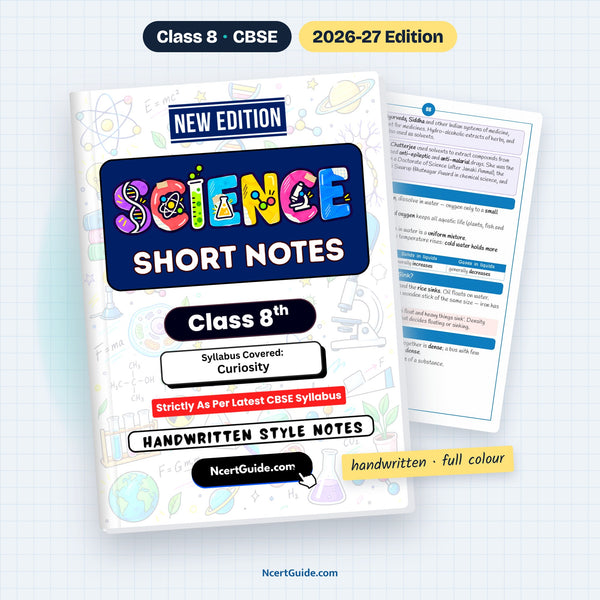
From the Class 8 Science Short Notes, made as per the new NCERT book Curiosity · Pages 12–19 of the book.
Key points
- WHO defines health as complete physical, mental and social well-being, not merely the absence of disease.
- Our health depends on our lifestyle and our environment.
- Good habits: personal hygiene, a balanced diet, regular exercise, relaxation, enough sleep and saying no to tobacco, alcohol and drugs.
- A symptom is what we feel; a sign is what can be seen or measured.
- Pathogens such as bacteria, viruses, fungi, worms and protozoa cause communicable diseases.
- Communicable diseases spread through air, direct or indirect contact, contaminated food and water, and vectors like mosquitoes and houseflies.
- Non-communicable diseases like cancer, diabetes and asthma are linked to lifestyle, diet and environment; they cause most deaths in India today.
- Diseases lasting more than 3 months are called chronic diseases.
- Vaccines train the immune system to recognise germs and give acquired immunity. They prevent disease but do not cure it.
- Antibiotics kill bacteria only; they do not work against viruses or protozoa.
- Misuse of antibiotics leads to antibiotic resistance, making common infections harder to treat.
Key terms
- Health (WHO): A state of complete physical, mental and social well-being, and not merely the absence of disease.
- Symptom: What we feel when unwell, e.g. pain, tiredness, dizziness.
- Sign: What can be seen or measured, e.g. fever, rash, high blood pressure, swelling.
- Pathogens: Disease-causing organisms — bacteria, viruses, fungi, worms and protozoa.
- Vectors: Insects like mosquitoes and houseflies that carry pathogens.
- Immunity: The natural ability of our body to fight diseases.
- Vaccine: Something that trains the immune system to recognise and attack harmful germs, giving acquired immunity.
- Antibiotic resistance: When bacteria that were earlier killed by an antibiotic survive and multiply despite it.
Diagrams to learn
- How communicable diseases spread (Fig 3.1)
- How antibiotic resistance develops and spreads (Fig 3.2)
- Table comparing communicable and non-communicable diseases
- Table of common communicable diseases with cause, site, symptoms and prevention
- Vaccines are preventive, not curative — they do not treat someone already sick.
- Antibiotics do not cure a cold, cough or flu, because these are caused by viruses.
- Some infectious diseases, like roundworm, are caused by worms, not by bacteria or viruses.
- Take antibiotics only when a doctor prescribes them, in the correct dose and for the right duration.
A real page from the book

Get the full chapter in the book
This page is a summary. The Class 8 Science Short Notes has the complete chapter in colour, with every diagram and worked example.
Frequently asked questions
What is the difference between communicable and non-communicable diseases?
Communicable diseases are caused by pathogens and spread from one person to another, like typhoid and dengue. Non-communicable diseases are not caused by pathogens and do not spread; they are linked to lifestyle, diet or environment, like diabetes and cancer.
Do antibiotics work against viruses?
No. Antibiotics act on parts of bacterial cells, so they work only against bacterial infections — not against viruses or protozoa. That is why they do not cure a cold or flu.
How do vaccines work?
A vaccine trains the immune system to recognise and attack harmful germs. It is made from weakened or dead pathogens or harmless parts of them, and gives acquired immunity before the disease can happen.
← Term I · Chapter 2: The Invisible Living World: Beyond Our Naked EyeTerm I · Chapter 4: Electricity: Magnetic and Heating Effects →