New NCERT Curiosity · Class 8 Science · Term II · Chapter 9: The Amazing World of Solutes, Solvents and Solutions
This chapter explains solutions as uniform mixtures of a solute dissolved in a solvent. It covers saturation, concentration and solubility of solids and gases, and then introduces density — how to measure mass and volume and why some things float while others sink.
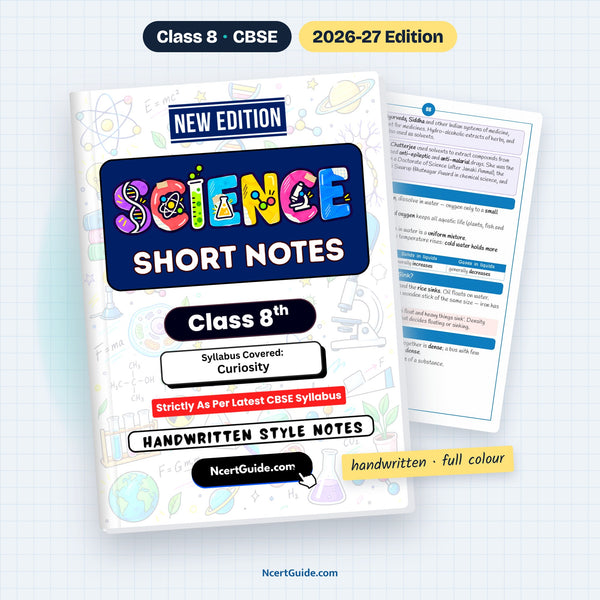
From the Class 8 Science Short Notes, made as per the new NCERT book Curiosity · Pages 53–59 of the book.
Key points
- A solution is a uniform mixture; the solute dissolves in the solvent.
- When two liquids mix, the one in the smaller amount is the solute and the larger one is the solvent.
- A fixed amount of water can dissolve only a limited amount of salt.
- An unsaturated solution can dissolve more solute; a saturated solution cannot at that temperature.
- Dilute and concentrated are relative terms that describe how much solute is present.
- For most solids, solubility increases with temperature; for gases, it decreases.
- The small amount of dissolved oxygen in water keeps aquatic life alive.
- Density is mass per unit volume; it does not depend on shape or size but on temperature and pressure.
- Oil (0.91 g/mL) is less dense than water, so it floats.
- The volume of an irregular solid is found by the displacement method in a measuring cylinder.
- Heating lowers density; that is why hot air rises. Water is densest at 4 °C, so ice floats.
Formulas
| Density | Density = Mass ÷ Volume SI unit kg/m³; also g/mL and g/cm³. |
| Relative density | Relative density = density of substance ÷ density of water It has no unit. |
| Unit conversion | 1 kg/m³ = 1 g/L |
| Volume units | 1 L = 1 dm³; 1 mL = 1 cm³ = 1 cc |
| Volume of a cuboid | Volume = l × w × h Notebook: 25 cm × 18 cm × 2 cm = 900 cm³. |
| Volume by displacement | Volume of stone = B − A 55 mL − 50 mL = 5 cm³. |
| Least count of measuring cylinder | 10 mL ÷ 10 divisions = 1 mL For a 100 mL cylinder. |
| Density of aluminium (example) | 27 g ÷ 10 cm³ = 2.7 g/cm³ |
Key terms
- Solution: A uniform mixture, e.g. salt or sugar in water.
- Solute: The substance that dissolves (in a solid + liquid solution, the solid).
- Solvent: The liquid in which the solute dissolves.
- Saturated solution: A solution in which no more solute can dissolve at that temperature.
- Concentration: The amount of solute in a fixed quantity of solution or solvent.
- Solubility: The maximum amount of solute that can dissolve in a fixed quantity of solvent at a particular temperature.
- Density: The mass present in a unit volume of a substance.
- Meniscus: The curved surface of a liquid in a measuring cylinder.
Diagrams to learn
- Unsaturated and saturated solutions (Fig 9.1)
- Volume of a stone by displacement (Fig 9.2)
- Table of effect of temperature on solubility of solids and gases
- Table of smallest readings of measuring cylinders
- In sugar syrup there is a lot of sugar in a little water, yet water is still the solvent.
- It is not simply that 'light things float and heavy things sink' — density explains a lot, but it is not the only factor.
- Mass and weight are not the same; most balances measure weight but show it in g or kg.
- Read the bottom of the meniscus for a colourless liquid and keep your eye level with it.
A real page from the book

Get the full chapter in the book
This page is a summary. The Class 8 Science Short Notes has the complete chapter in colour, with every diagram and worked example.
Frequently asked questions
What is the difference between a saturated and an unsaturated solution?
An unsaturated solution can still dissolve more solute at that temperature. A saturated solution cannot dissolve any more, and the extra solute settles at the bottom.
What is the formula for density?
Density = Mass ÷ Volume. Its SI unit is kg/m³, and g/mL or g/cm³ are also used.
Why does ice float on water?
Water is densest at 4 °C. When it freezes at 0 °C it expands, so the same mass takes more volume. Ice is therefore less dense than water and floats.
← Term II · Chapter 8: Nature of Matter: Elements, Compounds and MixturesTerm II · Chapter 10: Light: Mirrors and Lenses →