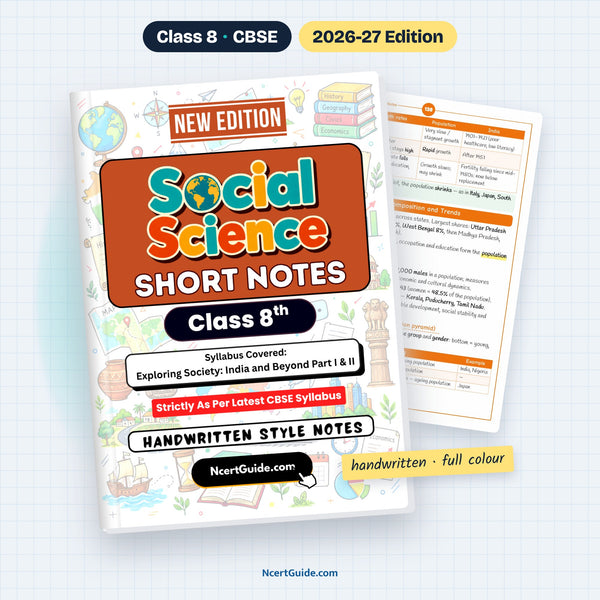
New NCERT Exploring Society: India and Beyond Part 1 · Class 8 Social Science · Part 1 · Chapter 1: Natural Resources and Their Use
This chapter explains when something in Nature becomes a resource and how we group natural resources. It looks at where resources are found, the 'paradox of plenty', and why we must use resources wisely as stewards of Nature.
From the Class 8 Social Science Short Notes, made as per the new NCERT book Exploring Society: India and Beyond · Pages 2–11 of the book.
Key points
- Nature becomes a resource when humans use it for sustenance or to make new things, e.g. a tree cut to make furniture.
- An entity is a resource only if it is technologically accessible, economically feasible and culturally acceptable.
- By use, natural resources are grouped as essential for life (air, water, food from soil), for materials (wood, marble, gold) and for energy (coal, petroleum, sun, wind).
- One resource can fall into more than one group: coal is both a material and a source of energy.
- Nature works in a restorative and regenerative way; renewable resources like sunlight, wind, flowing water and timber renew themselves if used sustainably.
- Non-renewable resources such as coal, petroleum, iron, copper and gold cannot be replaced at the rate we use them; India's coal may last only about another 50 years.
- Natural resources are unevenly distributed, which shapes settlements, trade, international relations and even conflicts, e.g. sharing of Kaveri water.
- The 'paradox of plenty' means resource-rich regions may grow slowly; India has generally avoided it by investing in industries, technology and skills.
- Over-pumping of groundwater in Punjab has left almost 80% of its area classified 'over-exploited'.
- Cement is needed for building but is one of the most polluting industries; mud, stone and plant-based materials are alternatives.
- Sikkim became a 100 per cent organic state in 2016, and farmers' incomes grew by 20 per cent on average.
- The International Solar Alliance was launched by India and France in 2015 to promote solar energy.
Key terms
- Natural resources: Materials and substances that occur in Nature and are valuable to humans.
- Exploitation: In this chapter, the extraction, use and consumption of natural resources; the word usually has a negative meaning.
- Restoration: Returning something to its original healthy state after damage, like a forest recovering after a wildfire.
- Regeneration: Goes beyond restoration; it is Nature's ability to create new life and conditions for thriving.
- Ecosystem services: Nature's own ways of working (ecosystem functions) when they benefit humans, such as clean water and pollinated crops.
- Paradox of plenty: Also called the natural resource curse; some regions rich in resources still grow slowly.
- Vṛikṣhāyurveda: Ancient Indian plant science, formalised in Surapala's Vṛikṣhāyurveda around the 10th century CE.
- Lokasangraha: An idea in the Bhagavad Gītā: rise above personal desires and act for the wellbeing of all.
Diagrams to learn
- Flowchart: categories of natural resources based on use
- Table: resources we use daily, their use and whether they are renewable
- Flowchart: regeneration in a forest
- Table: renewable vs non-renewable resources
- Map work: distribution of important minerals (coal, oil, iron ore, bauxite)
- Caselet flowchart: over-exploitation of groundwater in Punjab
- Fig 1.4 Over-pumping: the water table goes down
- A renewable resource can become non-renewable if we use it faster than Nature can restore it, e.g. over-cut forests or over-pumped groundwater.
- One resource can belong to more than one category: water is essential for life and also a source of energy.
- The Himalayas are the 'water tower' for the people of the plains.
A real page from the book

Get the full chapter in the book
This page is a summary. The Class 8 Social Science Short Notes has the complete chapter in colour, with every diagram and worked example.
Frequently asked questions
When does nature become a resource in Class 8 SST Chapter 1?
Nature becomes a resource when humans use it for their sustenance or make new things from it. For example, a tree becomes a resource when we cut it and make furniture from its wood.
What is the difference between renewable and non-renewable resources?
Renewable resources like sunlight, wind, flowing water and timber renew themselves through natural cycles. Non-renewable resources like coal, petroleum and metals formed over very long periods and cannot be replaced at the rate we use them.
What is the paradox of plenty?
It means that some regions rich in natural resources grow slowly, often because they fail to build industries that turn resources into higher-value products. It can be overcome by investing in technology and skills.