New NCERT Exploring Society: India and Beyond Part 1 · Class 8 Social Science · Part 1 · Chapter 2: Reshaping India’s Political Map
This chapter covers how invasions and new dynasties redrew India's map from the 11th to the 17th century. It describes the Delhi Sultanate, the Vijayanagara Empire, the Mughals, the many powers that resisted them, and how ordinary people lived.
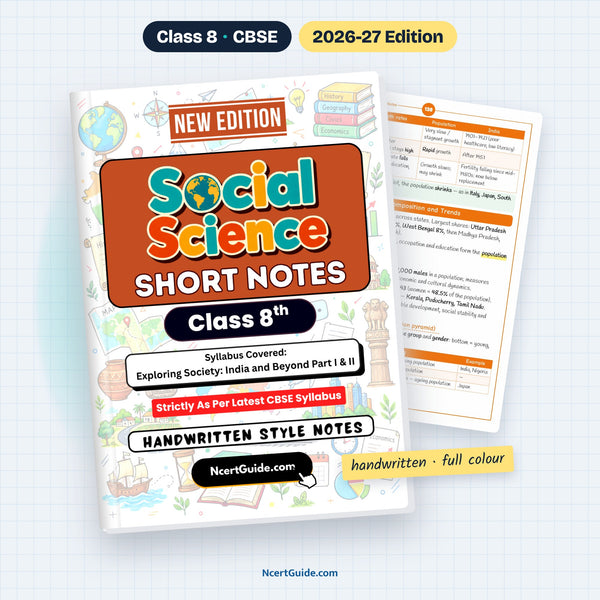
From the Class 8 Social Science Short Notes, made as per the new NCERT book Exploring Society: India and Beyond · Pages 12–23 of the book.
Key points
- In India, 'medieval' simply means the 11th to the 17th centuries; many invaders were Turkic or Afghan from Central Asia.
- The Delhi Sultanate was established in 1206 and was ruled by five dynasties: Mamluks, Khiljis, Tughlaqs, Sayyids and Lodis.
- Muhammad bin Tughlaq shifted the capital from Delhi to Daulatabad and introduced token currency; both schemes were poorly executed.
- Timur attacked Delhi in 1398 and left the city in ruins.
- Many powers resisted the Sultanate: the Eastern Gangas, Musunuri Nayakas, Hoysalas and Mewar under Rana Kumbha.
- The Vijayanagara Empire was founded in 1336 by Harihara and Bukka Raya; it peaked under Krishnadevaraya and its city was destroyed after the Battle of Talikota in 1565.
- Babur's victory at the First Battle of Panipat in 1526 established the Mughal Empire; Akbar won the Second Battle of Panipat in 1556.
- Akbar mixed brutality with tolerance: he abolished jizya and followed sulh-i-kul ('peace with all'); Aurangzeb reimposed jizya.
- The Mughals were resisted by the Rajputs (Haldighati, 1576), the Ahoms (Saraighat, 1671), the Sikhs, Jats, tribes and Rani Durgavati.
- The Sultanate used the iqta system; the Mughals under Akbar used the mansabdari system and divided the empire into 12 subahs.
- Despite political change, India stayed one of the wealthiest regions, with strong farming, crafts, trade and credit systems like the hundi.
Key terms
- Sultanate: A territory ruled by a Sultan, a title adopted by some Muslim rulers.
- Iconoclasm: Rejection or destruction of religious images considered idolatrous.
- Jizya: A tax on non-Muslims for 'protection' and exemption from military service.
- Jauhar: Rajput women jumping into mass fires to avoid capture and enslavement.
- Guerrilla warfare: Small groups who know the terrain use surprise attacks and ambushes to defeat bigger armies.
- Paik system: Ahom system in which every able-bodied man served the state by labour or military duty in return for land rights.
- Mansabdari: Mughal system where officers (mansabdars) of a rank (mansab) kept fixed numbers of troops and animals and were paid in land (jagirs).
- Hundi: A written instruction to pay a person, so money need not be carried; a precursor of modern banking.
Diagrams to learn
- Timeline: 13th to 18th centuries
- Flowchart: five dynasties of the Delhi Sultanate
- Table: Muhammad bin Tughlaq's schemes
- Table: resistance to the Delhi Sultanate
- Flowchart: fall of Vijayanagara
- Table: Delhi Sultanate vs Mughal administration, with Akbar's ministers
- Fig 2.6 A Persian wheel
- Map work: extent of kingdoms and battle sites
- Spellings vary because Persian script is hard to write in Roman letters: Khalji = Khilji; Mughal = Mughul = Moghul.
- NCERT uses the neutral word 'image' instead of 'idol' or 'icon', which are pejorative words.
- We must know the facts and respect the victims, but no one today bears responsibility for what individuals did hundreds of years ago.
A real page from the book

Get the full chapter in the book
This page is a summary. The Class 8 Social Science Short Notes has the complete chapter in colour, with every diagram and worked example.
Frequently asked questions
Which were the five dynasties of the Delhi Sultanate?
The Delhi Sultanate was ruled by five dynasties of Turkic–Afghan origin: the Mamluks ('Slave dynasty'), Khiljis, Tughlaqs, Sayyids and Lodis.
Who won the Battle of Saraighat?
In the Battle of Saraighat (1671) on the Brahmaputra near Guwahati, Lachit Borphukan with 10,000 men defeated 30,000 Mughal soldiers. The Ahoms stayed independent.
What was the mansabdari system?
Under the Mughals, officers called mansabdars were given a rank (mansab) and kept fixed numbers of troops and animals. They were paid in land (jagirs), which let the emperor raise an army at short notice.
← Part 1 · Chapter 1: Natural Resources and Their UsePart 1 · Chapter 3: The Rise of the Marathas →