New NCERT Exploring Society: India and Beyond Part 1 · Class 8 Social Science · Part 1 · Chapter 3: The Rise of the Marathas
This chapter explains who the Marathas were and how they became the largest pan-Indian power before the British. It covers Chhatrapati Shivaji's rise, the Marathas after him, their administration, cultural revival and legacy.
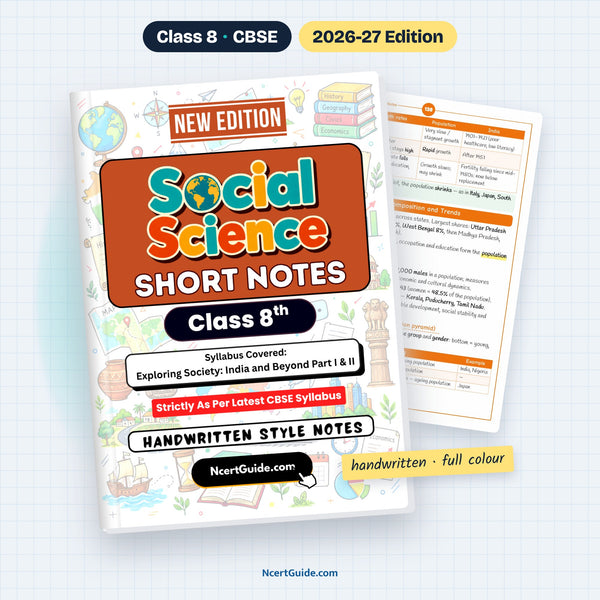
From the Class 8 Social Science Short Notes, made as per the new NCERT book Exploring Society: India and Beyond · Pages 24–34 of the book.
Key points
- The Marathas are a people native to the Deccan plateau, identified with the Marathi language.
- Bhakti saints of Maharashtra like Dnyaneshwar, Namdev, Tukaram and Ramdas gave society a strong cultural foundation.
- Chhatrapati Shivaji was born in 1630 to Shahji and Jijabai and began his rule at 16 by capturing forts around Pune.
- He founded the Maratha navy in 1657 and used guerrilla warfare against bigger armies.
- Key events: killing of Afzal Khan, the raid on Shaista Khan, the sack of Surat, the Treaty of Purandar and the escape from Agra in 1666.
- Shivaji was crowned at Raigad in 1674, the formal beginning of the Maratha Empire, and died in 1680.
- After Shivaji, the Marathas under Sambhaji, Rajaram and Tarabai resisted Aurangzeb, who died without subduing them.
- The Peshwas became very powerful; the Marathas were defeated at Panipat in 1761 but recaptured Delhi in 1771.
- Three Anglo–Maratha wars were fought between 1775 and 1818; the Third war in 1818 ended Maratha power.
- Shivaji paid officials salaries, was helped by the Aṣhṭa pradhāna manḍala (council of eight ministers) and collected chauth and sardeshmukhi.
- Maratha women like Tarabai and Ahilyabai Holkar played major roles; Serfoji II made Thanjavur a centre of culture.
Key terms
- Bhakti: Devotion to the divine or to a particular deity.
- Swarājya: Shivaji's vision of a sovereign kingdom covering political, economic and cultural life.
- Jāgīr: Land given by a king as a reward for service; the holder collected taxes from it.
- Surgical strike: A military attack on one specific target, with little or no damage to other people or infrastructure.
- Peshwa: Persian term for 'prime minister'; the Peshwas became very powerful, even over the Chhatrapati.
- Chauth and sardeshmukhi: Taxes of 25% and an additional 10% collected from provinces not directly under the Marathas, in return for protection.
- Aṣhṭa pradhāna manḍala: The council of eight ministers that helped the Chhatrapati.
- Moḍī script: A cursive form of Devanagari; the main script of Maratha correspondence.
Diagrams to learn
- Timeline: Chhatrapati Shivaji
- Table: key events (Afzal Khan, Shaista Khan, Surat, Purandar, Agra)
- Timeline: after Shivaji
- Table: Aṣhṭa pradhāna manḍala (council of eight ministers)
- Table: Sultans/Mughals vs Chhatrapati Shivaji
- Table: the mighty Maratha women
- Map work: Maratha Empire, 1759
- Compare: Shivaji's state was centralised with salaried officials, but in the 18th century the Maratha state became decentralised and often used Mughal-style coins with its own symbols.
- The panchāyat of Maratha times, a local gathering of officials and prominent men, is not the same as today's Panchayat.
A real page from the book

Get the full chapter in the book
This page is a summary. The Class 8 Social Science Short Notes has the complete chapter in colour, with every diagram and worked example.
Frequently asked questions
When was Shivaji crowned?
Shivaji was crowned in 1674 with full Vedic rites at the mountain fort of Raigad, with the title 'Shri Raja Shiva Chhatrapati'. This was the formal beginning of the Maratha Empire.
What were chauth and sardeshmukhi?
Chauth was 25% and sardeshmukhi an additional 10%, collected from provinces not directly under the Marathas. In return, the Marathas protected them and did not interfere in their internal administration.
Who were the members of the Ashta Pradhan?
The council of eight ministers had the Pradhān (Prime Minister), Amātya (Finance), Sachiv (Land Revenue), Mantrī (Intelligence), Sumant (Foreign Affairs), Senāpatī (Commander-in-chief), Nyāyādhīsh (Chief Justice) and Panḍitrāo (Religious Affairs).
← Part 1 · Chapter 2: Reshaping India’s Political MapPart 1 · Chapter 4: The Colonial Era in India →