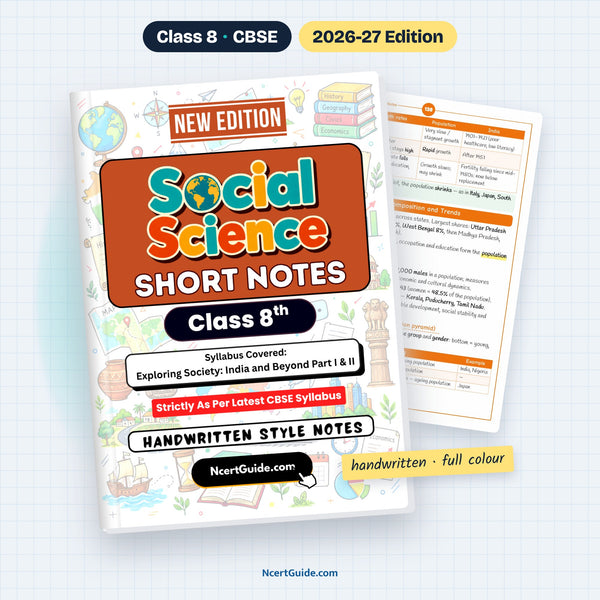
New NCERT Exploring Society: India and Beyond Part 1 · Class 8 Social Science · Part 1 · Chapter 5: Universal Franchise and India’s Electoral System
This chapter explains who can vote in India, how elections are run and who elects whom. It covers universal adult franchise, the Election Commission of India, elections to the Lok Sabha, state assemblies and Rajya Sabha, and how the President and Vice President are elected.
From the Class 8 Social Science Short Notes, made as per the new NCERT book Exploring Society: India and Beyond · Pages 47–56 of the book.
Key points
- Universal adult franchise means every adult citizen gets one vote, and all votes have equal value.
- Every Indian citizen aged 18 and above can vote; India lowered the voting age from 21 to 18 in 1988 (Article 326).
- All adults, including women, got the vote from the very beginning, even though literacy in 1947 was only about 14%.
- The Election Commission of India (ECI), set up in 1950, is an independent constitutional body that conducts free and fair elections.
- The ECI has taken accessibility measures such as voting from home, postal voting and polling stations even for one voter.
- The 2024 Lok Sabha elections had about 968 million voters, 543 constituencies and over 1 million polling stations.
- Voting is done on an EVM, and the VVPAT gives a paper record so voters can verify their vote.
- The Model Code of Conduct sets dos and don'ts for parties and candidates; T.N. Seshan made the ECI proactive after 1990.
- Lok Sabha and assembly elections use First-Past-the-Post: the candidate with the most votes wins.
- The Rajya Sabha has 245 members (233 elected by MLAs, 12 nominated); it is a Permanent House and one-third of members retire every 2 years.
- The President is elected by an electoral college of elected MPs and MLAs; the Vice President is elected by all members of both Houses of Parliament.
- Challenges include money power, candidates with criminal records and voter apathy.
Key terms
- Franchise: A right granted by the constitution or government; here, the right to vote. Also called suffrage.
- Universal adult franchise: Every adult citizen gets one vote, and all votes have equal value.
- Constituency: An area whose voters elect a representative to a legislative body.
- Secret ballot: No one knows who voted for whom, so voting is private and fair.
- NOTA: None Of The Above: an option that lets a voter reject all candidates.
- VVPAT: Voter Verifiable Paper Audit Trail: a paper record so a voter can check the vote was cast correctly.
- First-Past-the-Post: The candidate with the most votes in a constituency wins, even without 50% of the votes.
- Bicameral legislature: A legislature divided into two separate houses.
Diagrams to learn
- Table: why universal adult franchise is important
- Table: ECI accessibility measures
- Fig 5.2 Uttaramerur: names on palm leaves drawn from a sealed pot
- Flowchart: structure of the ECI
- Flowchart: voting at a polling station
- Fig 5.6 EVM and VVPAT
- Table: Lok Sabha vs Rajya Sabha
- Fig 5.7 Who elects whom
- Nominated MPs can vote for the Vice President but not for the President; MLAs vote for the President but not for the Vice President.
- About 34 per cent of eligible voters did not vote in the 2024 elections; low turnout is a concern.
- The right to vote is also a responsibility; cast a responsible vote.
A real page from the book

Get the full chapter in the book
This page is a summary. The Class 8 Social Science Short Notes has the complete chapter in colour, with every diagram and worked example.
Frequently asked questions
What is universal adult franchise?
It means every adult citizen gets one vote and all votes have equal value. In India, every citizen aged 18 and above can vote, irrespective of caste, creed, religion, gender, education or income.
How is the Rajya Sabha elected?
Rajya Sabha members are chosen by indirect election. Of its 245 members, 233 are elected by elected MLAs of the states using the single transferable vote, and 12 are nominated by the President.
Who elects the President of India?
The President is elected by an electoral college of elected MPs of both Houses and elected MLAs of every state and of Delhi and Puducherry. Nominated members do not vote.
← Part 1 · Chapter 4: The Colonial Era in IndiaPart 1 · Chapter 6: The Parliamentary System: Legislature and Executive →