New NCERT Exploring Society: India and Beyond Part 1 · Class 8 Social Science · Part 1 · Chapter 6: The Parliamentary System: Legislature and Executive
This chapter explains how Parliament is made up, how laws are made and who carries them out, both at the Union and in the states. It also looks at checks and balances and the challenges our legislatures face.
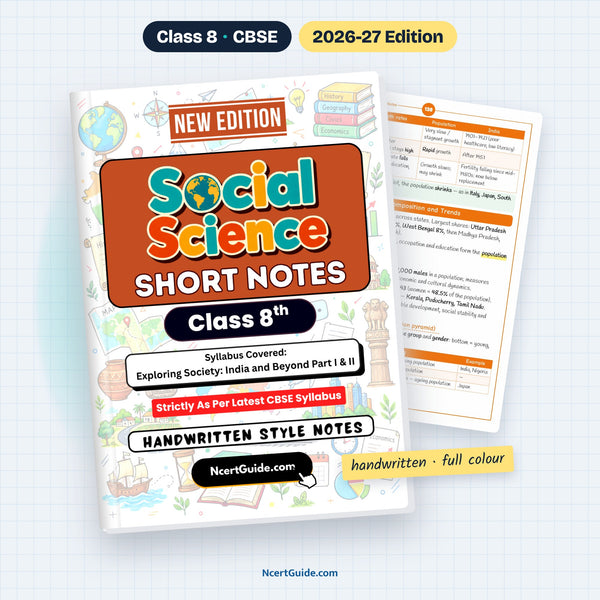
From the Class 8 Social Science Short Notes, made as per the new NCERT book Exploring Society: India and Beyond · Pages 57–66 of the book.
Key points
- Parliament is the supreme legislative body; it consists of the President, the Lok Sabha and the Rajya Sabha.
- Parliament is bicameral; the Rajya Sabha (Council of States) was needed in the spirit of federalism.
- The Speaker presides over the Lok Sabha; the Vice President of India chairs the Rajya Sabha.
- Parliament's legislative functions are constitutional functions, lawmaking, executive accountability and financial accountability.
- A bill passes through readings, committee study, clause-by-clause discussion and voting in both Houses, then gets Presidential assent.
- The Right to Education Act, 2009 gives free and compulsory education to children aged 6 to 14 (Article 21A).
- A Money Bill can be introduced only in the Lok Sabha, with the President's prior recommendation.
- The President is the nominal head; the Prime Minister and Council of Ministers are the real executive and are collectively responsible to the Lok Sabha.
- The judiciary checks that laws and executive actions follow the Constitution; this separation of powers keeps any one organ from becoming too powerful.
- States have a Governor, Chief Minister and Vidhan Sabha; only six states have a Vidhan Parishad as well.
- Laws are made on the Union List, State List and Concurrent List.
- Legislatures face challenges like disruptions, fewer sittings and lower productivity.
Key terms
- Bicameral: A structure with two houses; unicameral means having only one house.
- Federalism: A form of government where power is distributed between the centre, states and local governments.
- Bill: A draft of a proposed law that must be approved by Parliament before it becomes law.
- Money Bill: A bill on financial matters like taxation and government borrowing.
- Question Hour: Usually the first hour of a sitting, when MPs ask ministers about government policies and activities.
- Standing Committee: A permanent committee of MPs that scrutinises government activities.
- Gazette: Official government publication announcing legal documents and information.
- Productivity: Hours a House actually functioned compared with the time it was scheduled to.
Diagrams to learn
- Fig 6.1 Old and new Parliament buildings
- Flowchart: composition of the Parliament
- Flowchart: from bill to act
- Timeline: RTE's journey
- Table: legislature vs executive
- Flowchart: three organs of government
- Table: Union and State parallel structure
- Fig 6.6 Lok Sabha sittings have fallen over time
- Legislative function means making laws; executive function means implementing and enforcing them. Both are equally important.
- If the Union makes a law on a Concurrent List subject, the states must follow it, which is why RTE applies all over India.
- Interpretation in Parliament was earlier in 12 languages; 6 more were added recently: Bodo, Dogri, Maithili, Manipuri, Urdu and Sanskrit.
A real page from the book

Get the full chapter in the book
This page is a summary. The Class 8 Social Science Short Notes has the complete chapter in colour, with every diagram and worked example.
Frequently asked questions
How does a bill become a law in India?
A bill is introduced in either House, read, sometimes referred to a Standing Committee, discussed clause by clause and voted on. The process is repeated in the other House, then the President gives assent and it is notified in the Gazette.
What is the difference between the legislature and the executive?
The legislature makes laws and oversees the executive. The executive (President, Vice President and Council of Ministers under the PM) implements and enforces those laws.
Which states have two houses of legislature?
Six states are bicameral: Andhra Pradesh, Bihar, Karnataka, Maharashtra, Telangana and Uttar Pradesh. All other states are unicameral.
← Part 1 · Chapter 5: Universal Franchise and India’s Electoral SystemPart 1 · Chapter 7: Factors of Production →