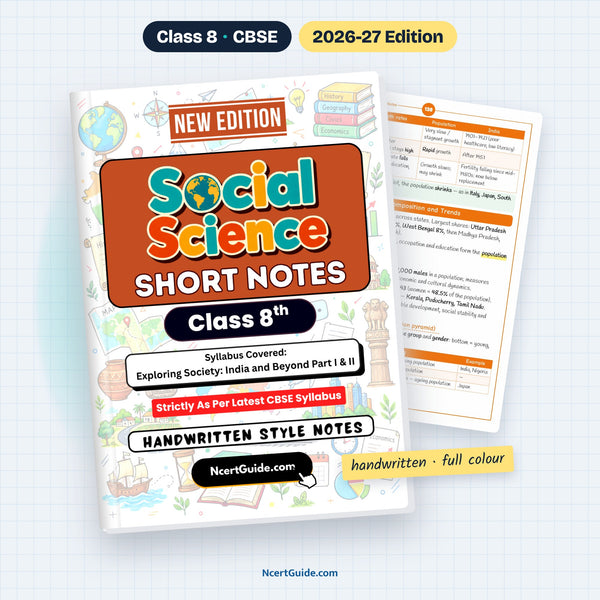
New NCERT Exploring Society: India and Beyond Part 2 · Class 8 Social Science · Part 2 · Chapter 2: India’s Long Road to Independence
This chapter tells how people of many languages and faiths came together to end nearly two centuries of British rule. It covers early uprisings, reform movements, the Congress, revolutionaries, Gandhi's mass movements, and Partition and Independence in 1947.
From the Class 8 Social Science Short Notes, made as per the new NCERT book Exploring Society: India and Beyond · Pages 89–101 of the book.
Key points
- Early uprisings in Odisha included the Paika Sangram led by Buxi Jagabandhu and the Sambalpur Uprising (1827–1862).
- After 1857, the British Crown took direct control in 1858, but promises in the royal proclamation were broken in practice.
- Reform movements like the Brahmo Samaj (1828) and Arya Samaj (1875) fought child marriage, caste discrimination and lack of education.
- The Indian National Congress held its first session in Bombay in 1885.
- The 1905 Partition of Bengal led to the Swadeshi and boycott movement; it was annulled in 1911.
- The Muslim League was founded at Dhaka in 1906, and the Congress split at Surat in 1907 between Moderates and Nationalists.
- Revolutionaries like Khudiram Bose, the Ghadar Movement, Bhagat Singh, Sukhdev and Rajguru gave their lives for freedom.
- In 1916 Tilak reunited the Congress and signed the Lucknow Pact; Tilak and Annie Besant led the Home Rule Movement.
- The Jallianwala Bagh massacre took place on 13 April 1919 in Amritsar.
- Gandhi led three big mass movements: Non-Cooperation (1920–22), Civil Disobedience (1930–34) and Quit India (1942).
- The Congress demanded Purna Swaraj at Lahore in 1929; Subhas Chandra Bose formed the INA and Azad Hind government in 1943.
- India became independent on 15 August 1947 along with Partition; Sardar Patel integrated the princely states.
Key terms
- Martyr: A person who is killed or tortured for his or her beliefs.
- Paramountcy: British supremacy under which some 560 princes kept their states.
- Seditious: Promoting rebellion against the authority of a state or monarch.
- Swadeshi: 'Of one's own country'; using Indian goods.
- Satyagraha: 'Insistence on truth'; Gandhi's method of nonviolence and passive resistance.
- Dominion status: Full internal autonomy, but Britain keeps defence, foreign policy and the Crown as head.
- Purna Swaraj: Complete independence, demanded by the Congress at Lahore in December 1929.
- Khadi: Hand-spun, hand-woven cloth; the symbol of the Non-Cooperation movement.
Diagrams to learn
- Timeline 1: 1858 to 1911
- Table: reform movements
- Table: Moderates vs Nationalists
- Fig 2.2 The Cellular Jail: 'Kala Pani'
- Fig 2.4 Jallianwala Bagh: why the crowd was trapped
- Flowchart: Gandhi's three big mass movements
- Fig 2.8 People jailed in the mass movements
- Timeline 2: 1915 to 1947
- 'Extremists' was the label given by the British and the Moderates; these leaders called themselves 'Nationalists'.
- Britain did not leave only because of Gandhi and nonviolence; popular uprisings, revolutionaries, the Air Force and Navy mutinies, Britain's weakness after WWII and worldwide decolonisation also played a part.
A real page from the book

Get the full chapter in the book
This page is a summary. The Class 8 Social Science Short Notes has the complete chapter in colour, with every diagram and worked example.
Frequently asked questions
What happened at Jallianwala Bagh in 1919?
On 13 April 1919, Baisakhi day, General Dyer blocked the exit and fired 1,650 rounds on an unarmed crowd in Amritsar. The British count was about 400 dead, while Indian estimates said over 1,000 died.
What was the difference between the Moderates and the Nationalists?
The Moderates wanted minor concessions and gradual self-rule within the Empire through petitions and dialogue. The Nationalists wanted full independence through Swaraj, Swadeshi, boycott and mass awakening.
What were Gandhi's three mass movements?
They were Non-Cooperation (1920–22), Civil Disobedience (1930–34), which began with the Salt March, and Quit India (1942).
← Part 2 · Chapter 1: World Geography: Some GlimpsesPart 2 · Chapter 3: A Journey Through Indian Architecture →