New NCERT Ganita Manjari · Class 9 Maths · Part II · Chapter 11: The World of Algorithms
This chapter explains what an algorithm is: a precise step-by-step procedure to solve a problem. It uses the column addition method and different ways of finding the GCD (HCF) of two numbers to show how algorithms are built, justified and made faster, ending with Āryabhaṭa's division algorithm.
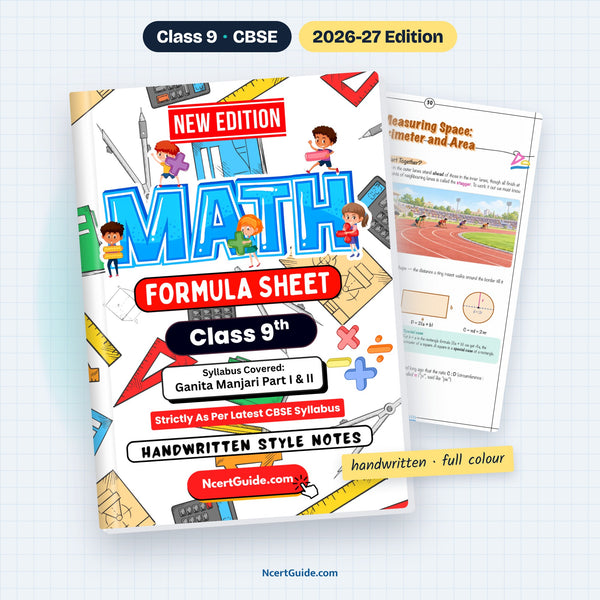
From the Class 9 Maths Formula Sheet, made as per the new NCERT book Ganita Manjari · Pages 54–57 of the book.
Key points
- An algorithm is a step-by-step procedure to solve a problem; each step must be written precisely.
- Algorithms are built from basic steps; steps may be repeated (loops) or conditional, and we must justify that the algorithm is correct.
- We also check how efficient (fast) an algorithm is.
- Column addition is much faster than counting dots: its work grows with the number of digits, not the size of the number.
- gcd(m, n) is the largest number that divides both m and n; it can be found by listing the divisors of both numbers.
- A list is an example of a data structure, a way to organise information so an algorithm works well.
- Euclid's subtraction algorithm uses gcd(m, n) = gcd(n, m − n), but it can be slow, e.g. gcd(99, 2) needs about 50 subtractions.
- Āryabhaṭa's division algorithm replaces repeated subtraction by division and uses the remainder; its steps grow only with the number of digits.
- In the Indian long-division layout, keep dividing the divisor by the remainder until the remainder is 0; the last divisor is the gcd.
- n is prime if divisors(n) has exactly two numbers, 1 and n.
- If gcd = 1, the two numbers are co-prime.
- The word 'algorithm' comes from the Latin name of Al-Khwārizmī, who wrote about the Indian place-value system.
Formulas
| Euclid's subtraction rule | gcd(m, n) = gcd(n, m − n) for m > n |
| Stopping rule | gcd(m, 0) = m |
| Āryabhaṭa's division rule | gcd(m, n) = gcd(n, m mod n) m mod n = remainder when m ÷ n |
| LCM from GCD | gcd(m, n) × lcm(m, n) = m × n e.g. lcm(60, 16) = 960 ÷ 4 = 240 |
| Handy GCD facts | gcd(m, n) = gcd(n, m); gcd(m, 1) = 1; gcd(m, m) = m if n divides m, gcd(m, n) = n |
Key terms
- Algorithm: A precise step-by-step procedure to solve a problem.
- Basic step: A step we assume we can already do, like adding two single digits.
- Repeated step (loop): The same step done again and again, e.g. for each j in 1, 2, …, n.
- Conditional step: A step done only if a condition holds.
- Executing / tracing: Running through the steps one by one.
- Data structure: A way to organise the values we keep track of, such as a list.
- Efficiency: How the work grows with the size of the input.
Diagrams to learn
- Column addition of 473 + 695 with carries
- Table: counting dots vs column addition
- Steps to improve the GCD algorithm
- Blocks diagram showing why gcd(m, n) = gcd(n, m − n)
- Trace table of Euclid's algorithm for gcd(375, 825)
- Flowchart of Āryabhaṭa's division algorithm
- Indian long-division layout for gcd(60, 16)
- Table comparing GCD algorithms
- Euclid's subtraction algorithm can still be slow: gcd(99, 2) takes about 50 subtractions, because the work grows with the value of the number.
- In long division for the gcd, divide the divisor by the remainder each time; the last divisor (when the remainder is 0) is the gcd.
- In column addition, align digits from the right and remember to add the carry.
A real page from the book

Get the full chapter in the book
This page is a summary. The Class 9 Maths Formula Sheet has the complete chapter in colour, with every diagram and worked example.
Frequently asked questions
What is an algorithm in Class 9 Maths?
An algorithm is a step-by-step procedure to solve a problem, with every step written precisely so anyone can follow it. Examples are column addition and long division.
What is Euclid's algorithm for GCD?
For m > n, gcd(m, n) = gcd(n, m − n), and gcd(m, 0) = m. You keep subtracting until one number becomes 0.
How do you find the GCD by Āryabhaṭa's division method?
Use gcd(m, n) = gcd(n, m mod n) until the remainder is 0. For example, 60 = 3 × 16 + 12, 16 = 1 × 12 + 4, 12 = 3 × 4 + 0, so gcd(60, 16) = 4.
← Part II · Chapter 10: How Quantities Combine: Understanding DataPart II · Chapter 12: Quadrilaterals →