New NCERT Ganita Manjari · Class 9 Maths · Part II · Chapter 13: Two Variables, One Line
This chapter is about linear equations in two variables, ax + by + c = 0, and their straight-line graphs. It explains solutions as ordered pairs, the slope of a line and the slope–intercept form. It then shows how to solve a pair of linear equations by substitution, elimination and graphs, and how to tell the nature of the solutions.
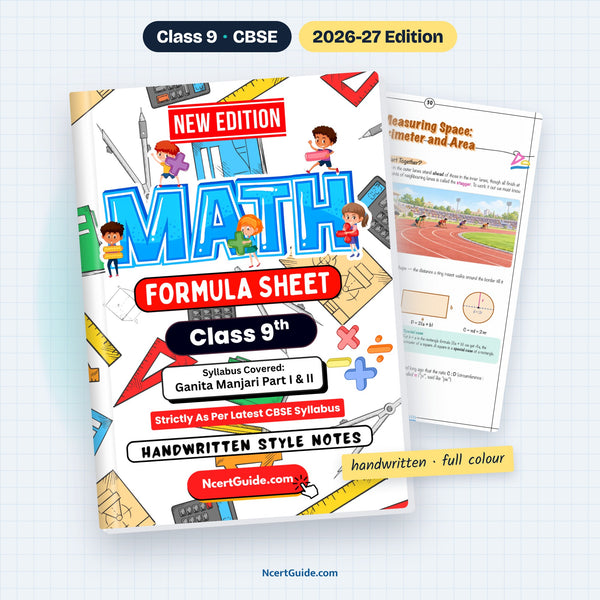
From the Class 9 Maths Formula Sheet, made as per the new NCERT book Ganita Manjari · Pages 63–67 of the book.
Key points
- A linear equation in two variables has the standard form ax + by + c = 0, where a and b are not both zero.
- Clear fractions first by multiplying the whole equation by a suitable number.
- x = k is a vertical line, y = k is a horizontal line, and ax + by = 0 passes through the origin.
- ax + by = c and kax + kby = kc (k ≠ 0) are the same line.
- A solution is an ordered pair (x, y) that satisfies the equation; a linear equation in two variables has infinitely many solutions.
- Every solution is a point on the line, and every point on the line is a solution.
- Intercept method: put x = 0 to find where the line cuts the y-axis and y = 0 to find where it cuts the x-axis.
- Slope measures the steepness of a line: positive (upward), negative (downward), zero (horizontal) or undefined (vertical).
- Lines with the same slope are parallel.
- A pair of linear equations can be solved by substitution, elimination or the graphical method.
- Two lines can intersect (unique solution), be parallel (no solution) or be coincident (infinitely many solutions).
- Mahāvīrācārya's trick: when the x and y coefficients are swapped, add and subtract the equations.
Formulas
| Standard form | ax + by + c = 0 a, b not both zero |
| Slope of a line | m = Rise/Run = (y₂ − y₁)/(x₂ − x₁) |
| Slope–intercept form | y = mx + d m = slope, d = y-intercept; cuts the y-axis at (0, d) |
| From standard form | m = −a/b, d = −c/b b ≠ 0 |
| x-intercept of y = mx + d | x = −d/m m ≠ 0 |
| Pair of linear equations | a₁x + b₁y + c₁ = 0 and a₂x + b₂y + c₂ = 0 |
| Unique solution (intersecting lines) | a₁/a₂ ≠ b₁/b₂ |
| No solution (parallel lines) | a₁/a₂ = b₁/b₂ ≠ c₁/c₂ |
| Infinitely many solutions (coincident lines) | a₁/a₂ = b₁/b₂ = c₁/c₂ |
| Two-digit number | number = 10x + y; reversed = 10y + x tens digit x, units digit y |
Diagrams to learn
- Table of equations in standard form with a, b, c
- Table of special lines
- Graph of 2x + y = 7 using the intercept method
- Rise and run on a line
- Four kinds of slope
- Word-problem toolkit table
- Graphs of intersecting, parallel and coincident lines
- Table: which method should I use
- Frame equations carefully: 'A notebook costs twice a pen' gives t = 2p, not p = 2t. Check with numbers.
- Order matters in a solution: (2, 3) satisfies 3x + 2y = 12 but (3, 2) does not.
- In elimination, if both variables vanish: 0 = 0 means infinitely many solutions; something false like 0 = 1 means no solution.
- Subtract the whole equation, both sides, in elimination; watch brackets and signs in substitution.
A real page from the book

Get the full chapter in the book
This page is a summary. The Class 9 Maths Formula Sheet has the complete chapter in colour, with every diagram and worked example.
Frequently asked questions
What is the standard form of a linear equation in two variables?
ax + by + c = 0, where a, b, c are real numbers and a and b are not both zero. For example, 5x + 2y = 2.7 becomes 5x + 2y − 2.7 = 0.
How do you find the slope of a line through two points?
Slope m = (y₂ − y₁)/(x₂ − x₁). For A(2, 0) and B(4, 3), m = 3/2.
How can you tell if a pair of linear equations has no solution?
If a₁/a₂ = b₁/b₂ ≠ c₁/c₂, the lines are parallel and there is no solution.
← Part II · Chapter 12: QuadrilateralsPart II · Chapter 14: Math of Space: Surface Area and Volume →