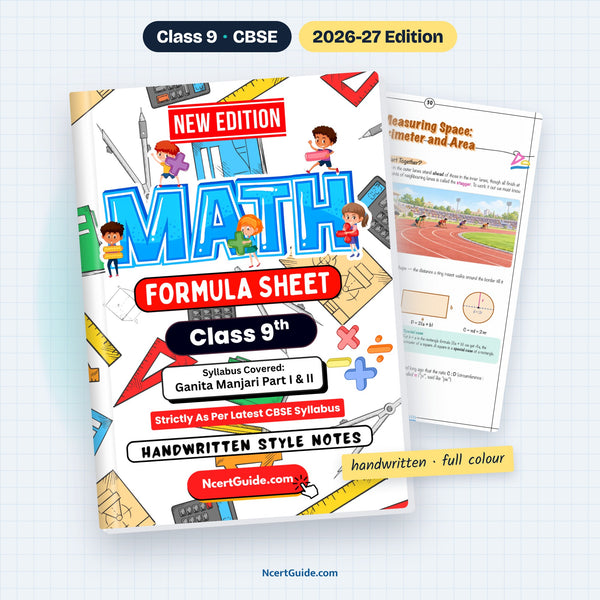
New NCERT Ganita Manjari · Class 9 Maths · Part II · Chapter 14: Math of Space: Surface Area and Volume
This chapter explains the difference between surface area and volume and gives the formulas for cuboids, cubes, cylinders, cones, pyramids, spheres and hemispheres. It shows where the formulas come from, how areas and volumes change when a solid is scaled, and how to make sensible guesstimates.
From the Class 9 Maths Formula Sheet, made as per the new NCERT book Ganita Manjari · Pages 68–72 of the book.
Key points
- Surface area is the total area of all the outer faces, in cm² or m²; volume is the amount of 3D space a solid occupies, in cm³ or m³.
- For prism-like solids (cuboid, cylinder), volume = area of base × height.
- For the same volume, a cube needs less wrapping material than a cuboid.
- Opening out the curved surface of a cylinder gives a rectangle of length 2πr and breadth h.
- A cross-section is the shape we get by taking a very thin slice of a solid.
- A right circular cone is formed by rotating a right triangle about one of its perpendicular sides.
- Exactly 3 cones of salt fill a cylinder with the same base radius and height, so the volume of a cone is ⅓ of the cylinder.
- For pointed solids (cone, pyramid), volume = ⅓ × base area × height.
- A sphere is the set of all points in space at a fixed distance r from a centre — the 3D version of a circle.
- Archimedes showed that a sphere's surface area equals the curved surface of the cylinder that fits tightly around it.
- If every length is multiplied by k, areas are multiplied by k² and volumes by k³.
- Guesstimates use sensible assumptions and approximations; different assumptions give different but reasonable answers.
Formulas
| Cuboid | TSA = 2(lw + wh + hl); V = l × w × h area of 4 walls = 2h(l + w) |
| Cube | TSA = 6a²; V = a³ lateral surface 4a² |
| Cylinder curved surface area | CSA = 2πrh circumference × height |
| Cylinder total surface area | 2πrh + 2πr² = 2πr(h + r) closed at one end: πr(2h + r) |
| Volume of a cylinder | V = πr²h |
| Slant height of a cone | l² = h² + r² Baudhāyana–Pythagoras |
| Cone surface area | CSA = πrl; TSA = πr(l + r) |
| Volume of a cone | V = ⅓πr²h |
| Volume of a pyramid | V = ⅓ × area of base × height |
| Sphere | Surface area = 4πr²; V = (4/3)πr³ V = ⅓ × surface area × r |
| Hemisphere | CSA = 2πr²; TSA = 3πr²; V = (2/3)πr³ |
| Scaling rule | lengths × k ⇒ areas × k², volumes × k³ 1 L = 1000 cm³, 1 m³ = 1000 L |
Diagrams to learn
- Cuboid with length, width and height
- Cube of edge a
- Right circular cylinder and its opened-out net
- Right circular cone and its curved surface opened into a sector
- Salt experiment: 3 cones fill a cylinder
- Pyramid with height
- Sphere inside a cylinder
- Hemisphere
- Master formula table for all solids
- Common mistakes table
- Do not use the diameter in place of the radius: r = d ÷ 2 before using any formula.
- Do not use height h in place of slant height l in πrl; find l = √(h² + r²) first.
- Area is in square units and volume in cubic units; convert everything to one unit (m or cm) first.
- For an open tank or tumbler, leave out the missing top: πr(2h + r) for a cylinder open at one end.
A real page from the book

Get the full chapter in the book
This page is a summary. The Class 9 Maths Formula Sheet has the complete chapter in colour, with every diagram and worked example.
Frequently asked questions
What is the formula for the volume of a cone?
Volume of a cone = ⅓πr²h. It is one-third of the volume of a cylinder with the same base radius and height.
What is the surface area and volume of a sphere?
Surface area of a sphere = 4πr² and volume = (4/3)πr³, where r is the radius.
What is the total surface area of a cylinder?
For a cylinder closed at both ends, TSA = 2πrh + 2πr² = 2πr(h + r). Its curved surface area is 2πrh.