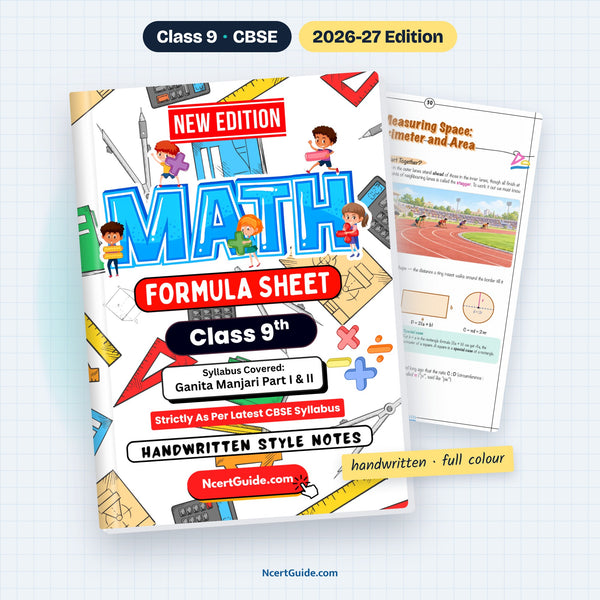
New NCERT Ganita Manjari · Class 9 Maths · Part I · Chapter 3: The World of Numbers
This chapter tells the story of numbers, from counting with pebbles to zero, integers, rational numbers and irrational numbers. It explains Brahmagupta's rules for zero and integers, why √2 is irrational, and how rationals and irrationals together make the real numbers. It also covers decimal expansions and how to change a repeating decimal into p/q form.
From the Class 9 Maths Formula Sheet, made as per the new NCERT book Ganita Manjari · Pages 12–17 of the book.
Key points
- Matching one object to another is called one-to-one correspondence; it gave us the natural numbers ℕ = {1, 2, 3, 4, …}.
- Brahmagupta defined zero as a number subtracted from itself: a − a = 0.
- Positive integers, zero and negative integers together form the integers ℤ = {…, −2, −1, 0, 1, 2, …}.
- A rational number is p/q, where p and q are integers and q ≠ 0; all integers are rational.
- ℕ is not closed under subtraction or division; ℤ is not closed under division; ℚ is closed under +, −, × and ÷ (divisor ≠ 0).
- Between any two rational numbers there is always another rational number, so there are infinitely many between them.
- A number that cannot be written as p/q is irrational, e.g. √2, √3, √5, √10, π.
- √2 is proved irrational by contradiction.
- √2, √3, √5 … can be constructed on the number line with ruler and compass (the square root spiral).
- Rational and irrational numbers together fill the number line with no gaps: the real numbers ℝ.
- A rational number has a terminating or a non-terminating repeating decimal; an irrational number has a non-terminating, non-repeating decimal.
- ℕ ⊂ ℤ ⊂ ℚ ⊂ ℝ and 𝕀 ⊂ ℝ.
Formulas
| Brahmagupta's rules for zero | a − a = 0, a + 0 = a, a − 0 = a, a × 0 = 0 |
| Signs in multiplication | (−) × (−) = (+), (−) × (+) = (−) |
| Rational number | p/q, where p, q are integers and q ≠ 0 |
| Equality of rationals | a/b = c/d exactly when ad = bc |
| Multiplying and dividing rationals | a/b × c/d = ac/bd; a/b ÷ c/d = ad/bc b, c, d ≠ 0 |
| Absolute value | |x| = x if x ≥ 0, |x| = −x if x < 0 |x| ≥ 0 always |
| Distance between a and b | |a − b| |
| Density of rationals | a < (a + b)/2 < b when a < b |
| Constructing square roots | √(n + 1) = √((√n)² + 1²) hypotenuse with sides √n and 1 |
| Terminating test | p/q (lowest terms) terminates exactly when q = 2ᵐ × 5ⁿ |
| Two-digit repeating decimal | 0.ab (bar over ab) = ab/99 e.g. 0.27 repeating = 27/99 = 3/11 |
| Mādhava's series for π | π = 4 × (1 − 1/3 + 1/5 − 1/7 + …) |
Diagrams to learn
- Integers on the number line (debts and fortunes)
- Table of Brahmagupta's laws for integers
- Rational numbers marked on the number line
- Closure table for ℕ, ℤ and ℚ
- Constructing √2 on the number line
- Square root spiral
- Real number line with rational and irrational points
- Decimal expansions table
- Family of numbers diagram (ℕ, ℤ, ℚ, 𝕀, ℝ)
- −7/4 = −1¾ lies between −2 and −1, not between −1 and 0. Left of 0, the larger absolute value is the smaller number.
- Irrationals are not closed: √2 + (−√2) = 0 and √2 × √2 = 2 are rational. But rational + irrational is always irrational.
- 22/7 is not equal to π. 22/7 = 3.142857… is only an approximation of π = 3.14159…
- For the terminating test, reduce p/q to lowest terms first: 6/15 = 2/5 = 0.4.
A real page from the book

Get the full chapter in the book
This page is a summary. The Class 9 Maths Formula Sheet has the complete chapter in colour, with every diagram and worked example.
Frequently asked questions
What is the difference between rational and irrational numbers?
A rational number can be written as p/q with integers p, q and q ≠ 0. An irrational number cannot be written this way, and its decimal is non-terminating and non-repeating, like √2 or π.
How do you know if p/q has a terminating decimal?
Write p/q in lowest terms. It terminates exactly when the denominator q is of the form 2ᵐ × 5ⁿ.
How do you convert 0.6 repeating into p/q form?
Let x = 0.666…, so 10x = 6.666…. Subtracting gives 9x = 6, so x = 2/3.
← Part I · Chapter 2: Introduction to Linear PolynomialsPart I · Chapter 4: Exploring Algebraic Identities →