New NCERT Ganita Manjari · Class 9 Maths · Part I · Chapter 4: Exploring Algebraic Identities
This chapter explains what an algebraic identity is and proves the main identities for squares and cubes using area and volume models. It shows how to use identities to factorise expressions, split the middle term, simplify rational expressions and do quick mental calculations.
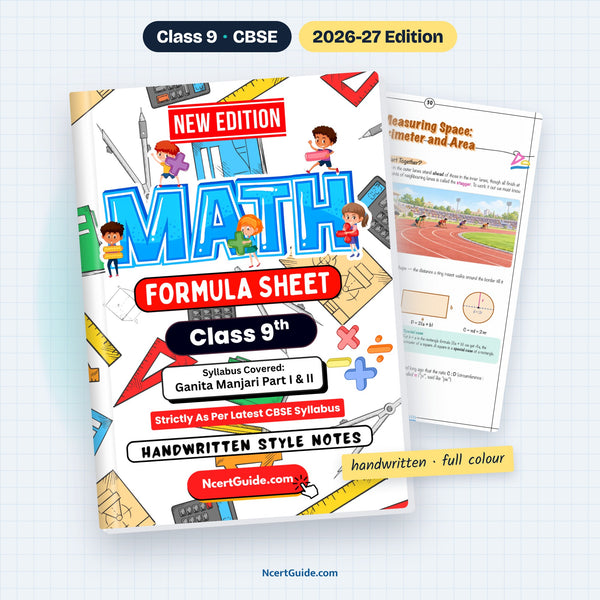
From the Class 9 Maths Formula Sheet, made as per the new NCERT book Ganita Manjari · Pages 18–23 of the book.
Key points
- An algebraic identity is true for all values of its variables; an ordinary equation need not be true for all values.
- (a + b)² can be shown as an area model: one a² square, one b² square and two ab rectangles.
- Reading an identity backwards helps factorise: a² + 2ab + b² = (a + b)².
- Take out a common factor first to avoid awkward square roots.
- Treat the sign as part of the term when using (a + b + c)².
- Algebra tiles arranged into a rectangle show (x + a)(x + b); the sides of the rectangle are the factors.
- To factorise x² + px + q, find two numbers with sum p and product q.
- Sign rule: if the constant is +, both numbers have the sign of the middle term; if the constant is −, they have opposite signs and the bigger one takes the sign of the middle term.
- A cube of edge a + b splits into 2 cubes (a³ and b³) and 6 cuboids.
- To simplify a rational expression, factorise the numerator and the denominator and cancel common factors.
- Identities make mental maths quick, e.g. 98² = (100 − 2)² = 9604 and 47 × 53 = 50² − 3² = 2491.
- Śrīdharācārya used a² = (a + b)(a − b) + b² to square numbers quickly.
Formulas
| Identity 1 | (a + b)² = a² + 2ab + b² |
| Identity 2 | (a − b)² = a² − 2ab + b² |
| Identity 3 | (a + b + c)² = a² + b² + c² + 2ab + 2bc + 2ca |
| Identity 4 | a² − b² = (a + b)(a − b) |
| Product of two binomials | (x + a)(x + b) = x² + (a + b)x + ab |
| General product | (ax + b)(cx + d) = acx² + (ad + bc)x + bd |
| Cube of a sum | (a + b)³ = a³ + 3a²b + 3ab² + b³ |
| Cube of a difference | (a − b)³ = a³ − 3a²b + 3ab² − b³ signs alternate +, −, +, − |
| Difference of two cubes | x³ − y³ = (x − y)(x² + xy + y²) |
| Sum of two cubes | x³ + y³ = (x + y)(x² − xy + y²) |
| Three-cubes identity | x³ + y³ + z³ − 3xyz = (x + y + z)(x² + y² + z² − xy − yz − zx) if x + y + z = 0, then x³ + y³ + z³ = 3xyz |
| Squaring numbers ending in 5 | a² = (a + b)(a − b) + b² e.g. 35² = 40 × 30 + 25 = 1225 |
Diagrams to learn
- Area model for (a + b)²
- Area model for (a − b)²
- Area model for (a + b + c)²
- Moving-the-strip diagram for a² − b² = (a + b)(a − b)
- Algebra tiles for (x + 3)(x + 4) and (2x + 3)(3x + 1)
- Cube of edge a + b split into cubes and cuboids
- Table: which identity to use
- Mental-maths tricks table
- (a + b)² ≠ a² + b². They differ by 2ab.
- Splitting 7x as 2x + 5x does not make a rectangle with 12 unit tiles; the split must use two numbers whose product is 12.
- Cancel factors, never terms: (x + 3)/(x + 5) ≠ 3/5, because x is a term, not a common factor.
- Careful with signs: treat the sign as part of the term, e.g. in (x − 2y + 3z)² take b = −2y.
A real page from the book

Get the full chapter in the book
This page is a summary. The Class 9 Maths Formula Sheet has the complete chapter in colour, with every diagram and worked example.
Frequently asked questions
What is an algebraic identity?
An algebraic identity is an equation that is true for all values of the variables in it, like (x + y)² = x² + 2xy + y². An ordinary equation such as x² − 1 = 24 is true only for some values.
How do you factorise x² + 7x + 12 by splitting the middle term?
Find two numbers whose sum is 7 and product is 12. These are 3 and 4, so x² + 7x + 12 = (x + 3)(x + 4).
What is the formula for x³ + y³ + z³ − 3xyz?
x³ + y³ + z³ − 3xyz = (x + y + z)(x² + y² + z² − xy − yz − zx). If x + y + z = 0, then x³ + y³ + z³ = 3xyz.
← Part I · Chapter 3: The World of NumbersPart I · Chapter 5: I'm Up and Down, and Round and Round →