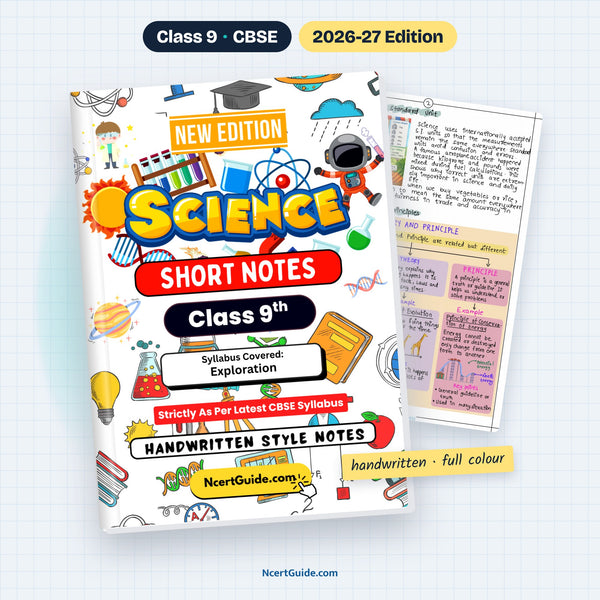
New NCERT Exploration · Class 9 Science · Chapter 1: Exploration: Entering the World of Secondary Science
This chapter explains what science really is and how secondary science is different from earlier classes. It shows how scientists use models, precise language, standard units, laws, theories and principles to understand the world. It also covers prediction, critical thinking, estimation and how all branches of science work together.
From the Class 9 Science Short Notes, made as per the new NCERT book Exploration · Pages 1–3 of the book.
Key points
- Science is not just facts and formulas; it is a way of understanding the world around us.
- In secondary science we learn not only what happens, but also how and why it happens.
- Scientists use models to simplify the very complicated natural world; a model keeps the important details and leaves out less important ones.
- In science, everyday words like force, work, reaction and cell have special meanings and are used carefully.
- Science uses symbols, units and mathematical expressions; equations show relationships between quantities and help us think clearly.
- SI units are accepted internationally, so measurements mean the same everywhere and errors are avoided.
- A law describes what happens, a theory explains why it happens, and a principle is a general truth or guideline.
- Using laws and theories, scientists can predict weather, motion, chemical reactions and other natural events from evidence, not guessing.
- Science encourages us to question claims and look for evidence, for example the belief that food becomes harmful during an eclipse.
- Estimation means making approximate calculations to check whether an answer is reasonable or impossible.
- Physics, chemistry, biology and earth science are linked; understanding face masks during COVID-19 needed all of them.
Key terms
- Model: A simplified picture of something in nature that keeps only the important details.
- SI units: Internationally accepted units that keep measurements the same everywhere.
- Law: A statement that describes what happens in nature, such as Newton's Law of Gravity.
- Theory: An explanation of why something happens, based on facts and laws and tested many times, such as the Theory of Evolution.
- Principle: A general truth or guideline that helps us understand or solve problems, such as the Principle of Conservation of Energy.
- Estimation: An approximate calculation used to check whether an answer is reasonable.
- Prediction: Telling in advance what will happen, using scientific laws, theories, evidence and measurements.
Diagrams to learn
- Cricket hitting a six as a model of force and motion
- Flowchart comparing Law, Theory and Principle with examples
- Human lungs and air volume estimation using balloons
- Weighing vegetables with standard weights
- Do not mix up law and theory: a law tells 'what' happens, a theory tells 'why' it happens.
- Always use correct units: a famous aeroplane accident happened because kilograms and pounds were mixed up during fuel calculations.
- Weather forecasts can sometimes be wrong because weather depends on many changing factors like temperature, pressure, humidity and wind.
A real page from the book

Get the full chapter in the book
This page is a summary. The Class 9 Science Short Notes has the complete chapter in colour, with every diagram and worked example.
Frequently asked questions
What is the difference between a law and a theory in science?
A law describes what happens in nature, like Newton's Law of Gravity. A theory explains why something happens and is based on facts, laws and many tests, like the Theory of Evolution.
Why does science use standard units?
Standard SI units make measurements mean the same everywhere. They avoid confusion and errors, ensure fairness in trade and keep scientific work accurate.
Why do scientists use models?
The natural world is very complicated, so scientists use models to simplify it. A model focuses only on important details and ignores less important ones, which makes problems easier to study.