New NCERT Exploration · Class 9 Science · Chapter 2: Cell: The Building Block of Life
This chapter studies the cell, the basic unit of life. It covers the cell membrane, osmosis and diffusion, the cell wall, and the organelles inside the cell and their jobs. It ends with cell division (mitosis and meiosis) and the cell theory.
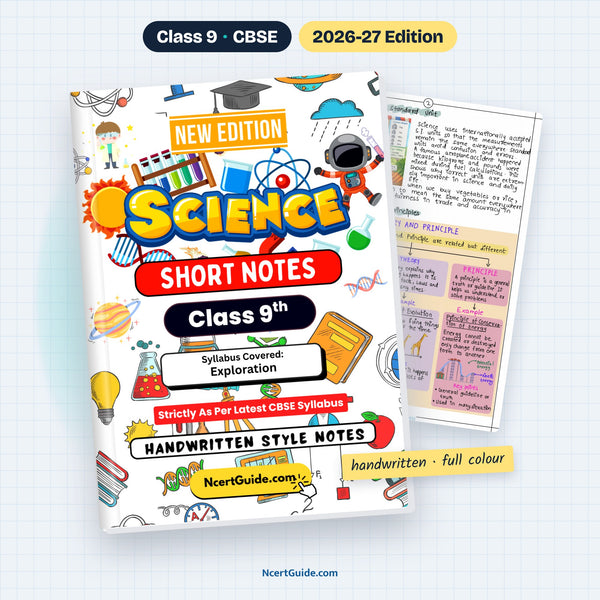
From the Class 9 Science Short Notes, made as per the new NCERT book Exploration · Pages 4–12 of the book.
Key points
- Cells are very small and usually need a microscope to be seen; Robert Hooke discovered cells in cork.
- The cell membrane (plasma membrane) is made of lipids and proteins in a fluid-mosaic pattern and is selectively permeable.
- Diffusion is movement of particles from higher to lower concentration; osmosis is movement of water through a selectively permeable membrane from dilute to concentrated solution.
- Plant, fungal and bacterial cells have a cell wall; in plants it is mainly cellulose and gives rigidity, support and shape. Animal cells have no cell wall.
- Prokaryotic cells (like bacteria) have no well-defined nucleus; eukaryotic cells (plant and animal) have a true nucleus and membrane-bound organelles.
- The nucleus controls all cell activities and contains chromosomes made of DNA and proteins; DNA carries hereditary information through genes.
- Ribosomes make proteins; rough ER has ribosomes and helps in protein synthesis, smooth ER helps make fats and hormones.
- The Golgi apparatus packages and transports proteins and lipids; lysosomes contain digestive enzymes and clean up the cell.
- Mitochondria release energy during cellular respiration and store it as ATP, the energy currency of the cell.
- Plastids are of three types: chloroplasts (photosynthesis), chromoplasts (colour) and leucoplasts (storage).
- Mitosis gives two identical daughter cells; meiosis gives four gametes with half the chromosome number.
- Cell theory: all living things are made of cells, the cell is the basic unit of life, and all cells come from pre-existing cells.
Key terms
- Selectively permeable: Allowing only selected substances to pass through, like the cell membrane.
- Osmosis: Movement of water through a selectively permeable membrane from a dilute to a concentrated solution.
- Diffusion: Movement of particles from a region of higher concentration to lower concentration.
- Cytoplasm: Jelly-like substance inside the cell that contains the organelles.
- Chromatin: Thread-like DNA and protein material in a non-dividing nucleus that condenses into chromosomes during cell division.
- Cristae: Folds of the inner membrane of mitochondria that increase surface area for energy production.
- Contact inhibition: Stopping of cell division when cells touch neighbouring cells; cancer cells lose this control.
- Meiosis: Cell division that makes four gametes with half the chromosome number and creates variation.
Diagrams to learn
- Structure of a cell membrane (lipid bilayer with proteins)
- Potato osmosis experiment in distilled water and salt solution
- Labelled plant cell and animal cell with comparison table
- Bacterial, plant and animal cell (prokaryotic vs eukaryotic)
- Structure of the nucleus, chromosome and DNA
- Rough and smooth endoplasmic reticulum with comparison table
- Golgi apparatus
- Structure of mitochondria and flowchart of energy production
- Three types of plastids
- Stages of mitosis in onion root tip cells
- Mitosis and meiosis diagrams
- Osmosis needs a selectively permeable membrane, but diffusion can happen without a membrane.
- Potato pieces swell in plain water (water enters) and shrink in salt solution (water moves out).
- Mitosis keeps the chromosome number the same; meiosis halves it.
- Rough ER has ribosomes; smooth ER does not.
A real page from the book

Get the full chapter in the book
This page is a summary. The Class 9 Science Short Notes has the complete chapter in colour, with every diagram and worked example.
Frequently asked questions
What is the difference between osmosis and diffusion?
Diffusion is the movement of particles from higher to lower concentration and can happen without a membrane. Osmosis is the movement of water through a selectively permeable membrane from a dilute to a concentrated solution.
Why are mitochondria called the powerhouse of the cell?
Mitochondria release energy during cellular respiration. This energy is stored in ATP molecules, which are called the energy currency of the cell.
What are the three points of cell theory?
All living organisms are made of one or more cells, the cell is the basic structural and functional unit of life, and all cells arise from pre-existing cells.
← Chapter 1: Exploration: Entering the World of Secondary ScienceChapter 3: Tissues in Action →