New NCERT Exploration · Class 9 Science · Chapter 3: Tissues in Action
This chapter explains how similar cells group together to form tissues, and how tissues form organs and organ systems. It covers plant tissues (meristematic and permanent) and animal tissues (epithelial, connective, muscular and nervous). It ends with the musculoskeletal system, types of joints and the human skeleton.
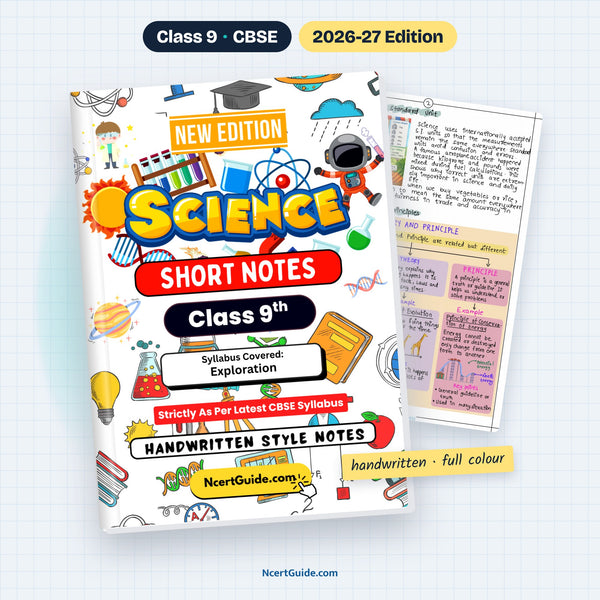
From the Class 9 Science Short Notes, made as per the new NCERT book Exploration · Pages 13–23 of the book.
Key points
- Levels of organisation: cells → tissues → organs → organ systems → organism.
- Plants mostly stay in one place and need support and protection; animals move and need tissues for movement, coordination and quick response.
- Meristematic tissues have actively dividing cells: apical meristem increases length, lateral meristem increases girth, intercalary meristem helps regrowth after cutting.
- Meristematic cells are small, thin-walled, with dense cytoplasm, a large nucleus and usually no vacuoles.
- Differentiation is when meristematic cells stop dividing and become specialised; this forms permanent tissues.
- Simple permanent tissues are parenchyma (stores food), collenchyma (flexibility) and sclerenchyma (hardness, dead cells with lignified walls).
- Xylem carries water and minerals from roots; phloem carries food from leaves to other parts. Both are complex permanent tissues.
- Animal tissues are of four types: epithelial, connective, muscular and nervous.
- Connective tissues include blood, bone, cartilage, tendon and ligament; tendons join muscle to bone and ligaments join bone to bone.
- Muscles are skeletal (voluntary, striated), smooth (involuntary, no striations) and cardiac (involuntary, striated, branched).
- A neuron has dendrites, a cell body and an axon; it receives, processes and transmits information.
- Joints include ball and socket, hinge, pivot and fixed joints; the rib cage has 12 pairs of ribs and the backbone has 33 vertebrae.
Key terms
- Tissue: A group of similar cells working together to perform a specific function.
- Meristematic tissue: Plant tissue with actively dividing cells that helps the plant grow.
- Differentiation: The process in which meristematic cells stop dividing and become specialised for a job.
- Epidermis: The outermost single layer of plant cells, often covered by a waxy cuticle, that protects the plant.
- Xylem: Conducting tissue that carries water and minerals from roots to the rest of the plant.
- Phloem: Conducting tissue that carries food from leaves to other parts of the plant.
- Tendon: Tough connective tissue of collagen fibres that attaches muscle to bone.
- Ligament: Tough, elastic connective tissue that connects bone to bone and stabilises joints.
- Neuron: A specialised nerve cell that receives, processes and transmits information.
Diagrams to learn
- Levels of organisation in living beings
- Onion root growth experiment
- Apical and lateral meristem (shoot and tree trunk)
- Leaf epidermis, stomata and root hairs
- Parenchyma, collenchyma and sclerenchyma cells
- Internal structure of a sunflower stem
- Xylem and phloem structure
- Types of epithelial tissue in the human body
- Connective tissue table: blood, bone, cartilage, tendon, ligament
- Comparison table of skeletal, smooth and cardiac muscle
- Labelled structure of a neuron
- Types of joints in the human body
- Human skeleton showing skull, rib cage and backbone
- Apical meristem increases the length of the plant, while lateral meristem increases its girth (thickness).
- Tendons connect muscle to bone, but ligaments connect bone to bone.
- Joints do not move bones by themselves; movement happens because muscles contract and pull on bones.
A real page from the book

Get the full chapter in the book
This page is a summary. The Class 9 Science Short Notes has the complete chapter in colour, with every diagram and worked example.
Frequently asked questions
What are the types of meristematic tissue?
There are three: apical meristem at root and shoot tips (increases length), lateral meristem on the sides of the stem (increases girth), and intercalary meristem at the base of internodes (helps grasses regrow after cutting).
What is the difference between xylem and phloem?
Xylem transports water and minerals from roots to the rest of the plant and also gives support. Phloem transports food from leaves to other parts of the plant.
What are the four types of animal tissues?
Animal tissues are epithelial, connective, muscular and nervous. They are adapted for functions like protection, connection, movement and control.
← Chapter 2: Cell: The Building Block of LifeChapter 4: Describing Motion Around Us →