New NCERT Exploration · Class 9 Science · Chapter 7: Work, Energy and Simple Machines
This chapter explains work done by a constant force and when work is zero, positive or negative. It covers energy, its forms, kinetic and potential energy, the conservation of mechanical energy and power. It ends with simple machines such as levers, pulleys and inclined planes.
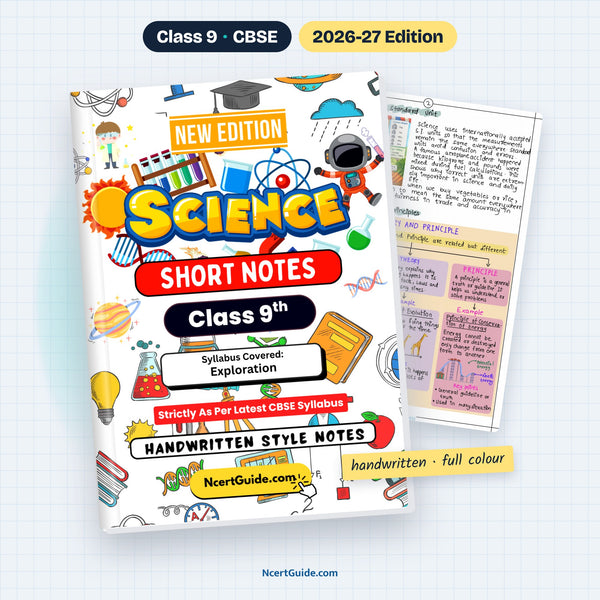
From the Class 9 Science Short Notes, made as per the new NCERT book Exploration · Pages 46–54 of the book.
Key points
- In physics, work is done only when a force makes an object move in the direction of the force.
- Work = force × displacement; the SI unit of work is joule (J).
- Work is zero when no force acts, when there is no displacement, or when the force is perpendicular to the displacement.
- Work is positive when force and displacement are in the same direction and negative when they are opposite.
- Energy is the capacity to do work; its SI unit is joule (J).
- Work-energy theorem: work done on an object equals the change in its kinetic energy.
- Energy has many forms (light, heat, electrical, sound, chemical, mechanical, nuclear) and can change form, but is never created or destroyed.
- Kinetic energy is energy due to motion; potential energy is energy due to position (gravitational) or shape (elastic).
- Mechanical energy (KE + PE) stays constant if no external force like friction acts; in free fall PE changes into KE.
- Power is the rate of doing work; its SI unit is watt (W), and 1 kW = 1000 W.
- Simple machines (lever, pulley, inclined plane, wheel and axle, screw, wedge) make work easier but do not reduce total work.
- Levers are of three classes depending on the positions of fulcrum, load and effort; no machine is 100% efficient.
Formulas
| Work done | W = F × s F in newton, s = displacement in direction of force in metre |
| One joule | 1 J = 1 N × 1 m |
| Work from force-displacement graph | Area of shaded rectangle = F × x = work done |
| Kinetic energy | KE = ½mv² m = mass, v = velocity |
| Potential energy | PE = mgh g = acceleration due to gravity, h = height above ground |
| Power | P = W ÷ t 1 kW = 1000 W; 1 MW = 1000 kW |
| Mechanical advantage | MA = Load ÷ Effort |
| Velocity ratio | VR = Distance moved by effort ÷ Distance moved by load |
| Efficiency | Efficiency = (Useful work output ÷ Work input) × 100 |
Key terms
- Work: Product of a constant force and the displacement in the direction of the force.
- Energy: The capacity to do work.
- Kinetic energy: Energy an object has because of its motion.
- Potential energy: Energy an object has because of its position or shape.
- Power: The rate at which work is done or energy is transferred.
- Simple machine: A device that makes work easier by changing the size or direction of the applied force.
- Fulcrum: The fixed point around which a lever rotates.
- Mechanical advantage: How many times a machine multiplies the applied force; load divided by effort.
Diagrams to learn
- Lifting bags to a height (work done)
- Force-displacement graph
- Positive work (pushing a wheelchair) and negative work (goalkeeper)
- Forms of energy chart
- Kinetic energy of slow bicycle vs fast car
- Potential energy of a flowerpot and a stretched rubber band
- Freely falling ball showing PE and KE at top, middle and bottom
- Lifting quickly vs slowly (power)
- Three classes of levers
- Fixed pulley at a well and inclined plane
- Energy can be converted from one form to another, but it can neither be created nor destroyed.
- A person carrying a box on a level road does zero work against gravity, because the supporting force is upward and the displacement is horizontal.
- No machine is 100% efficient because some energy is always lost as friction, heat or sound.
A real page from the book

Get the full chapter in the book
This page is a summary. The Class 9 Science Short Notes has the complete chapter in colour, with every diagram and worked example.
Frequently asked questions
When is work done equal to zero?
Work is zero when no force acts, when the object does not move (like pushing a rigid wall), or when the force is at 90° to the displacement.
What is the law of conservation of mechanical energy?
Mechanical energy is the sum of kinetic and potential energy. The total stays constant if no external force such as friction acts; for a falling object, potential energy changes into kinetic energy.
What is the SI unit of power?
The SI unit of power is the watt (W). One watt is the power of a machine that does 1 joule of work in 1 second.
← Chapter 6: How Forces Affect MotionChapter 8: Journey Inside the Atom →