New NCERT Exploration · Class 9 Science · Chapter 8: Journey Inside the Atom
This chapter traces how our idea of the atom developed, from Acharya Kanada's parmanu and Dalton's theory to the models of Thomson, Rutherford and Bohr. It explains electrons, protons and neutrons, atomic number, mass number and electronic configuration. It also covers valency, isotopes, average atomic mass and isobars.
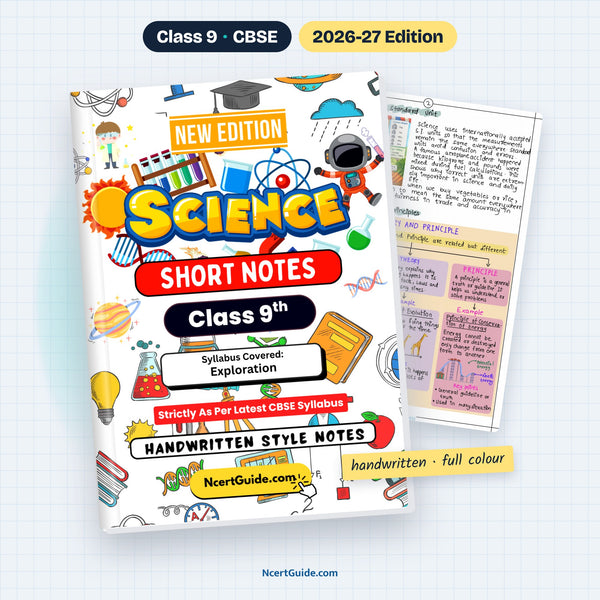
From the Class 9 Science Short Notes, made as per the new NCERT book Exploration · Pages 55–63 of the book.
Key points
- All matter is made of tiny particles called atoms; Acharya Kanada called the smallest particles parmanu.
- Leucippus and Democritus called them atoms, meaning indivisible; these early ideas were based on reasoning, not experiments.
- In 1808 John Dalton gave the first scientific atomic theory, saying atoms combine in simple whole-number ratios.
- In 1897 J.J. Thomson discovered the electron using a cathode ray discharge tube and proposed the plum pudding model.
- Rutherford's gold foil experiment showed that most of the atom is empty space with a tiny, dense, positive nucleus.
- Bohr's model (1913) says electrons move in fixed shells or energy levels and do not lose energy while revolving.
- James Chadwick discovered the neutron in 1932; neutrons have no charge and add to the mass of the atom.
- Atomic number (Z) is the number of protons; mass number (A) is protons plus neutrons.
- Shells are named K, L, M, N; a shell can hold at most 2n² electrons and the outermost shell at most 8.
- Valency is the combining capacity of an atom: atoms with 1–3 outer electrons usually lose them, with 5–7 usually gain electrons.
- Isotopes have the same atomic number but different mass numbers; isobars have the same mass number but different atomic numbers.
- Isotopes are used in radiocarbon dating (C-14), cancer therapy (Co-60) and nuclear reactors (U-235).
Formulas
| Atomic number | Z = Number of protons |
| Mass number | A = Protons + Neutrons |
| Number of neutrons | Neutrons = A − Z Example: sodium (A = 23, Z = 11) has 12 neutrons |
| Maximum electrons in a shell | 2n² n = shell number; K = 2, L = 8, M = 18, N = 32 |
Key terms
- Parmanu: Acharya Kanada's name for the smallest particle of matter that cannot be divided further.
- Electron: Negatively charged subatomic particle found outside the nucleus.
- Proton: Positively charged particle inside the nucleus; its number decides the identity of the element.
- Neutron: Particle with no charge inside the nucleus that adds to mass and helps stabilise the nucleus.
- Electronic configuration: The arrangement of electrons in different shells of an atom.
- Valency: The combining capacity of an atom: how many electrons it loses, gains or shares.
- Isotopes: Atoms of the same element with the same atomic number but different mass numbers.
- Isobars: Atoms of different elements with the same mass number but different atomic numbers, like calcium-40 and argon-40.
Diagrams to learn
- Atom as the building block of everything around us
- Thomson's plum pudding model
- Rutherford's gold foil experiment set-up
- Rutherford's nuclear model of the atom
- Bohr's atomic model with K, L, M shells
- Table of electron, proton and neutron
- Dalton's symbols of elements
- Table of maximum electrons in K, L, M, N shells
- Table of isotopes of hydrogen and carbon
- Applications of isotopes: carbon-14, cobalt-60, uranium-235
- Electrons decide the chemical behaviour of an element, protons decide its identity, and neutrons add to its mass.
- In a chemical symbol, the first letter is always a capital and the second letter, if any, is lowercase.
- Average atomic mass need not be a whole number: chlorine's is 35.5 u because it is a mix of chlorine-35 and chlorine-37.
A real page from the book

Get the full chapter in the book
This page is a summary. The Class 9 Science Short Notes has the complete chapter in colour, with every diagram and worked example.
Frequently asked questions
What did Rutherford's gold foil experiment show?
Most alpha particles passed straight through, a few were deflected slightly and very few bounced back. This showed that most of the atom is empty space and that its mass and positive charge are in a tiny central nucleus.
What is the difference between isotopes and isobars?
Isotopes are atoms of the same element with the same atomic number but different mass numbers, like hydrogen-1, 2 and 3. Isobars are atoms of different elements with the same mass number, like calcium-40 and argon-40.
How many electrons can a shell hold?
A shell can hold a maximum of 2n² electrons, where n is the shell number. So K holds 2, L holds 8, M holds 18 and N holds 32, but the outermost shell can have at most 8.
← Chapter 7: Work, Energy and Simple MachinesChapter 9: Atomic Foundations of Matter →