New NCERT Exploration · Class 9 Science · Chapter 9: Atomic Foundations of Matter
This chapter covers the basic laws of chemical combination: the law of conservation of mass and the law of constant proportions. It explains Dalton's atomic theory and its limits, and how atoms combine to form molecules through covalent and ionic bonds. It also shows how to write chemical formulae using the criss-cross method.
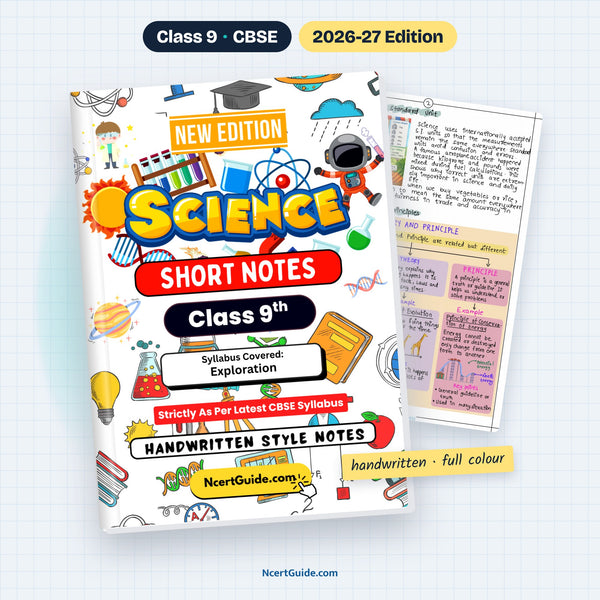
From the Class 9 Science Short Notes, made as per the new NCERT book Exploration · Pages 64–73 of the book.
Key points
- Law of Conservation of Mass (Lavoisier, 1789): mass is neither created nor destroyed in a chemical reaction.
- In an open container, mass seems to decrease only because a gas escapes into the air, not because mass is destroyed.
- Law of Constant Proportions (Proust): a pure compound always has the same elements in the same fixed ratio by mass, whatever its source.
- Water from rain, river or laboratory is always H₂O, with hydrogen and oxygen atoms in the ratio 2 : 1.
- Dalton's theory (1808) explained both laws but had limits: atoms have smaller particles, can be divided in nuclear reactions, and isotopes and isobars exist.
- Atoms combine to become stable by completing 2 electrons in the first shell or 8 in the outermost shell (octet rule).
- A molecule is the smallest particle of a substance that can exist independently; it may be of an element (H₂, O₂) or a compound (H₂O, NH₃).
- A covalent bond is formed by sharing electron pairs, usually between non-metals: single (H₂), double (O₂) or triple (N₂).
- An ionic bond is formed by complete transfer of electrons, usually from a metal to a non-metal, giving cations and anions.
- Sodium (2,8,1) loses one electron and chlorine (2,8,7) gains one to form NaCl, which has a 3-D crystal lattice.
- Polyatomic ions like ammonium, hydroxide, nitrate, carbonate, sulfate and phosphate carry a net charge.
- Ionic compounds are hard with high melting points and conduct electricity when molten or dissolved; covalent compounds usually have low melting points and do not conduct.
Formulas
| Law of conservation of mass | Total mass of reactants = Total mass of products |
| Precipitation example | Na₂SO₄(aq) + BaCl₂(aq) → BaSO₄(s)↓ + 2NaCl(aq) Mass stays 250.50 g before and after mixing |
| Formation of sodium ion | Na → Na⁺ + e⁻ |
| Formation of chloride ion | Cl + e⁻ → Cl⁻ |
| Criss-cross example | Mg²⁺ + Cl⁻ → MgCl₂ Subscript 1 is omitted |
Key terms
- Molecule: The smallest particle of a substance that can exist independently and keep all its chemical properties.
- Chemical bond: The attractive force that holds atoms together in a molecule or compound.
- Octet rule: Atoms combine to get 8 electrons in the outermost shell (or 2 in the first shell).
- Covalent bond: A bond formed when two atoms share one or more pairs of electrons.
- Ionic bond: A bond formed by complete transfer of electrons, holding oppositely charged ions together.
- Cation: A positively charged ion formed when an atom loses electrons, e.g. Na⁺, Mg²⁺.
- Anion: A negatively charged ion formed when an atom gains electrons, e.g. Cl⁻, O²⁻.
- Polyatomic ion: An ion made of two or more atoms joined together that carries a net charge, e.g. SO₄²⁻.
Diagrams to learn
- Conservation of mass with vinegar and baking soda in open and closed flasks
- Sodium sulfate and barium chloride mixing on a balance
- Water from rain, river and laboratory showing fixed H : O ratio
- Table comparing the two laws of chemical combination
- Formation of a stable molecule by sharing electrons
- Formation of H₂, Cl₂ and O₂ molecules (Lewis dot structures)
- Formation of sodium chloride by electron transfer
- Ionic crystal lattice of NaCl
- Tables of naming compounds and common polyatomic ions
- Criss-cross method for MgCl₂
- Criss-cross steps: write ion symbols with charges, exchange the numbers, write them as subscripts, and reduce to the simplest ratio.
- Solid ionic compounds do not conduct electricity because their ions are fixed; they conduct only when molten or dissolved in water.
- Conservation of mass is about total mass staying the same (Lavoisier); constant proportions is about fixed ratio by mass (Proust).
A real page from the book

Get the full chapter in the book
This page is a summary. The Class 9 Science Short Notes has the complete chapter in colour, with every diagram and worked example.
Frequently asked questions
What is the law of constant proportions?
Proposed by Joseph Proust, it says a pure chemical compound always contains the same elements combined in the same fixed proportion by mass, whatever its source or method of preparation.
What is the difference between a covalent bond and an ionic bond?
A covalent bond forms when atoms share pairs of electrons, usually between non-metals. An ionic bond forms when electrons are completely transferred, usually from a metal to a non-metal, creating oppositely charged ions.
How do you write a chemical formula by the criss-cross method?
Write the ion symbols with their charges, exchange the numerical values of the charges, write them as subscripts and reduce to the simplest ratio. For Mg²⁺ and Cl⁻ this gives MgCl₂.
← Chapter 8: Journey Inside the AtomChapter 10: Sound Waves: Characteristics and Applications →