New NCERT Understanding Society: India and Beyond · Class 9 Social Science · Part 1 · Chapter 8: Building Blocks in Economics: The Problem of Choice
This chapter explains the basic problem of economics: wants are unlimited but resources are limited, so we must choose. It covers opportunity cost, the production possibility curve, the three key questions of economics and different economic systems.
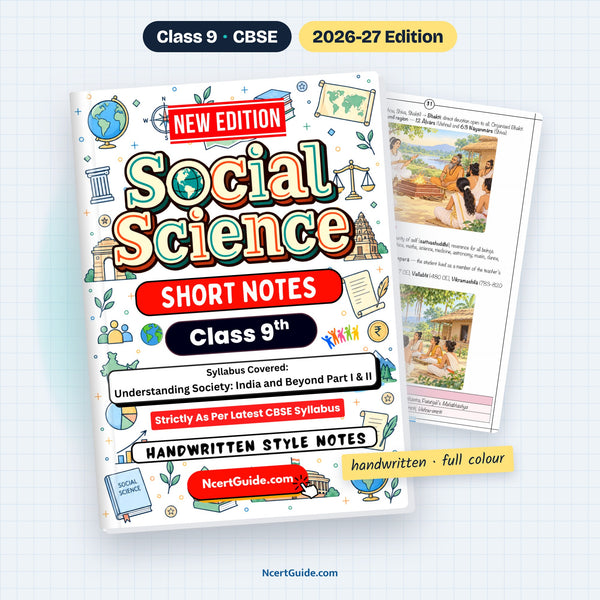
From the Class 9 Social Science Short Notes, made as per the new NCERT book Understanding Society: India and Beyond · Pages 45–49 of the book.
Key points
- Needs are essentials like food, water and shelter; wants are unlimited and keep changing.
- Resources (land, labour, capital, technology) are limited and have alternative uses, so we must choose.
- Opportunity cost is the value of the next best alternative given up when a choice is made.
- The production possibility curve (PPC) shows different combinations of two goods that can be made with all available resources.
- The PPC slopes downward; points on the curve show efficient use, points inside show wasted resources.
- 'Economics' comes from the Greek oikonomia, meaning household management.
- The three key questions are: what to produce, how to produce and for whom to produce.
- Production can be labour-intensive (more workers) or capital-intensive (more machines).
- Planned, market and mixed economies differ in who decides and who owns resources.
- India moved towards a more market-oriented economy after the 1991 reforms; almost all economies are mixed.
- The Economic Survey of India is presented in Parliament before the Union Budget.
Key terms
- Scarcity: Resources are limited compared to unlimited wants.
- Opportunity cost: The value of the next best alternative given up.
- Factors of production: Land, labour, capital and technology used to produce goods.
- PPC: A curve showing combinations of two goods possible with all available resources.
- Market: A place, physical or online, where goods and services are bought and sold.
- Economic system: The way a country decides how the three questions are answered and who controls resources.
- Public goods: Goods available to all, whose use by one does not stop others — like parks and street lights.
Diagrams to learn
- Production possibility curve with table
- Three key questions of economics chart
- Table: planned vs market vs mixed economy
- Table: labour-intensive vs capital-intensive
- Wants are unlimited and resources are limited — this is why choice is needed.
- On the PPC, each extra 25 kg of barley costs more wheat (10 → 20 → 30 → 40 kg) — the sacrifice grows.
- Examples: planned — Cuba, North Korea; market — USA, Japan; mixed — India (post-1991), China (post-1978).
A real page from the book

Get the full chapter in the book
This page is a summary. The Class 9 Social Science Short Notes has the complete chapter in colour, with every diagram and worked example.
Frequently asked questions
What is opportunity cost?
Opportunity cost is the value of the next best alternative given up when a choice is made. For example, spending ₹100 on a notebook means giving up saving it for a tennis racket.
What is a production possibility curve?
A PPC shows the different combinations of two goods that can be produced using all available resources. It slopes downward because producing more of one good means giving up some of the other.
What are the three central questions of economics?
What to produce, how to produce and for whom to produce. They arise because resources are limited and wants are unlimited.
← Part 1 · Chapter 7: ElectionsPart 1 · Chapter 9: The Price Puzzle: What Drives the Market →