New NCERT Curiosity · Class 8 Science · Term II · Chapter 11: Keeping Time with the Skies
This chapter explains why the Moon seems to change shape and how regular sky cycles — day, month and year — gave us calendars. It compares lunar, solar and luni-solar calendars, links festivals to the Moon and Sun, and introduces artificial satellites.
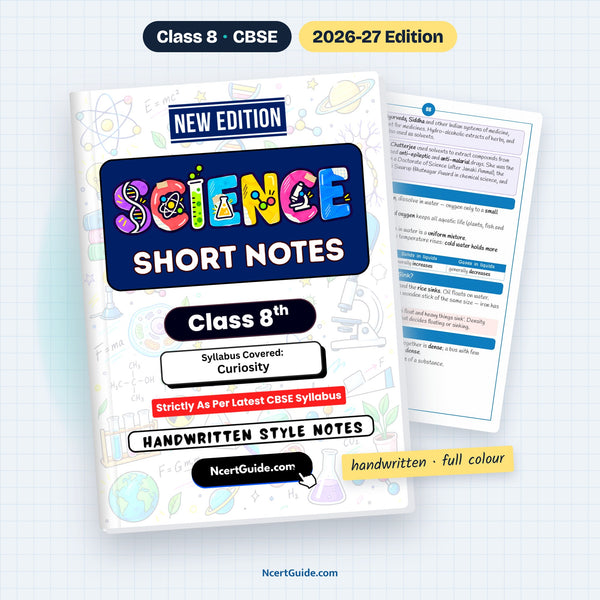
From the Class 8 Science Short Notes, made as per the new NCERT book Curiosity · Pages 66–72 of the book.
Key points
- Phases of the Moon are the changing shapes of its bright part as seen from Earth.
- Full Moon is Purnima and new Moon is Amavasya; waxing is Shukla Paksha and waning is Krishna Paksha.
- One cycle of phases, from one full Moon to the next, takes about a month (about 29.5 days).
- The Moon reflects sunlight; its shape never changes, only the part of its lit side that we see.
- The Moon rises about 50 minutes later each day and can be seen in daylight.
- A day comes from Earth's rotation, a month from the Moon's revolution, and a year from Earth's revolution around the Sun.
- A lunar year of 12 lunar months is 354 days, so seasons drift in a lunar calendar.
- The Gregorian solar calendar has 365 days, with a leap day added to February every 4 years.
- Luni-solar calendars add an extra month, Adhika Maasa, every few years to stay in step with the seasons.
- The Indian National Calendar is a 365-day solar calendar starting on 22 March.
- Artificial satellites orbit the Earth for communication, navigation, weather monitoring and research.
Formulas
| Mean solar day | 1 mean solar day = 24 hours |
| Lunar year | 12 lunar months = 354 days |
| Gap between solar and lunar year | 365 − 354 = 11 days This gap adds up to nearly a month in 2–3 years. |
| Leap year | ¼ day × 4 years ≈ 1 day February gets 29 days in a leap year. |
Key terms
- Phases of the Moon: The changing shapes of the bright portion of the Moon, as seen from the Earth.
- Waxing (Shukla Paksha): The period when the bright part of the Moon increases.
- Waning (Krishna Paksha): The period when the bright part of the Moon decreases.
- Gibbous and crescent: Gibbous: more than half of the lit portion is seen; crescent: less than half is seen.
- Mean solar day: The average time the Sun takes to go from its highest position one day to the next — 24 hours.
- Tropical year: The time between two successive spring equinoxes.
- Adhika Maasa: An extra (intercalary) month added every few years in luni-solar calendars.
Diagrams to learn
- The Moon at eight positions in its orbit and the phases seen from Earth (Fig 11.1)
- Sunrise point shifts along the eastern horizon (Fig 11.2)
- Table of natural cycles and units of time
- Table comparing lunar, solar and luni-solar calendars
- The Moon does not always rise when the Sun sets, and it is not seen only at night.
- Phases are not caused by Earth's shadow; Earth's shadow on the Moon causes a lunar eclipse.
- A lunar eclipse happens only on a full Moon day and a solar eclipse only on a new Moon day.
- Century years like 1900 are not leap years, but every 400th year like 2000 is.
A real page from the book

Get the full chapter in the book
This page is a summary. The Class 8 Science Short Notes has the complete chapter in colour, with every diagram and worked example.
Frequently asked questions
Why do we see different phases of the Moon?
The Moon reflects sunlight and only its Sun-facing half is lit. As it revolves around Earth, we see different amounts of this lit half, so its shape seems to change.
What is the difference between a lunar and a solar calendar?
A lunar calendar follows the Moon's phases and has a 354-day year, so seasons drift. A solar calendar follows the cycle of seasons and has 365 days, with a leap day every 4 years.
Why do festivals like Diwali fall on different dates each year?
They follow the Moon's phases using lunar or luni-solar calendars, so their Gregorian dates change. Luni-solar festivals shift by less than a month because Adhika Maasa corrects the gap.
← Term II · Chapter 10: Light: Mirrors and LensesTerm II · Chapter 12: How Nature Works in Harmony →