New NCERT Curiosity · Class 8 Science · Term II · Chapter 12: How Nature Works in Harmony
This chapter shows how living and non-living parts of nature are closely connected. It explains habitats, populations, communities and ecosystems, food chains and food webs, the role of decomposers, and how human actions can upset the balance of nature.
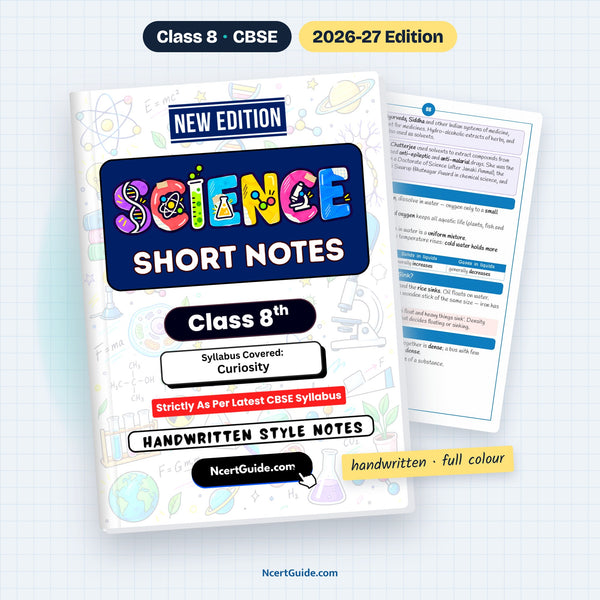
From the Class 8 Science Short Notes, made as per the new NCERT book Curiosity · Pages 73–80 of the book.
Key points
- A habitat is where an organism lives; it can be as big as a forest or as small as tree bark.
- Biotic components are living things; abiotic components are non-living things like air, water, sunlight and soil.
- A population is a group of the same kind of organism; a community is all the populations sharing a habitat.
- An ecosystem is the biotic and abiotic components of an area interacting with each other.
- Levels of organisation: individual → population → community → ecosystem.
- Producers (green plants) make their own food; consumers depend on others and can be herbivores, carnivores or omnivores.
- A food chain shows who eats whom; the arrow means 'is eaten by'. Many linked food chains form a food web.
- Decomposers like fungi and bacteria break down dead matter and return nutrients to the soil.
- One change leads to another — e.g. falling frog numbers led to more insect pests and more pesticide use.
- Mutualism, commensalism, parasitism and competition help keep ecosystems balanced.
- The Sundarbans, the largest mangrove forests, protect against storms but face many threats.
- Overuse of fertilisers and pesticides harms soil; organic and natural farming are more sustainable.
Key terms
- Habitat: The place where an organism lives.
- Population: A group of organisms of the same kind living in a habitat at a given time.
- Community: All the different populations sharing the same habitat.
- Ecosystem: The biotic and abiotic components of an area interacting with each other.
- Producers (autotrophs): Organisms that make their own food by photosynthesis — green plants.
- Consumers (heterotrophs): Organisms that cannot make food and depend on other organisms.
- Food chain: A simple, linear sequence showing who eats whom in an ecosystem.
- Trophic level: The position of an organism in a food chain.
- Decomposers (saprotrophs): Organisms like fungi and bacteria that break down dead matter and wastes.
Diagrams to learn
- How fish in a pond help nearby plants make seeds (Fig 12.1)
- Food chain of a crop field drawn as a pyramid (Fig 12.2)
- A grassland food web (Fig 12.3)
- Table of biotic and abiotic interactions in a pond
- Table of mutualism, commensalism and parasitism
- A food chain is one path of food; a food web shows all the paths joined together.
- In a food chain the arrow points from the food to the eater.
- In nature nothing is wasted — decomposition reuses everything.
- Ecological balance is dynamic, not fixed, and can be upset by natural or human-made changes.
A real page from the book

Get the full chapter in the book
This page is a summary. The Class 8 Science Short Notes has the complete chapter in colour, with every diagram and worked example.
Frequently asked questions
What is the difference between a food chain and a food web?
A food chain is a simple, linear sequence showing who eats whom. A food web is many food chains linked into a network, because each organism may eat or be eaten by two or more kinds of organisms.
What are biotic and abiotic components?
Biotic components are the living beings of a habitat — plants, animals and microorganisms. Abiotic components are the non-living things — air, sunlight, water, temperature and soil.
What is the role of decomposers in an ecosystem?
Decomposers like fungi and bacteria break down dead plants, animals and wastes into simpler substances. This returns nutrients to the soil for plants to use.
← Term II · Chapter 11: Keeping Time with the SkiesTerm II · Chapter 13: Our Home: Earth, a Unique Life-Sustaining Planet →