New NCERT Curiosity · Class 8 Science · Term II · Chapter 13: Our Home: Earth, a Unique Life-Sustaining Planet
This chapter explains why Earth is the only planet known to support life — its position, size, atmosphere and magnetic field. It also covers how Earth's systems sustain life, how reproduction keeps life going, and the threats that endanger life today.
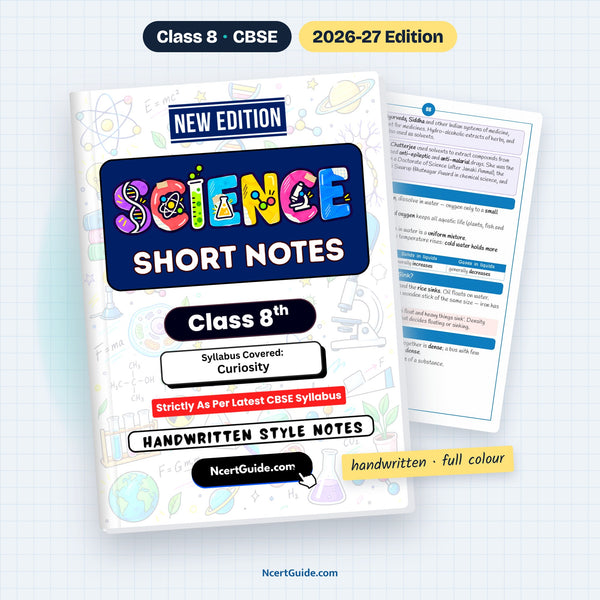
From the Class 8 Science Short Notes, made as per the new NCERT book Curiosity · Pages 81–88 of the book.
Key points
- Life exists on a very thin layer called the crust; below it lie the mantle and the core.
- Eight planets orbit the Sun; the inner four are small and rocky, the outer four are large and mostly gas.
- Venus is the hottest planet because its thick carbon dioxide atmosphere traps heat.
- A mild greenhouse effect keeps Earth warm enough for water to stay liquid.
- Earth lies in the habitable (Goldilocks) zone, where water remains liquid.
- Earth is the right size — its gravity holds an atmosphere but is not strong enough to crush us.
- The ozone layer blocks harmful UV rays; Earth's magnetic field shields us from cosmic rays and solar wind.
- Atmosphere, hydrosphere, geosphere and biosphere are linked and support life together.
- Reproduction ensures the continuity of life; genes pass instructions from parents to young ones.
- Asexual reproduction needs one parent and gives exact copies; sexual reproduction needs two parents and gives variation.
- The triple planetary crisis is climate change, biodiversity loss and pollution.
Key terms
- Greenhouse effect: Trapping of heat by gases like carbon dioxide in a planet's atmosphere.
- Habitable zone (Goldilocks zone): The range of distances from a star over which water remains liquid.
- Hydrosphere: All the water on Earth; it covers about 70% of Earth's surface.
- Geosphere: The solid parts of Earth — rocks, soil and minerals of the crust.
- Biosphere: All living beings together with the places they live.
- Vegetative propagation: Growing a new plant from a part of a plant — leaf, stem or root.
- Gametes: Special reproductive cells carrying half the parent's genetic material.
- Triple planetary crisis: Climate change, biodiversity loss and pollution taken together.
Diagrams to learn
- Greenhouse effect on Earth (Fig 13.1)
- The habitable zone around a star (Fig 13.2)
- Table comparing planets (temperature, radius, atmosphere)
- Why Earth can support life — summary box
- Table comparing asexual and sexual reproduction
- A plant greenhouse keeps warm air in because it is closed; the atmosphere's greenhouse effect works by gases absorbing radiation from Earth.
- Venus is hotter than Mercury even though Mercury is closer to the Sun.
- Gametes carry only half the genetic material, so instructions do not double every generation.
A real page from the book

Get the full chapter in the book
This page is a summary. The Class 8 Science Short Notes has the complete chapter in colour, with every diagram and worked example.
Frequently asked questions
Why is Earth the only planet known to support life?
Earth is at the right distance from the Sun for liquid water, is the right size to hold an atmosphere, has an ozone layer that blocks UV rays, and has a magnetic field that shields it from harmful particles.
What is the habitable zone?
It is the range of distances from the Sun (or any star) over which water remains liquid. It is also called the Goldilocks zone.
What is the difference between asexual and sexual reproduction?
Asexual reproduction needs one parent and gives offspring that are exact copies. Sexual reproduction needs two parents; their instructions mix, so offspring show variation.