New NCERT Curiosity · Class 8 Science · Term I · Chapter 5: Exploring Forces
This chapter explains a force as a push or a pull that comes from an interaction between two objects. It covers what forces can do, the main types of contact and non-contact forces, weight and how to measure it, and why some objects float while others sink.
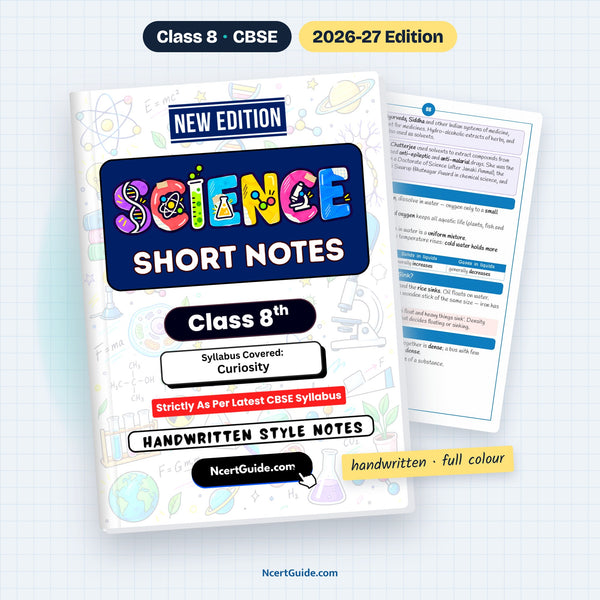
From the Class 8 Science Short Notes, made as per the new NCERT book Curiosity · Pages 26–32 of the book.
Key points
- A force is a push or a pull on an object. Its SI unit is the newton (N).
- A force can move an object from rest, change its speed, change its direction or change its shape.
- At least two objects must interact for a force to act; when the interaction stops, the force disappears.
- Contact forces act only when objects touch — muscular force and friction.
- Friction always acts opposite to motion; it is greater on rough surfaces. Air and water also exert friction.
- Non-contact forces act from a distance — magnetic, electrostatic and gravitational forces.
- Like magnetic poles and like charges repel; unlike poles and unlike charges attract.
- Gravity is the Earth's pull on objects; it is always attractive and acts even at the top of a ball's path.
- Weight is the force with which the Earth pulls an object, measured in newtons with a spring balance.
- Mass stays the same everywhere; weight changes from place to place — on the Moon it is about one-sixth of that on Earth.
- A liquid pushes objects upward with a buoyant force. An object sinks if gravity is more than upthrust and floats if they are equal.
Formulas
| SI unit of force | Unit of force = newton (N) Weight is also a force, so it is measured in newton. |
| Least count of a spring balance (example) | 1 N ÷ 5 small divisions = 0.2 N From the book's spring balance with range 0 to 10 N. |
| Weight of 1 kg mass on Earth and Moon | Earth: 10 N; Moon: 1.6 N Mass stays 1 kg; only weight changes. |
Key terms
- Force: A push or pull on an object resulting from its interaction with another object.
- Muscular force: The force produced by the action of our muscles.
- Friction: The force that acts when an object moves, or tries to move, over another surface; it opposes motion.
- Magnetic force: The force exerted by a magnet on another magnet or on a magnetic material.
- Electrostatic force: The force exerted by a charged body on another charged or uncharged body.
- Gravitational force: The force with which the Earth attracts objects towards itself; also called gravity.
- Weight: The force with which the Earth pulls an object towards itself; measured in newton.
- Upthrust / buoyant force: The upward force applied by a liquid on an object placed in it.
Diagrams to learn
- Types of forces (Fig 5.1)
- Friction opposes motion (Fig 5.2)
- A spring balance (Fig 5.3)
- Sinking and floating (Fig 5.4)
- Table of mass vs weight
- Table of weight of 1 kg on Earth, Moon, Mars, Venus and Jupiter
- An object at rest does not mean no force acts on it — the forces on it are balanced.
- Gravitational force is always attractive; magnetic and electrostatic forces can attract or repel.
- In science, '10 kg' is mass; weight is measured in newton.
- Never hang an object heavier than the maximum reading of a spring balance — check its range and least count first.
A real page from the book

Get the full chapter in the book
This page is a summary. The Class 8 Science Short Notes has the complete chapter in colour, with every diagram and worked example.
Frequently asked questions
What is the difference between contact and non-contact forces?
Contact forces act only when objects touch, directly or through a stick or rope — like muscular force and friction. Non-contact forces act from a distance — like magnetic, electrostatic and gravitational forces.
What is the difference between mass and weight?
Mass is the amount of matter in an object, measured in g or kg, and it is the same everywhere. Weight is the force with which the Earth (or another planet) pulls the object, measured in newton, and it changes from place to place.
Why does a coin sink but a wooden block float?
The coin's weight is more than the upthrust on it, so it sinks. For the wooden block, the upthrust becomes equal to its weight, so it floats. Floating depends on this balance, not on size.
← Term I · Chapter 4: Electricity: Magnetic and Heating EffectsTerm I · Chapter 6: Pressure, Winds, Storms and Cyclones →