New NCERT Curiosity · Class 8 Science · Term I · Chapter 6: Pressure, Winds, Storms and Cyclones
This chapter defines pressure as force per unit area and shows how liquids and air exert pressure in all directions. It then links differences in air pressure to winds, thunderstorms, lightning and cyclones, and explains how to stay safe.
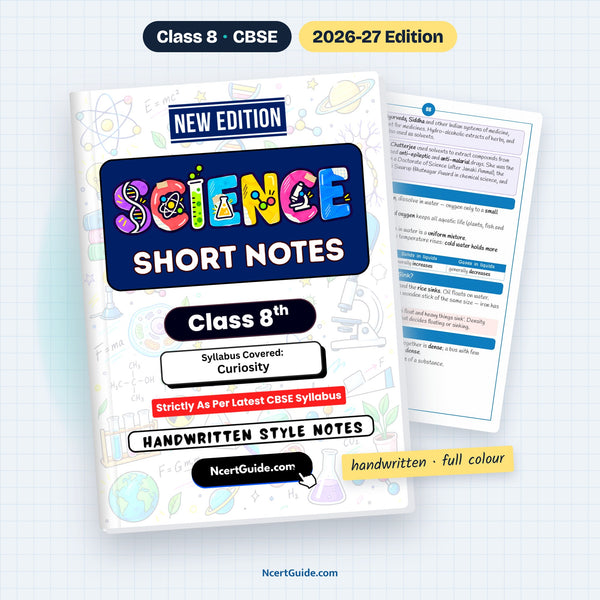
From the Class 8 Science Short Notes, made as per the new NCERT book Curiosity · Pages 33–39 of the book.
Key points
- Pressure is the force acting per unit area; its SI unit is the pascal (Pa).
- A smaller area gives more pressure — that is why nails and knives have sharp ends, and bag straps are broad for comfort.
- Liquid pressure increases with the height of the liquid column and acts in all directions.
- The atmosphere presses on everything around us; we are not crushed because the pressure inside our body balances it.
- Air moves from high pressure to low pressure; a greater pressure difference makes faster wind.
- By day, land heats faster, so a sea breeze blows from sea to land; at night a land breeze blows from land to sea.
- High-speed wind lowers air pressure — this can lift a weak roof during a storm.
- A storm forms when warm, moist air rises, cools and forms clouds; cooler air rushes in to take its place.
- Rubbing of ice particles and water droplets in a cloud separates charges; lightning is a sudden flow of these charges.
- A cyclone is a spinning storm around a very low-pressure eye, formed over warm ocean water.
- Cyclones cause storm surges, floods and landslides; follow IMD warnings and move to cyclone shelters.
Formulas
| Pressure | Pressure = Force ÷ Area Only the force acting perpendicular to the surface is taken. |
| Unit of pressure | 1 Pa = 1 N/m² Pascal is the SI unit. |
| Practical units of air pressure | 1 millibar (mb) = 100 Pa; 1 hectopascal (hPa) = 100 Pa |
| Worked example | 100 N ÷ 2 m² = 50 Pa |
Key terms
- Pressure: The force acting per unit area.
- Atmosphere: The envelope of air around the Earth, many kilometres high.
- Atmospheric pressure: The pressure exerted by the air around us, on all objects and in all directions.
- Storm: Strong winds accompanied by rain.
- Lightning: A bright flash produced by a sudden flow of charges when the insulating property of air breaks down.
- Thunder: The loud sound made when lightning rapidly heats and expands the air around it.
- Lightning conductor: A metal rod on a building that gives charges an easy path into the ground.
- Cyclone: A large storm over warm ocean water — a spinning system of clouds, winds and rain around a very low-pressure area.
Diagrams to learn
- Sea breeze (day) and land breeze (night) (Fig 6.1)
- Charge separation and lightning (Fig 6.2)
- A cyclone seen from above (Fig 6.3)
- Table of local thunderstorms of India
- Table comparing thunderstorm and cyclone
- Liquids press in all directions, not only on the bottom of a container.
- In a strong storm, closing all doors and windows is not safer for a weak roof — keep them open.
- Lying flat on the ground during lightning is unsafe — crouch instead.
- The weather at the eye of a cyclone is calm, not stormy.
A real page from the book

Get the full chapter in the book
This page is a summary. The Class 8 Science Short Notes has the complete chapter in colour, with every diagram and worked example.
Frequently asked questions
What is the formula for pressure and its SI unit?
Pressure = Force ÷ Area. Its SI unit is N/m², which is called the pascal (Pa).
Why does a sea breeze blow during the day?
During the day, land heats faster than water. Warm, light air over land rises and makes low pressure there, so air blows from the sea to the land.
What should we do to stay safe during lightning?
Stay away from tall objects, find a low-lying open area and crouch down, touching the ground as little as possible. Do not lie flat, do not use an umbrella with a metal rod and get out of water.
← Term I · Chapter 5: Exploring ForcesTerm I · Chapter 7: Particulate Nature of Matter →