New NCERT Curiosity · Class 8 Science · Term I · Chapter 7: Particulate Nature of Matter
This chapter shows that all matter is made of a very large number of extremely small particles. It explains how the spacing, attraction and movement of these particles decide whether a substance is a solid, a liquid or a gas.
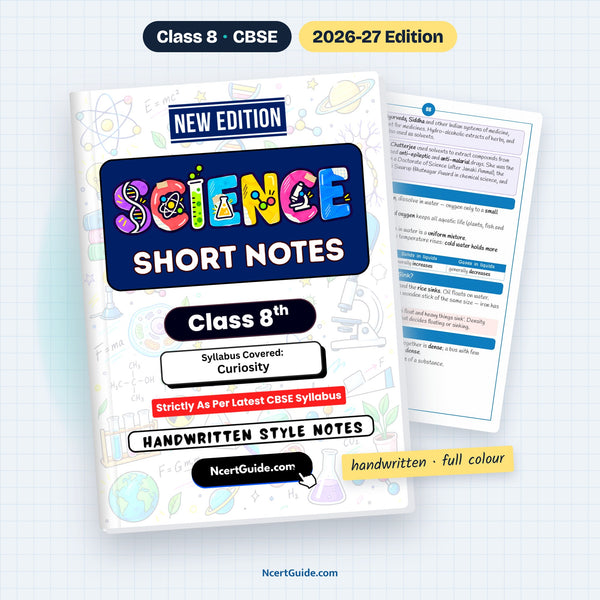
From the Class 8 Science Short Notes, made as per the new NCERT book Curiosity · Pages 40–45 of the book.
Key points
- Grinding chalk is a physical change; every tiny speck is still chalk.
- Matter is made up of a very large number of extremely small particles that cannot be seen even with an ordinary microscope.
- Dissolved sugar breaks into its constituent particles, which occupy the spaces between water particles.
- Interparticle attractions hold particles together; even a slight increase in distance decreases them drastically.
- Solids have a definite shape and volume; their particles are tightly packed and can only vibrate.
- Liquids have a fixed volume but no fixed shape; their particles move freely within a limited space.
- Gases have no fixed shape or volume; their particles move freely in all directions and attractions are negligible.
- Gases can be compressed easily; water is practically incompressible.
- Heat increases the movement of particles — colour spreads fastest in hot water.
- Diffusion is the spreading of particles of one substance through another, like incense fragrance through a room.
- Acharya Kanad spoke of the Parmanu — tiny, indivisible, eternal particles — in his Vaisheshika Sutras.
Key terms
- Constituent particle: The basic unit that makes up a larger piece of a substance or material.
- Interparticle spaces: The spaces between the particles of matter.
- Interparticle attractions: The attractive forces that hold the constituent particles of matter together.
- Melting point: The minimum temperature at which a solid melts to become a liquid at atmospheric pressure.
- Boiling point: The temperature at which a liquid boils and turns into vapour at atmospheric pressure.
- Fluids: Liquids and gases — both can flow and do not keep a fixed shape.
- Diffusion: The spreading of particles of one substance through another.
Diagrams to learn
- Particles in the three states of matter (Fig 7.1)
- Sugar particles fill spaces in water (Fig 7.2)
- Table of melting points of ice, urea and iron
- Table comparing boiling and evaporation
- Table comparing properties of solids, liquids and gases
- Ice is an exception — its particles are farther apart than those in water.
- The space between particles of a solid is not filled with air — it contains nothing at all.
- In SPM (air pollution), 'particle' means a dust particle, which is much bigger than a constituent particle.
- Rice grains and rice flour take the shape of the jar, but they are still solids.
A real page from the book

Get the full chapter in the book
This page is a summary. The Class 8 Science Short Notes has the complete chapter in colour, with every diagram and worked example.
Frequently asked questions
What decides whether a substance is a solid, liquid or gas?
The strength of the interparticle attractions finally decides the state. Strong attractions hold particles in fixed positions in solids, slightly weaker ones let them move within a limited space in liquids, and negligible ones let gas particles move freely.
What is the difference between boiling and evaporation?
Boiling happens only at the boiling point, both at the surface and inside the liquid, and is very fast. Evaporation happens at all temperatures, only at the surface, and is slow.
Why does the water level fall slightly when sugar dissolves?
There are spaces between water particles. When sugar dissolves, its particles fill these spaces, so the volume of the solution is less than water plus sugar.
← Term I · Chapter 6: Pressure, Winds, Storms and CyclonesTerm II · Chapter 8: Nature of Matter: Elements, Compounds and Mixtures →