New NCERT Understanding Society: India and Beyond · Class 9 Social Science · Part 1 · Chapter 1: Understanding Social Science
This chapter explains what Social Science is and why it matters in daily life. It introduces the four core disciplines studied in Grades 9 and 10 — Geography, History, Political Science and Economics — and how social scientists work.
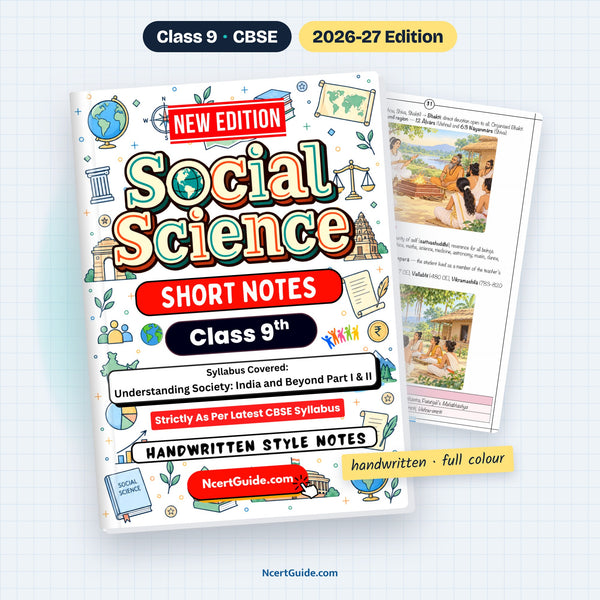
From the Class 9 Social Science Short Notes, made as per the new NCERT book Understanding Society: India and Beyond · Pages 2–5 of the book.
Key points
- Social Science is the systematic study of human society — what happened, where things are, and why events occur.
- Natural sciences study the natural world; Social Science studies society, institutions, cultures and human interactions.
- Even simple daily activities depend on governance, economic production, social cooperation and the natural environment.
- Indian knowledge traditions valued discussion, questioning and logical reasoning — e.g. Pañchamahābhūtas, Vasudhaiva Kuṭumbakam and the Arthaśhāstra.
- Social scientists observe people's lives, do interviews and surveys, examine documents, compare times and places, and explain with evidence.
- The four core disciplines are Geography, History, Political Science and Economics.
- Geography studies the location and distribution of places and people, using tools like maps, globes, atlases and GIS.
- History studies the human past using empirical evidence such as human genetics, carbon-14 dating and archaeology.
- Sources of history are literary, archaeological, epigraphic (inscriptions) and numismatic (coins).
- Political Science studies governance; Economics studies how limited resources are used to meet needs.
- Sustainable growth means meeting present needs without harming the ability of future generations to meet theirs.
Key terms
- Social Science: The systematic study of human society — how people live together, how governments work and how economies operate.
- Vasudhaiva Kuṭumbakam: "The world is one family" — the idea that human societies are interconnected.
- Arthaśhāstra: An ancient text attributed to Kauṭilya, about 2,300 years old, on administration, economic management, taxation and the duties of rulers.
- GIS: Geographical Information System — a tool used in Geography along with maps, globes and atlases.
- Epigraphic sources: Inscriptions, such as a Brāhmī inscription on a Gupta-period pillar.
- Numismatic sources: Coins, such as the coin of Samudragupta (4th century CE).
- Genealogical records: Records that trace family lineage — births, marriages and deaths across generations.
- Sustainable growth: Meeting present needs without harming the ability of future generations to meet theirs.
Diagrams to learn
- Social Science — a family of disciplines (circle diagram)
- Table: sources of history with examples
- Table: what you will study in Grades 9–10
- Social Science connects the past, present and future — it helps societies handle climate change, sustainable development and social harmony.
- Learn the four kinds of historical sources with one example each: literary, archaeological, epigraphic and numismatic.
- Arthaśhāstra is attributed to Kauṭilya, about 2,300 years ago.
A real page from the book

Get the full chapter in the book
This page is a summary. The Class 9 Social Science Short Notes has the complete chapter in colour, with every diagram and worked example.
Frequently asked questions
What is Social Science in Class 9?
Social Science is the systematic study of human society. It tells us what happened and where things are, and explains why events occur, how people live together, how governments work and how economies operate.
What are the four core disciplines of Social Science?
The four core disciplines are Geography, History, Political Science and Economics. Sociology, Philosophy, Anthropology and Psychology are also part of the Social Science family.
What are the sources of history?
Historians use literary sources (manuscripts, travelogues, folklore), archaeological sources (monuments, artefacts), epigraphic sources (inscriptions) and numismatic sources (coins).